Upping my coffee game
This has nothing to do with organizing, really, but I am so happy with how I make coffee I wanted to share with you all. I don’t have counter space (or desire) for an electric coffee maker. For many years, I made pour-over coffee with my trusty Hario ceramic cone, pouring hot water over the grounds through a paper filter and dripping coffee directly into the mug. I’d add half and half and I was good to go. I drink only one cup of coffee a day, so this worked well. It was tasty coffee, but a bit bitter and it sometimes left my stomach feeling a little jittery. If I had my druthers, I’d have had a latte (that’s my standard Starbucks order), but I wasn’t willing to buy a whole latte-making set up.
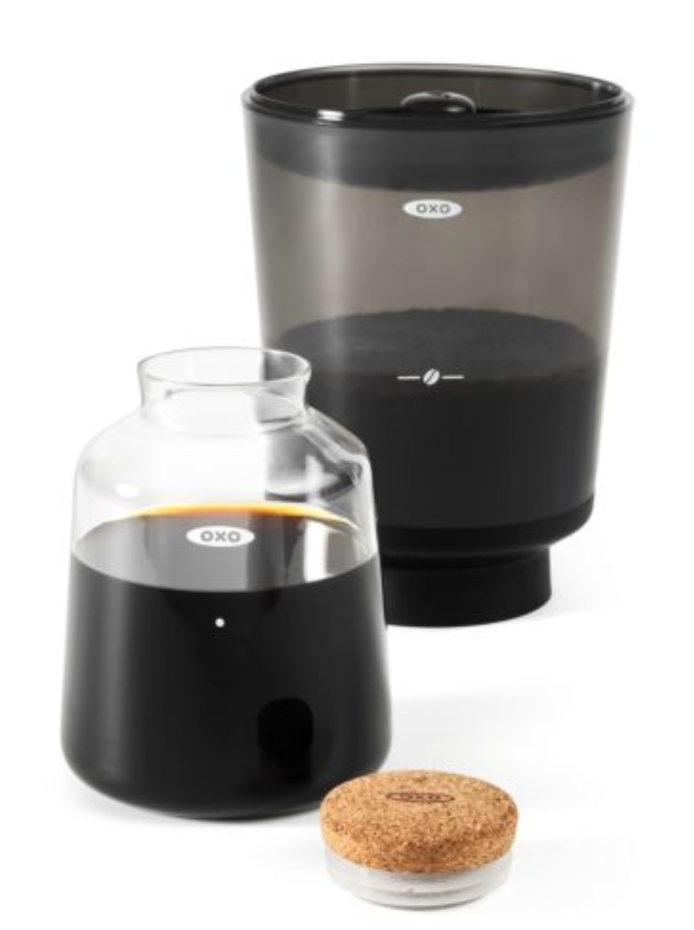
A couple of years ago I got curious about cold brew. I bought this OXO compact cold brew maker and gave it a try. I added ground coffee to the line of the brewer, then poured 24 ounces of cold, filtered water over the grounds. I let it sit for 24 hours, then put the brewer on top of the little carafe that came with it. The spring-loaded bottom emptied the coffee concentrate into the carafe, leaving the grounds in the brewer to be emptied into the trash.
I watched YouTube videos to find out what to do with the concentrate and decided to try mixing one part concentrate with two parts milk. Because I like hot morning beverages, I heat up the mug of coffee (a total of 240 grams or 8.5 ounces) for 90 seconds in the microwave. It’s delicious and doesn’t make me jittery.
I get four or five cups of coffee out of one batch of concentrate. I store the unused concentrate in the carafe (which comes with a lovely cork lid) in the refrigerator.
The result is a low-acid, filling, delightful cup of joe (a latte, really) that I enjoy so much I wanted to share it with you.
What’s your favorite way to make coffee?
Worth repeating: Organizing coloring supplies
My team and I unpacked a client after a move recently and her new home has a lovely craft room. It was a joy to organize all her crafting supplies, including those for coloring. At one point during our organizing, I pulled up this post, which I originally wrote in 2016, to show how I organized my colored pencils. Alas, the Container Store no longer sells the acrylic pencil trays, but I suspect they’re available elsewhere. I thought I’d re-run this post again today for the benefit of other coloring enthusiasts.
I jumped aboard the adult coloring book craze last June. I loved coloring as a kid and I love it now. It’s so wonderful that so many interesting types of coloring books are available. And the coloring supplies! When I was a kid, I used Crayola crayons. Now, I use pencils, pens, markers…it feels like the sky’s the limit.
As with many new hobbies, part of the fun is acquiring the supplies. I now feel like a kid in a candy shop in an art store, which is a new feeling. (I’m not particularly artistic.) But with the acquisition of supplies comes organizing challenges. I worked out a great organizing system for my colored pencils that I thought I’d share here. (I also color with colored Sharpies and I’m still working on a system for storing those.)
My first purchase was a single coloring book and a tin of 36 Prismacolor Premier colored pencils. Those were great—I loved the quality of the pencils and the blending I could do with them. They were contained, so all I had was a book and a tin, which I kept on the end table by the couch, along with a clipboard used while coloring a single page. Easy peasy.
But soon 36 colors wasn’t enough. So I went to locally owned Art Mart and bought more individual Prismacolor pencils. That’s when I started having a storage challenge. Then I bought more pencils and books (I asked for Art Mart gift cards for my birthday) and I had not only a storage challenge, but an organizing one. I love this kind of challenge!
Enter these lovely acrylic pencil trays from the Container Store. They’re high quality and hold two dozen pencils. I bought three. So I have space to store 72 pencils plus the 36 in the original tin.
So here’s how I worked it out. I sorted the pens by color category that made sense to me. In the acrylic trays I have:
- Reds
- Blues
- Neutrals
In my tin, I have three trays of 12. I’ve divided them into:
- Greens
- Purples
- Yellows
There’s a little overlap—some oranges could go in either the red or the yellow tray and some blue-purple pencils could go either way. Pinks go with the reds, but I put some with the purples. It’s all about how I think of them.
Here are some photos.
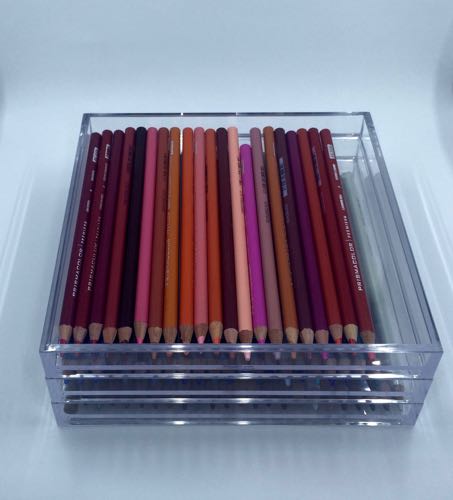
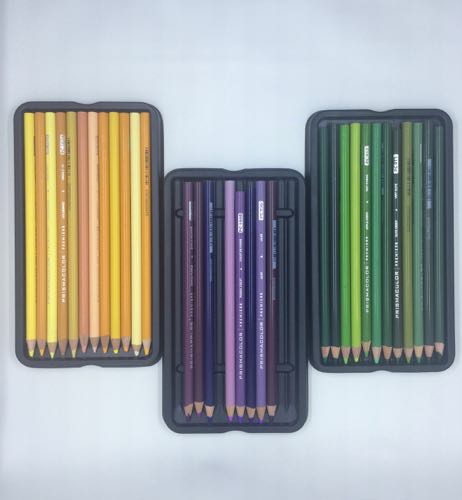
I store all the pencils in a Bigso Letter Box from the Container Store, along with my pencil sharpener and a box cutter for cutting pages out of a coloring book whose pages aren’t perforated. (I prefer to color a single page on a clipboard.)
See how nicely they fit?
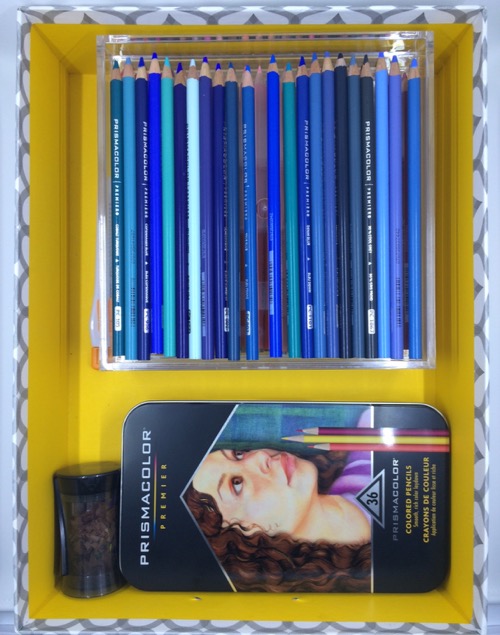
(Incidentally, all these photos were taken using the SHOTBOX tabletop photo light studio.)
I used to store my coloring books in a second Bigso box, but after my friend Patti gave me six books for Christmas, my books outgrew the box. So I now keep them in magazine holders on a bookshelf in an adjacent room and keep my not-yet-organized collection of Sharpies in that second box, along with the current page I’m coloring on its clipboard. (I’ll post again when I figure out my Sharpies and other markers!)
The two boxes reside stacked on the end table, because I typically color while watching TV (though sometimes I color on the dining room table nearby). If we have visitors, it’s easy for me to move them out of the way.
If you’re a colorer, how do you store your supplies?
Time to edit your Halloween decorations

In my neighborhood, people are going all-out with Halloween decor this year. I’ve noticed an abundance of skeletons in people’s yards in particular. And many of them look new. (There must be a skeleton trend I’m missing out on by not going to stores.)
If you bought new Halloween decor this year (or even if you didn’t), I encourage you to take a good look at the Halloween decorations you didn’t put up this year. Rather than just leaving it in the bin when you put away this year’s items, perhaps you could take a few minutes and look through this year’s rejects. Is there decor you could let go of so you don’t have to sort through it next year?
Holiday decor tends to take up so much storage space in our homes, yet it’s used so infrequently. I always think it’s a great idea to edit your collection when you’re putting decor away so that you’re not taking up valuable space by storing items you may never use again. Perhaps anything tattered or wilted can go away (unless it makes your heart sing when you see it). Make sure your decor is worthy of its storage space!
How would it feel to stop giving holiday gifts?

I’m a big believer in not giving people clutter as gifts. In our clients’ homes, we often see how hard it is for them to let go of items they received as a gift, even if they don’t like or don’t use the item. As I’ve blogged about before I’m in favor of making the holiday season easier on gift givers by simplifying or limiting the gifts you give and receive.
How about stopping giving gifts altogether?
It’s late October. As you’re thinking about your Christmas or Hanukkah gift list this year do you think you could approach some of the adults on the list and propose that you not exchange gifts at all? Think of the benefits:
- Less time spent shopping
- Less time spent wrapping
- Less money spent on gifts
- Less emotion spent angsting over the perfect gift
- No worry about adding clutter to your loved one’s home
You don’t have to eschew the exchange of gifts altogether (though I think that’s a great idea). You could replace a physical gift with an event you could attend together. Or a spa day. Or a meal. Or you could agree to make a donation to a charity on the other person’s behalf.
I exchange very few gifts in December and I have the easiest holiday season of anyone I know. (I do send out holiday cards, but I really enjoy doing that.)
How would it feel to let go of buying so many gifts (and also receive fewer gifts)? If the prospect of limiting your gift giving gives you a sense of ease, I suggest you try contacting one person on your gift list and see how s/he would feel about not exchanging gifts this year. I wouldn’t be surprised if your suggestion was met with great enthusiasm. Taking away the pressure to give might be a gift in itself.
Then approach someone else. And another person. If you whittle down your list of people you have to shop for, your holiday season might become less stressful and more celebratory. Doesn’t that sound nice?
Worth repeating: A knitting project that makes me smile
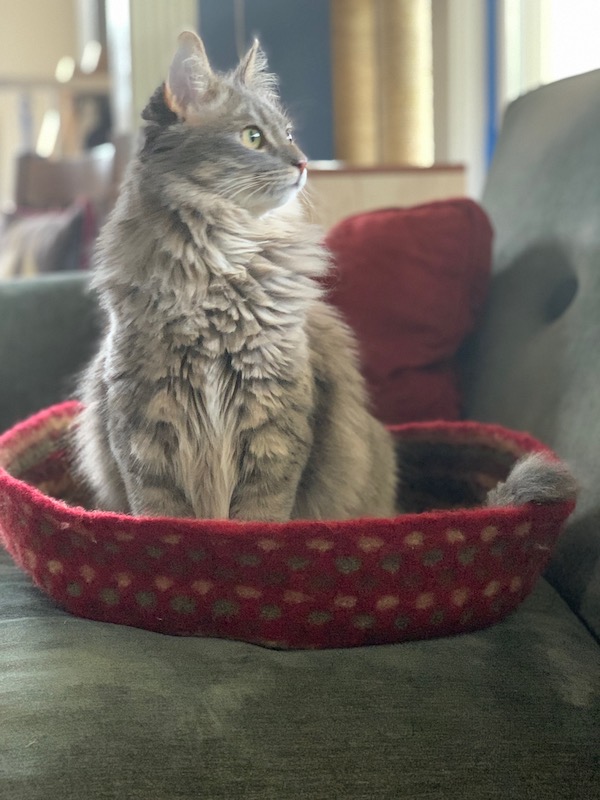
I originally wrote this post in 2019, but I just got back from a visit with my friend Shannon Wilkinson in Portland and was THRILLED to see that almost five years later Cleo still loves the bed I knit for her. So I thought I would run this post again. Isn’t Cleo beautiful?
I’ve been knitting since 2005 (the year I started my organizing business) and in the early years of this blog, I would write occasionally about knitting projects I was working on or had completed.
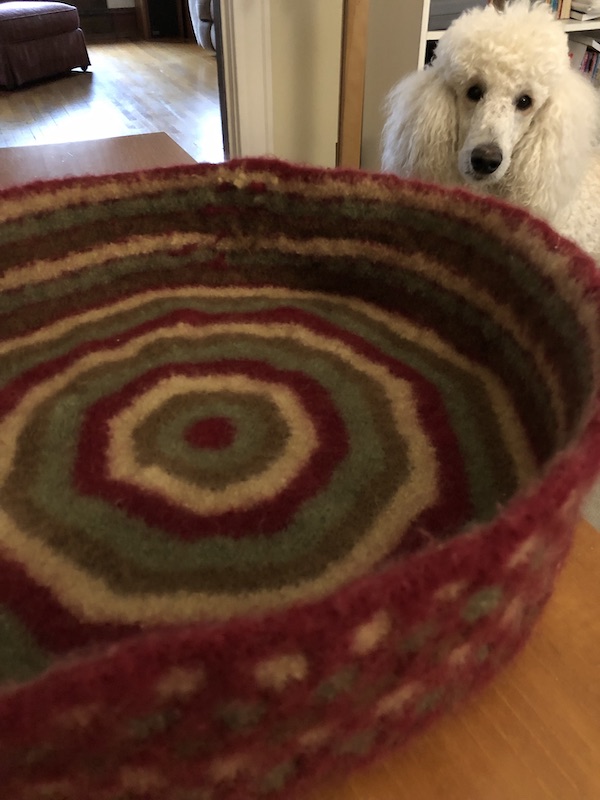
It’s been quite a while since I blogged about knitting, but a recent finished project has making me smile so much I just had to share. As I’ve written here, I knit an afghan that took me about 12 years. It’s made from four colors of wool. I used Knit Picks Wool of the Andes for that project, in green, beige, burgundy and brown. I love the color combination and I still had some skeins of that yarn left over. I decided to use it to knit a felted cat bed for my friend Shannon’s beautiful (and large) young cat, Cleo.
I went with the Dotty Cat Bed pattern by Kelly Porpiglia, which I had downloaded from the Ravelry website. (I’ve since discovered that it’s not available, but the pattern is available here thanks to the Wayback Machine.)
I finished it and shipped it off to Shannon and was so delighted when Cleo took to it like a fish to water. Shannon is kind enough to text me photos because she knows they make me happy.
Incidentally, today’s episode of Getting to Good Enough, the podcast that Shannon and I co-host, is on topic of Hobbies. So if you’re interested in hearing me talk a little about knitting, I encourage you to download Episode 35.
Here are several pictures of beautiful Cleo in the bed I made for her, along with one of the bed before I mailed it, so you can see the interior. It looked huge when I finished it, but I’m glad it’s just the right size for Cleo!


Organize Your Family History milestone

I started my genealogy blog, Organize Your Family History, back on June 14, 2012. (I started this blog on November 10, 2006, in case you’re curious.)
Over the weekend, I achieved a milestone I’d been watching out for: OYFH surpassed one million page views. That’s one million with six zeros! I’m astonished and thrilled.
Here’s what my all-time stats looked like at 5:54 pm central on September 30:

If you’re interested in genealogy and have any difficulty in organizing your research, I encourage you to hop over there and check it out. While you’re there, you can join my mailing list and receive an educational email sequence, as well as a monthly email with links to the previous month’s blog posts.
I want to extend a big thank you to my readers!
Bamboo lids make yogurt jars even better!
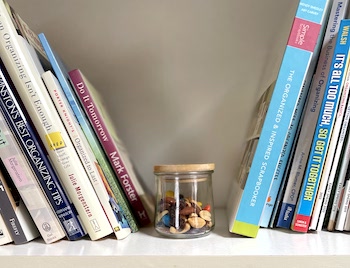
Back in January 2019, I wrote a post about how I love Oui by Yoplait French-style yogurt, which comes in little glass jars. The yogurt tastes great, but what I really love about it is the jars, which are reusable for so many things. Since 2019, I’ve amassed quite a few jars after a client gave me her collection. But I don’t mind making space for them, because the ways to use them seem endless. And now I’ve found a new lid for them (see below), which makes them even more useful.
As I detailed back in 2019, here are some of the ways I use them:
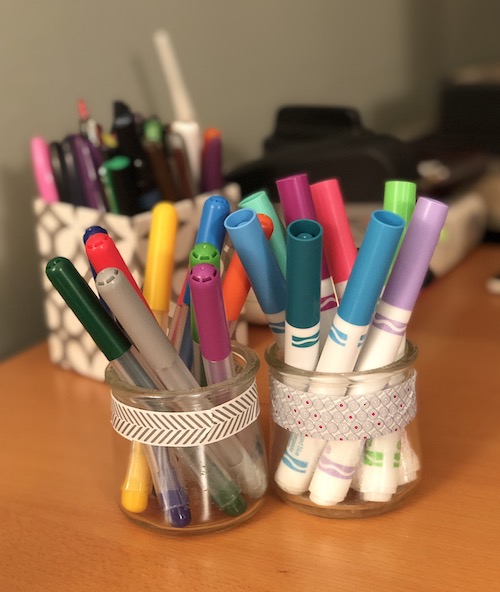
- They’re great pen holders. I’ve taken up hand lettering, and true to form I have purchased a bunch of pens to feed my habit. These little jars are great holding categories of pens and markers. (Here’s a post I wrote on how I organize my lettering pens.)
- I use them to hold pairs of glasses on end on my desk, which keeps them handy. (I have many pairs of glasses for various uses.)
- I put cotton balls in them in the bathroom and I also use one to hold my brush upright
- I decorated one with Washi tape to use on the sink as a toothbrush holder for guests
The Oui yogurt website has a Crafts section with lots of ideas (and instructions) for using Oui yogurt jars.
Here’s a photo I took in 2019 of two Oui jars holding some markers on my desk. I used a little Washi tape to pretty them up.
A tight lid makes them useful for more things, like filling with trail mix in my lunchbox. Yoplait sells plastic lids for these jars and I discovered today that they sell seasonal lids too. (Right now it’s Halloween.) They’re not cheap; at 4 for $4.99 or 8 for $7.98 plus $4.49 for shipping, they cost more than the yogurt jars themselves.
I was thrilled recently when I discovered these bamboo lids with silicone seals that fit the yogurt jars snugly. They look great and feel secure. I bought plain bamboo lids, but decorative ones are also available. I paid $9.99 for eight of these substantial lids and got free shipping.
I’m so happy to pass along this relatively low cost container idea. Honestly, I find them life enhancing!
Search
Recent Posts
- Worth repeating: Figuring out what to watch on TV
- The power of incremental progress
- Podcast guest spot on the role of organization for folks with chronic illness
- No excuses series (part 3): "It was a present"
- No excuses series (part 2): "I paid a lot for that item"
- No excuses series (part 1): "But I might need it!"
- Retiring the New Organizer Guides
Tags
About Janine

Hello! I’m Janine Adams — a certified professional organizer based in St. Louis, and the creator of Peace of Mind Organizing®.
I love order, harmony + beauty, but I believe that the way that you feel about yourself and your home is what truly matters.
If you’re ready to declutter with a purpose and add more ease to your life, you’ve found the right blog — and you’ve found the right company.
read more »Links
- National Association of Productivity and Organizing Professionals
- Institute for Challenging Disorganization
- Are you interested in becoming a professional organizer?
- NAPO St. Louis
- Organize Your Family History
- Shannon Wilkinson, life coach
- Ravelry
- Getting to Good Enough podcast
- Peace of Mind Spending