Personal Kanban for task management
For several years I’ve been using the various task management techniques created by Mark Forster. The most recent has been DWM. But life and work got sort of crazy and I spent a few weeks doing nothing but putting out fires. I ignored my task list in my DWM planner. These task lists are calendar based, so I needed to figure out how best to get back in the saddle.
A week ago, I went to the discussion forum on MarkForster’s website to see if I could figure out the best way to rejuvenate my list. In this thread and I stumbled upon the concept of personal kanban. I didn’t do a lot of research into it before jumping in, but I gather that kanban was originally designed to help teams of software developers. Then someone adapted it to work personal task/life management.
There are two overriding principles in personal kanban, both of which appeal to me.
- Visualize your work
- Limit your work in progress
The photo of a personal kanban board that I saw on Personal Kanban 101 was immensely appealing. It was a white board, divided into thirds with the headings Backlog, Doing, and Done. In each section were sticky notes. I had to try it.
I spent about 15 minutes setting up the system. I dusted off a white board I’d been storing in a basement, pulled out my Super Sticky Post-It Notes and combed through my DWM task diary to create my Backlog. I limited the number of tasks I could be working on at any one time to 5 (the maximum recommended number) and put them in the Doing column. Then I got to work. When I’d finish a task, I’d move it to Done.
I colored coded my sticky notes into three categories. Green notes for an e-course I’m working on (my major focus at the moment), blue notes for tasks related to my various volunteer activities and orange notes for everything else. I also created a horizontal category at the bottom for daily activities (exercise, getting my email down to 15 messages, etc.).
I had three work days at my desk last week and I found my personal kanban board to be really effective. I plowed through the tasks and enjoyed moving them through the process.
This weekend, I treated Saturday as a workday. (But boy did I take Sunday off.) Here’s a photo of my personal kanban board at the beginning of the day:
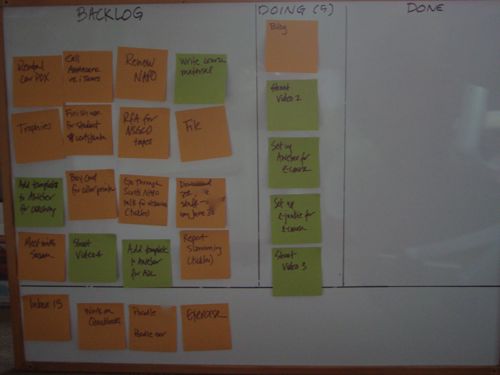
My personal kanban in the morning.
And here’s how it looked at 7 p.m.
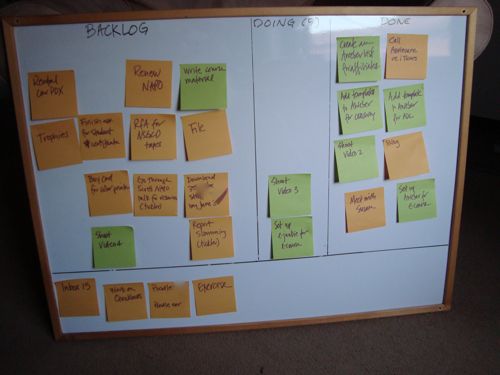
Here's my board at the end of the day.
(I wrote this blog post on Saturday but decided to wait until today to post it.)
I love the low-tech nature of the white board and sticky notes. But, of course, there’s software you can download to help you do the same thing on your computer. Leankit Kanban is just one example.
I love how the personal kanban board is. And tactile. I also love that it keeps me focused and keeps me from feeling overwhelmed.
I’m going to stick with this for another week or two and see how it ends up working out. I’ll report back!
Favorite posts from June 2008
Since June tends to be a particularly prolific month on my blog, yesterday I posted about my favorite posts from last June. And I promised to post my favorite posts from June 2008. So here you go.
- Mark Forster is one of my favorite time-management gurus. In his book, Do It Tomorrow and Other Secrets of Time Management
he puts forth some really innovative ideas about getting stuff done. In June 2008 I created two blog posts highlighting two of my favorite tricks from Do It Tomorrow. First there was his revolutionary idea of tricking your reactive mind in order to get started on a task you’re resisting. The next day I blogged about his trick for keeping going once you’ve started. The guy’s brilliant.
- I usually start planning sessions with clients by having them create a vision for their space. I transformed my own weekend to-do list into a plan with a vision in this post.
- A theme of my blog seems to be about how imperfect I am. I can truly empathize with my clients. In this blog post, I vent my frustration over not being able to find things.
- In 2008 I took an incredibly stressful day trip to IKEA (five hours away) to purchase some office furniture. I documented the stress of having to make many, many decisions in quick succession. It was a good reminder of the stress our clients are under during a decluttering session.
- I’m a knitter and for several years my knitting supplies were in disarray. Then in 2008 I purchased an Elfa drawer unit to store my yarn and such. Two years later, my knitting supplies are still in order. It’s bliss. In a pair of posts, I wrote about how I organize my knitting supplies, in hopes it will help other knitters or crafty sorts. First, I wrote about how things used to be. Then I wrote about how I organized my yarn and knitting supplies into my new Elfa drawer unit.
Last June on the blog
Inspired by my friend, Margaret Lukens, I’ve decided to point out some of my favorite from this blog from Junes gone by. June is usually a pretty busy blogging month for me (though not so much this year). I had so many posts to choose from that I’m going to split the recap into two posts.
Here are my favorite posts from June 2009. Tomorrow I’ll post my faves from June 2008.
- A timer is a great tool for focusing. When I’m doing something particularly mindless, I’ll use an iTunes playlist as a timer. (I stop when the music’s up.) At the risk of embarrassing myself, I revealed my Clean the Office for 30 Minutes playlist.
- Even professional organizers need professional help. I hired an organizer to help my husband and me declutter my basement. It was an amazing experience. (This post comes complete with embarrassing before photos.)
- Inbox Zero is an elusive goal. But I’ve achieved a daily Inbox 15 (or fewer) thanks to a process for my inbox I developed last year coupled with a great accountability partner. I’ve truly achieved email liberation.
- Embarrassment seems to be a recurring theme in June. Since I somehow never seem to tire of posting embarrassing before pictures, here’s a post about how I whipped my office into shape in only 30 minutes.
Building on success
As I’ve written about before, I’ve had some success in recent years in creating some really meaningful habits. For example, I now automatically clear my desk at the end of each workday. That allows me to hit the ground running in the morning and helps me keep my head clear about what I need to do. I used the Don’t Break the Chain method to help me build that habit.
I’m also in the process of creating the habit of keeping my email box lean. I try to get it down to 15 message or below and when I do email my email accountability partner, Aby Garvey. That’s been a real boost to productivity and I’m not losing things in my email.
The latest success is creating the habit of properly putting away my clothes at the end of the day. My whole life I’ve tended to take off my clothes and put them on the bureau or on a chair or couch. When I was kid, I’d just leave them on the floor.
There are all sorts of problems associated with that, including, of course, waking up to a mess. In addition, it meant that I couldn’t re-wear clothes that I otherwise could; the clothes would get wrinkled sitting on the bureau. If I’d hung them back up, they’d be okay.
So in April, I put my mind to keeping that bureau clear. I used the Don’t Break the Chain method. Rather than using www.dontbreakthechain.com I printed out a blank calendar for the month of April, posted it near the bureau and marked a big red X every time I put away the clothes I could re-wear before bed (and threw the dirty ones down the laundry chute). As usual, not breaking the chain was really motivating. And now, a couple of months later, it’s pretty much effortless.
The thing about any daily habit is that if you do it every day, there’s no accumulation to overwhelm you. This is true of dealing with (postal or e-)mail, running the dishwasher, wiping down bathroom fixtures, cleaning off my desk. These were all daily habits that I’ve managed to develop in the past. And now I can add putting away my clothes at night to the list.
Do you have any daily habits that have helped your life run more smoothly?
Avoiding overpacking
I’m leaving for a weekend trip to attend a family wedding. As I think about packing, I thought I’d share my method for ensuring I don’t overpack.
I’ve been doing this for years — decades, really. I think I invented this system. And I’m happy to share it.
Here’s what I do:
- I think about the clothes I’d like to take on the trip and make a list. It usually includes the clothes I’m particularly fond of wearing these days, or ones I feel really good in.
- I number each item in the list
I did this last night for my trip. And I took a picture. (The backs of envelopes are good for this.)
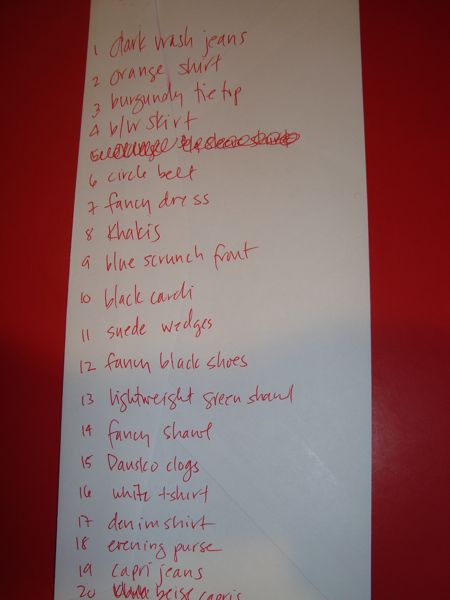
- I make a list of the days I’ll be there. Since there’s usually a change of clothes, I’ll have columns for AM and PM. (If there were going to more than one change of clothes in a day, I’d increase the number of columns.)
- I put together outfits for each day, using the numbers next to each item on the packing list.
- I go through the numbers (looking for each number, in order) and make sure that each number is represented. If there’s no number 5, for instance, on the outfit list, I scratch item number five off my packing list.
Here’s my outfit list for this trip:
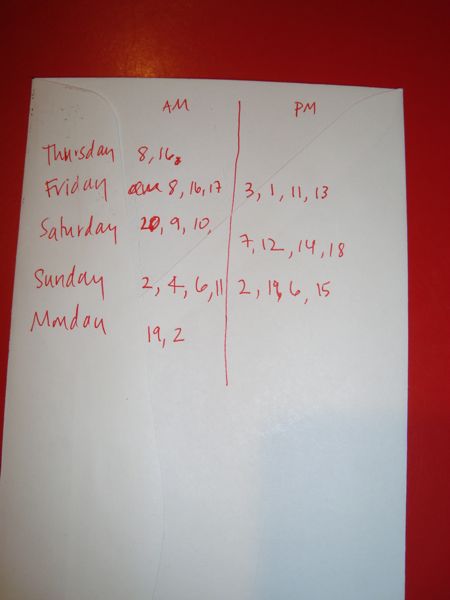
There was no item number five!
A nice bonus is that if I want, I can bring along the lists and then I don’t have to think about what I’m going to wear each day.
I don’t list undergarments (unless there’s something special) or jewelry. I certainly could list jewelry, but I don’t have that much and I just sort of eyeball it.
I hope you find it helpful. I’ve made my packing list but haven’t packed for my trip yet — we’re leaving after I get home from a client this afternoon. It’s so nice to have the list; packing will be a snap!
Top 50 organizing blogs
I woke up this morning to a nice email telling me that this blog was selected for inclusion in Onlinedegrees.net’s list of the “50 Best Blogs to Organize Everything In Your Life.”
I’m included in the Life Organizers section, alongside blogs I admire like Creative Organizing, Jeri’s Organizing and Decluttering News, Unclutterer and lots of others.
The other categories (in addition to Life Organizers) are Family, Home and Garden and Specific Category.
There are some new-to-me blogs on the list and I look forward to exploring them. I hope you do too!
Friends and families in the organizing process
Last night, after several months of repeats, A&E aired a new episode of its hit documentary TV series, Hoarders.

One of the pair of clients represented was Kim, a young woman whose professional exterior belied her deep secret (one she had trouble admitting to herself): she’s a hoarder. While her home wasn’t filled to the rafters, she had acquired a whole lot of stuff in a relatively short period of time (she’s in her early 30s).
My pal, Geralin Thomas was the expert organizer on the show, ably assisted by a team of POs from the Nashville area.
Here’s the thing that really struck me about this episode. Kim had two close friends who were on hand to help. In contrast to the professionals on the scene, these friends seemed to lose patience with the pace of the decision-making and seemed frustrated that Kim was allowed to make decisions about keeping or letting go of her possessions at her own pace.
I often tell people that decluttering is generally easier when you have someone helping. But I caution them to select their clutter buddies carefully. The buddy should not be judgmental or bossy, and, ideally, should not have a personal stake in the outcome. (This is why professional organizers are so great — their status as outsiders help neutralize the emotions of the situation and they never stand in judgment.)
Sadly, Kim’s friends seemed to meet none of these criteria. Their apparent frustration seemed to add unnecessary tension to an already stressful (for Kim) situation.
I loved that A&E included Kim, whose case was less dramatic than others who’ve been featured (including Michelle, the bird hoarder who shared this episode). While Kim’s situation wasn’t as wince inducing, it was very interesting to me. Her denial of her problem (she didn’t seem to comprehend how many clothes she’d acquired, for instance) and her highly functioning exterior contrasted with her lower functioning home (she spread out papers all over the floor of her home office, instead of using furniture) was fascinating.
And, on a show that can sometimes leave you feeling defeated, it was nice to see an episode that ended on a hopeful note.
Search
Recent Posts
- Worth repeating: Figuring out what to watch on TV
- The power of incremental progress
- Podcast guest spot on the role of organization for folks with chronic illness
- No excuses series (part 3): "It was a present"
- No excuses series (part 2): "I paid a lot for that item"
- No excuses series (part 1): "But I might need it!"
- Retiring the New Organizer Guides
Tags
About Janine

Hello! I’m Janine Adams — a certified professional organizer based in St. Louis, and the creator of Peace of Mind Organizing®.
I love order, harmony + beauty, but I believe that the way that you feel about yourself and your home is what truly matters.
If you’re ready to declutter with a purpose and add more ease to your life, you’ve found the right blog — and you’ve found the right company.
read more »Links
- Shannon Wilkinson, life coach
- Peace of Mind Spending
- Organize Your Family History
- Are you interested in becoming a professional organizer?
- Getting to Good Enough podcast
- National Association of Productivity and Organizing Professionals
- NAPO St. Louis
- Ravelry
- Institute for Challenging Disorganization