Fill out your census form
You should have received your 2010 Census form in the mail this week, if you’re in the U.S. I know this isn’t organizing-related, but it’s important. Please fill it out.
The census provides vital data that allows for allocation of sets in the House of Representatives and also for government resources. The Census Bureau is committed to making sure every resident is counted. If you don’t fill out the form, they’ll send an enumerator to your home to count you. And that’s expensive. It costs the government 42 cents if you mail back the form. It costs the government $25 if an enumerator is sent to your home. (I got that little tidbit through a google search that landed me on this little FAQ.)
My first real job out of college was at the Population Reference Bureau, a non-profit clearinghouse for demographic information. We used census data constantly and I developed a real appreciation for the importance of the census. Now that I dabble in genealogical research, I see the value of the census for generations to come.
When my form arrived on Monday, I filled it out immediately. There were only ten questions for each person in the home (actually maybe fewer for the second person in the home) and it took just a few minutes. I was a little disappointed that something so important didn’t take longer, but that’s not a reasonable complaint.
I saw a news story the other night about how some census forms are addressed to the wrong city, since some zip codes cross city lines. (This is a problem here in St. Louis where there are many, many municipalities.) The news story quoted the Census Bureau as saying that the city on the form doesn’t matter; it’s the street address, zip code and, most importantly, the bar code on your form that makes sure you’re counted. So if your city name is wrong, you can ignore the error.
If you have any trouble filling out your phone, all you have to do is pick up the phone. The contact information is available on the Census Bureau’s website.
How do you handle your mail?
Dealing the mail that comes to the house can be a huge hassle for many people. Most of my clients have difficulty dealing with it and I know I’ve let it pile up in the past. I’m thinking of developing some sort of product to help people with their mail and I’m curious how my blog readers handle their mail.
So if you don’t mind please take my poll on how you deal with your mail.
I’ll do a post in a week or two with the results.
Update on StickK
Three weeks ago, I signed up for stickK.com, a website that helps you keep goals and commitments by asking you to pledge to pay money if you don’t do what you say you’ll do. I blogged about it shortly after I joined.
I pledged to stickK that I would exercise four times a week for 12 weeks. Any week in which I failed to exercise four times I would pay $5 to an “anti-charity” I selected. (That would be an organization that I don’t want to give money to.) At the time I signed up, I gave them a credit card number.
I figured it would be motivating. I was right—I have exercised four times each of the last three weeks because there’s no way that group is going to get my money. But an interesting side effect I’ve noticed is that each of those weeks I’ve exercised no more four times. Somehow it’s had a demotivating effect for doing any extra exercise.
I don’t know why. Once I’ve reached the goal the incentive to do more vanishes. I guess that’s a product of using a negative to motivate me. Hmmm. If I were being paid $5 to exercise four times a week, I wonder if I’d do more than four. I would if I were being paid more for extra effort, I’m sure.
I’ll report back on whether this trend continues and what I make of it. I’d love to hear if anyone has any theories.
Hazardous waste disposal
It’s important to dispose of hazardous material safely, of course. Here in St. Louis, it’s not that easy. If you live in St. Louis County, there are two hazardous chemical collection events coming up this spring. (A third date is being planned, but hasn’t been established yet.)
At these events, you can drive up with your cans of paint, varnishes, herbicides, solvents, poisons, etc. and the waste will be accpeted and disposed of properly. Here are dates and locations of the two events:
- Saturday, April 24, 10 a.m. to 3 p.m., at South County Center (formerly Westfield Shoppingtown—South County)
- Saturday, May 8, 10 a.m. to 3 p.m., St. Louis Community College—Florissant Campus
For more details on locations and accepted materials click here. Proof of county residency is required.
If you live in St. Louis City, as I do, it’s not quite so easy. The city itself doesn’t have a collection event. But they offer this page with information on how you can go about disposing of dangerous materials safely.
ETA: Afer I posted that there isn’t a hazardous waste disposal event for St. Louis City residents, my fabulous friend Lisa Otke reminded me that ARCHs, a community partnership, is sponsoring a Tox-Away Day for safe disposal of household chemicals this spring. It will be held on April 24 from 10 to 2 at New Sunny Mount Missionary Baptist Church, 4700 Florissant Road (Highway 70 and Shreve Ave.), St. Louis, MO 63115. Click on the link for more info. Thanks, Lisa!
Ready to make a change?
I’ve been fortunate to have a good deal of success in my life. Here’s one reason: I have a secret weapon, my friend and life coach (and Declutter Happy Hour partner), Shannon Wilkinson.
Shannon and I have been friends for ten years now. I was there when she made the decision to pursue hypnotherapy and neurolinguistic programming (NLP). I was one of her early guinea pigs, in fact. Over the last seven or eight years that she’s been a coach, she has helped me immeasurably. Whenever I face a roadblock (and that roadblock is almost always inside of me), I turn to Shannon. She does her thing with me and the barriers melt away.
Since Shannon and I go back so far, she’s always made her work with me very affordable. But for others, she very rightly charges handsomely for her services. Because working with her is utterly life changing.
I am so excited because Shannon has created a product that puts her process right into your hands. And it’s very affordable. The product, Boring Change: No Augers Required, is a kit that allows you to easily make a change without painful soul searching, without journaling forever, without having to force yourself to do something you don’t want to do. Read the 17-page guidebook, then listen to the 30-minute audio while doing the process and you’re done. If you want to make more changes, you can skip to the five-minute audio and quickly make as many changes as you want.
I tried it yesterday for an internal conflict that had been bothering me since the beginning of the year. Boom! I had clarity and I was freed from that annoyance.
Please, click here to read more about it. For only $47, you can have the tools at your disposal to quickly and easily make the changes you crave. If you have any questions about my experience with Shannon and her process, feel free to comment and I’ll answer them.
One last thing: While I am an affiliate of Shannon’s, the links above are not affiliate links. I believe in her so much that I don’t want to take a dime from her. She has priced this product so reasonably that I want her to get every penny.
Taming the messy drawer (and a giveaway!)
In our kitchen we have lots of drawers. One of them is a drawer full of miscellaneous cooking utensils and gadgets that we don’t use much. The things we use with any regularity are usually on top, but that’s the extent of the organization of the drawer. And that’s not really organization at all. That’s just physics.
The good folks at Rubbermaid recently sent me a set of six no-slip interlocking drawer organizers to try out. So one day last week I spent 28 minutes organizing that utensil drawer.
Here’s a before shot. I know, ugly.
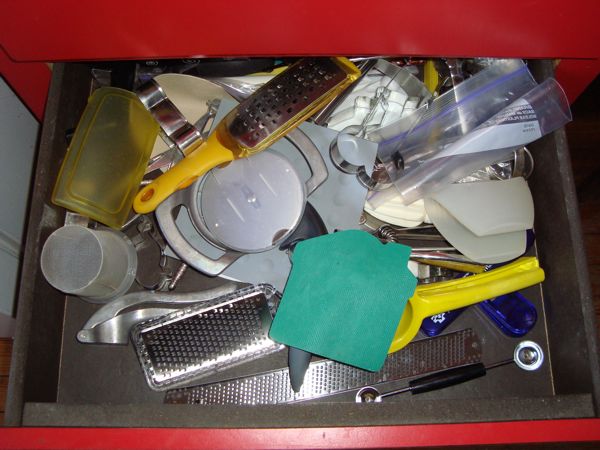
Talk about a hodge podge of stuff.
I pulled everything out of the drawer and put it on the counter. I found a few duplicates, like the three pizza cutters and the two citrus reamers. There were a lot of dog-themed cookie cutters, because back in 2003 I wrote a couple of dog-treat cookbooks. (I no longer bake dog biscuits; my dogs think that Milkbones® are manna from heaven.)
Here’s a shot of the stuff laid out on the counter. (Try not to laugh at our 80s-era red countertops.)
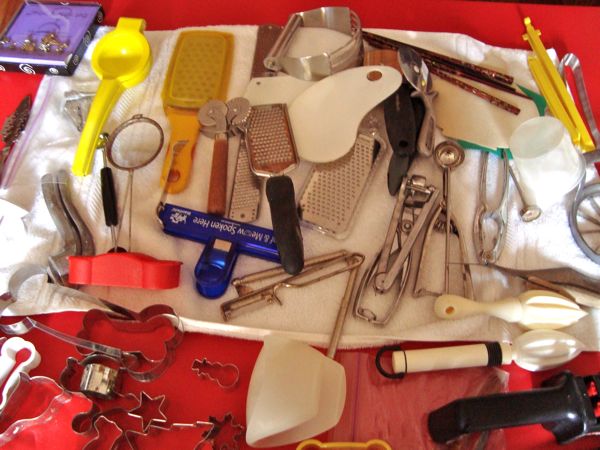
I sorted like things together and I called my husband in to identify the more esoteric items, like the asparagus peeler and the absinthe spoon. My husband is a “but we might need it some day” kind of guy and since the kitchen is his territory, I bowed to his wishes. Case in point: There was an unopened box of wine charms. I was ready to donate them because we’d never used them, but my husband said he didn’t know we owned any (that’s the problem with a messy drawer). He says we’ll use them. So they stayed.
I didn’t get rid of a ton of stuff. But I did part with a bunch of cookie cutters.
I pulled out the Rubbermaid drawer organizers and in just a few minutes put everything away. There’s still a lot in that drawer. But the stuff we use the most (for me, that’s the yellow lemon juicer and the grippy mat thing for opening tight lids) is very accessible. The wine charms and corn-cob holders are neatly contained. Like things are together.
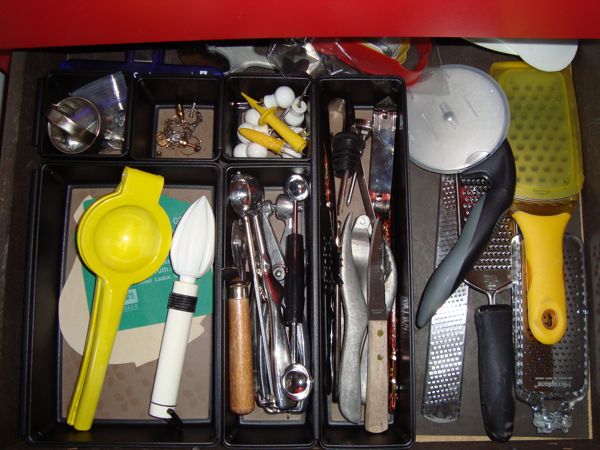
That feels much better.
Note that the drawer was much larger than the drawer organizer set. That worked out just fine. The organizers added much-needed structure to the drawer and I used the space next to it and behind it as well.
It’s very satisfying. And the whole process took literally 28 minutes. That’s the thing about little messes. We tolerate having to search around for things in a drawer, for example. Just a little focused effort on sorting, weeding and putting things in appropriate containers can make such a huge difference.
Giveaway!
Rubbermaid has offered to send a set of drawer organizers to one lucky reader of my blog. To enter, just make a comment below and/or tweet about the giveaway. (Be sure and put my twitter handle, @janinea, in the tweet, so I’ll see it.)
A winner will be selected at random on Saturday afternoon (March 13). I’m sorry, but the giveaway is open to people in the U.S. and Canada only. That’s not because my last winner lived in Switzerland. It’s because Rubbermaid will be shipping the product and that’s their stipulation.
Become an Imperfectionist
Some people are surprised to hear that many of my chronically disorganized clients are perfectionists. The truth is that perfectionism can be paralyzing. If a perfectionist doesn’t know exactly how to do something the best way, or how it will turn out, they just can’t start.
I thought this article by performer, songwriter, and creativity consultant Christine Kane was spot on, I had to share it with you. It comes from her newsletter, Live Creative, and I’m reprinting it with permission.
— Janine
Why Becoming an Imperfectionist Makes You Successful and Happy
by Christine Kane
“Anything worth doing is worth doing badly.”
~ Julia Cameron
How much stuff do you think about doing?
How many things would you love to try but stop yourself because you don’t know how to begin?
Do you avoid projects because of the pressure to do them well?
If so, feel free to join me and some of my most successful friends in our exclusive club of very special and talented people:
We call ourselves the Imperfectionists!
What’s an Imperfectionist?
- An Imperfectionist is often a recovering perfectionist.
- An Imperfectionist knows that getting something done is better than sitting back and waiting to do it perfectly.
- An Imperfectionist knows that being a Perfectionist is simply an excuse NOT to take action.
- An Imperfectionist congratulates herself for taking small steps.
- An Imperfectionist buys herself flowers when she accomplishes something — even if it’s not quite up to her ego’s high standards.
- An Imperfectionist knows that getting a scary thing done IS the reward. Not the kudos or adoration.
You Might Need to Become an Imperfectionist if…
- You tell yourself you need to get “just a little more information” before you’ll try something.
- You have a case of the “Used-to-Be’s.” (“I used to be so good at this!” Or “I used to be so thin!” Or, “I used to write everyday and now look…”)
- Your mantra to the world is: “I’m just so overwhelmed! There’s too much to do! It’s so hard to be me!”
- You call friends and co-workers to get sympathy for how hard it is to accomplish your goals and dreams. They often agree, citing how special you are because you have been given so much talent – and how it must be quite a burden.
- You spend more than one hour per day on Facebook, watching television, or not fully engaging in other addictive activities.
- At the end of every year, you wonder why you never seem to move any further towards your dreams.
- You are waiting for your POTENTIAL to finally kick in.
Why Becoming an Imperfectionist Makes You Successful and Happy
Being an Imperfectionist is an Intention.
When you become an Imperfectionist, you finally recognize your ego voice exactly for what it is: Your own personal Success Prevention Expert.
When you become an Imperfectionist, you finally realize how many Success Prevention Experts exist in the world.
When you become an Imperfectionist, you lower the bar – or better yet, remove it altogether. You can then create in the moment without any grade or standard. Ironically, this allows for such freedom and joy that you might end up doing a great job. (Or at least having a great time!)
When you become an Imperfectionist, you place your creative attention on the project or activity itself. You don’t waste it on obsessing about the outcome. (This paradoxically leads to a higher chance of greatness, and a definite outcome of happiness!)
When you become an Imperfectionist, you get things done imperfectly. You then learn that you can tweak and fix and try again. This process makes you Unstoppable.
When you become an Imperfectionist, you finally understand that there are no mistakes. Just judgments.
Becoming an Imperfectionist doesn’t mean you don’t become a master of your craft or your passion – but that’s not the starting goal.
How to Become an Imperfectionist
1 – Imperfectly pick one thing you keep telling yourself you want to do.
2 – If you read #1 and think, “I can’t possibly pick just one! There’s too many!” then do not proceed until you have picked just one.
3 – Get a timer, and set it to 55 minutes.
4 – Walk away from your computer right now and spend 55 minutes doing that very activity.
5 – Repeat #4 again tomorrow.
6 – Repeat #4 again every day after that until the item is complete.
7 – Celebrate the item’s completion with chocolate, flowers, or a manicure.
8 – Go back to #1 and start over.
An Imperfect List of Things You Can Do Imperfectly
- Imperfect Writing
- Imperfect Meditation
- Imperfect Yoga
- Imperfect Romance
- Imperfect Hiking
- Imperfect Vacations
- Imperfect Scrapbooking
- Imperfect Cooking
- Imperfect Dinner Parties
- Imperfect Bowling
Add your own items to this list as needed. (Janine adds “Imperfect Knitting.”) Find a way to let yourself experience them without judgment. And listen to this recovering perfectionist when she tells you that your success is guaranteed when you live by this principle!
Disclaimer: The preceding article should be ignored by the following people:
Brain surgeons.
Commercial airline pilots.
Skydivers.
Performer, songwriter, and creativity consultant Christine Kane publishes her ‘LiveCreative’ weekly ezine with more than 11,000 subscribers. If you want to be the artist of your life and create authentic and lasting success, you can sign up for a free subscription to LiveCreative at www.christinekane.com.
Search
Recent Posts
- Worth repeating: Figuring out what to watch on TV
- The power of incremental progress
- Podcast guest spot on the role of organization for folks with chronic illness
- No excuses series (part 3): "It was a present"
- No excuses series (part 2): "I paid a lot for that item"
- No excuses series (part 1): "But I might need it!"
- Retiring the New Organizer Guides
Tags
About Janine

Hello! I’m Janine Adams — a certified professional organizer based in St. Louis, and the creator of Peace of Mind Organizing®.
I love order, harmony + beauty, but I believe that the way that you feel about yourself and your home is what truly matters.
If you’re ready to declutter with a purpose and add more ease to your life, you’ve found the right blog — and you’ve found the right company.
read more »Links
- Ravelry
- Institute for Challenging Disorganization
- Getting to Good Enough podcast
- Organize Your Family History
- Are you interested in becoming a professional organizer?
- National Association of Productivity and Organizing Professionals
- NAPO St. Louis
- Shannon Wilkinson, life coach
- Peace of Mind Spending