My microwave method of filing
I’ve let some filing pile up around here. The room where our household’s filing cabinet is happens to be situated close to the kitchen. The “to-file” stuff is on top of the filing cabinet.
For the last few days, whenever I’ve used the microwave, I’ve done a little filing while my food is heating. When the timer goes off, I stop filing. If the food needs more time, I do it again. I’ve made an astounding amount of progress, basically a minute or two at a time.
It may not be the most efficient way to file, but it sure is painless!
Facing down my email inbox
I freely admit that I’m an email packrat. Since my hard drive is large, I have no problem hanging on to emails I think might come in handy some day. This is a habit I’ve had since I started with email in the 90s. And I don’t intend to change.
I don’t get stressed by an inbox with thousands of messages in it, because I’ve never treated my inbox like a to-do list. Other people (particularly organizers) were incredulous when I’d mention that I had 7,000 (or whatever) messages in my inbox. They wondered why I didn’t use folders. I do use folders. Those seven grand were the uncategorized ones.
It wasn’t a problem, but I felt like I must be missing something, since everyone talked about the value of an empty inbox. About a year ago, I tried reducing the number of messages in mine. (I started at 6,000 and got it down to 1,500 before I stalled.) But the system I put in place didn’t really work for me, I think because the emails requiring action were filed into a “follow-up” folder and then I never looked at them again. So the numbers crept up.
But this year, I decided to try again. I think it might have to do with my memory getting worse. In the past I would remember that I needed to respond to an email and it didn’t matter that it had scrolled out of sight when more emails came in. But at 46, my memory isn’t a steel trap any more and things were falling through the cracks.
I was inspired by my friend Aby Garvey who recruited me to help her get her email under control. (I served as an accountability partner for her, along with www.dontbreakthechain.com.)
Aby’s goal was to have a certain (small) number of emails left her in inbox at the end of the day. Those emails were ones that required some action. If she kept that small number constant, that meant only a few things weren’t getting done the same day they came in.
After I saw her great success with this, I quizzed her a little more about it and decided to set a goal of doing the same. I created a folder called “Archive (handled)” which would contain all those emails that don’t require action (or were acted on) and that I didn’t want to categorize further.
The next step was filing the contents of my inbox so that all it contained were emails that required action. I started with 7,128 messages (I kept notes) and each day reduced that number by half. Finally, I got down to 74, all of them requiring some sort of action.
The trick has been to train myself to move the emails once I respond to them into the archive folder. My new goal is to have no more than 10 messages in my inbox at the end of the day. All those messages will require some action. I know I’m going to have to get there in stages. Today, as I write this, I have 25 messages in my inbox. (The fewest I’ve had since I got the computer.) I want to get it down to 15 by the time I leave the house this afternoon. And I’ll strive to keep it at 15 by the time I go to bed tonight.
I’m starting to get why people like having an uncluttered email basket. It’s been really rewarding to watch the numbers go down. As this becomes a habit, I think I’ll start to reap a lot of benefits in terms of staying on top of my communication with others.
Thanks, Aby, for your help and inspiration!
The power of 15 minutes
A decade ago, Flylady told me to set my timer for 15 minutes and declutter. She told all of her followers, “You can do anything for 15 minutes.” I’ve put that into use over and over again through the years. And I blog about it a lot because it’s so true. I use my Time Timer all the time (especially the one on my computer—I especially like the Time Timer software) to measure 15 minutes when I’m starting a decluttering project.
Yesterday, my friend (and partner), Shannon Wilkinson, blogged about how she cleaned up her desk top in only 15 minutes.
I was so inspired by her before and after photos, that I went upstairs to tackle my knitting clutter. A bunch of stuff had accumulated next to my spot on the couch where I knit. I’d been finishing a lot of projects lately and not putting away the project bags, the extra balls of yarn and needles, and they just kept piling up. Here’s the before photo (I’m cringing a little as I post this):
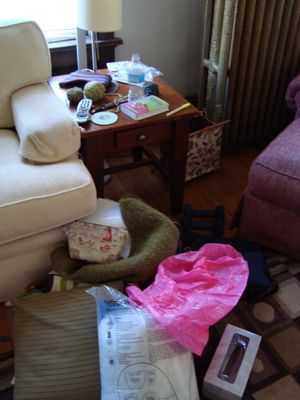
Even that Kleenex box was part of my knitting.
I set my timer and just seven minutes later took this picture:
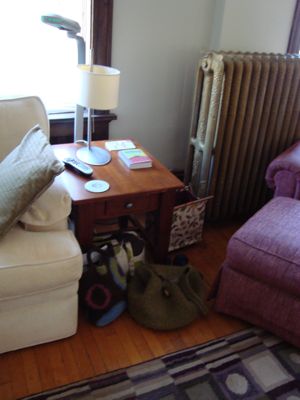
Ah, that's better.
That’s not the whole story, since I was able to clear that space by taking away all the stuff that didn’t belong there. It belongs in the fabulous Elfa drawer system that I use to store my knitting gear. So I took an additional eight minutes to put everything away.
15 minutes. Why in the world did I step over all that knitting clutter when it took only 15 minutes to make it orderly? It’s a question for the ages and one I grapple with all the time, as do my clients.
One of the things I’m so excited about with Declutter Happy Hour is that we’re providing 30 minutes during the teleclass itself for participants to do some decluttering. If I can create the order pictured above in 15 minutes, just think what you can do in a half hour.
P.S. The price for Declutter Happy Hour goes up by $30 on Sunday, so if you’re inclined to sign up, you’re going to want to do it before Sunday.
P.P.S. If you like my Elfa drawer system, Oprah wants you to save money on it. She’s offering viewers a 25 percent off coupon from the Container Store, good through April 13 (as part of her “Clean Up Your Messy House Tour with Peter Walsh). In addition, all Elfa is 30 percent off. Just go to the Container Store’s website for details.
Announcing Declutter Happy Hour!
Recently, I’ve been blogging quite a bit about how hard it can be to get rid of clutter, not just because it’s hard work that’s difficult to find the time to do, but because of emotional barriers to the work, or unhelpful beliefs that get in the way.
In the poll I ran on the blog this week which allowed readers to vote for their emotional barriers to getting organized, “Overwhelm” was the top vote-getter. The next most popular reason was “Avoidance.”
I get it. I think when you view the work as a big drag that will take forever to accomplish, when it feels like there’s no way you can get it done on your own or you don’t know where to start, you become paralyzed. It’s easier to go do something (anything) else.
If you can identify with this, I have great news for you. Life coach Shannon Wilkinson and I are offering an exciting new teleclass called Declutter Happy Hour.
Shannon is a certified hypnotherapist and master NLP practitioner. I’ve been using her services for years and she’s helped me get past emotional barriers to some pretty major things. She does it with fun exercises that we do together over the phone. (She lives in Portland, Oregon.)
We’ve decided to team up to help people get rid of both their emotional clutter—the negative emotions that get in the way of dealing with physical clutter—and the actual clutter in their space.
Declutter Happy Hour is comprised of four teleclasses on four consecutive Tuesday afternoons, starting March 31. They’ll be recorded, with recordings available to class participants the following day, so if you’re not available during the class time, you can still benefit.
During the classes, we’ll go through exercises to clear emotional clutter. We’ll identify areas of clutter in your space that you want to address. We’ll discuss techniques to do that. Then, while Shannon and I remain on the phone line in case you have questions, you’ll hang up and declutter for a half hour. We’ll reconvene and set goals for the coming week.
There are so many great benefits:
- You set aside time in your week to actually deal with clutter
- You actually deal with the emotions — and the techniques are fun
- You get to work with two experts for a fraction of the cost of working with us privately
- You learn techniques and tools that will help you long after the class is over
- You can stop letting clutter get in the way of living
Right now, the four-week class is being offered at the early-bird price of only $99. On Sunday, it goes up to $129. There are a limited number of premium add-on packages for an additional $129 that will get you hour-long private phone sessions with Shannon and with me.
Just go to Declutter Happy Hour to sign up via PayPal. It’s a great first step toward taking control of your clutter, rather than letting it control you.
Take the poll: Emotional barriers to decluttering
On Friday, I posted about emotional barriers to getting organized. Jim Dietzel from Rubbermaid’s blog suggested in a comment that I do a poll on the various emotional blocks folks have when it comes to decluttering.
I didn’t know how to do a poll on my blog, but I thought it was a great idea. In a nice moment of serendipity, my friend, the fabulous writer Michelle Rafter, had a poll on her blog and I saw that she used Poll Daddy.
Poll Daddy makes it incredibly easy. In less than 60 seconds, I put together this poll. Please take a moment and weigh in! You can select as many answers as you’d like. And feel free to click “other” and share some other emotional barriers as well.
If you’re interested in addressing these emotions, pay a visit to Declutter Happy Hour to learn about an exciting learning opportunity.
Emotional barriers to getting organized
Earlier this week, I wrote about unhelpful beliefs that can stop you from being able to let go of stuff. Today I want to talk about emotional barriers that can come up when you’re trying to get organized (or even just thinking about it).
These emotional barriers can block your progress or even keep you from starting. Intellectually, you know the value of getting organized. You’re sick of the clutter and the helpless feeling it can bring. You’re tired of life just being more difficult than it ought to be because you can’t find anything.
But when you contemplate starting to declutter or setting up systems, emotions like these can pop up:
- I don’t know what I’m going to find in there. What if there’s bad news? Fear
- I don’t know where to start. Overwhelm
- Why do I have to be the one who has to do this. Why doesn’t my husband [partner, child, roommate] help me? Resentment
- I don’t want the process to dredge up old emotions. Avoidance
- I might need this thing some day. Fear of regret
- I spent good money on this item, I’d better keep it. Guilt
- What if the organizing system I set up doesn’t work? Perfectionism
I encourage you to sit down and think about exactly why you want to get organized. Visualize your life as an organized person. Feel the freedom and peace of mind an uncluttered home can bring you. And write all that stuff down.
As difficult it can be to get past the emotional roadblocks that stop you from getting organized, revisiting your vision for your life and your space can help. And so can reaching out for help.
Can you think of other emotional barriers to getting organized? I’d love to hear them in the comments.
I’ve teamed up with life coach Shannon Wilkinson to offer a teleclass that will help you clear those emotional barriers while clearing up physical clutter as well. Check it out at Declutter Happy Hour.
Free talk on time management
As part of my plan to present a free organizing-related talk to the public every other month in 2009, I’ve scheduled my April event.
Here are the particulars:
Time management: New ways to get more done
At this free talk, you’ll learn some tips and techniques to help you be more productive—and maybe even create some time to relax. Many of the principles to be discussed originated with Mark Forster, author of Do It Tomorrow and Other Secrets of Time Management
- Autofocus: an exciting new system for keeping track of what you have to do
- Conquering procrastination
- Selecting a calendar
- Automating your life: creating new habits and routines
- The importance of taking breaks
The event will be held on Tuesday, April 22, from 7 to 8 p.m. at Pudd’nHead Books in Webster Groves, Missouri.
Registration is required. Go to the events page on my website to sign up
Search
Recent Posts
- Worth repeating: Figuring out what to watch on TV
- The power of incremental progress
- Podcast guest spot on the role of organization for folks with chronic illness
- No excuses series (part 3): "It was a present"
- No excuses series (part 2): "I paid a lot for that item"
- No excuses series (part 1): "But I might need it!"
- Retiring the New Organizer Guides
Tags
About Janine

Hello! I’m Janine Adams — a certified professional organizer based in St. Louis, and the creator of Peace of Mind Organizing®.
I love order, harmony + beauty, but I believe that the way that you feel about yourself and your home is what truly matters.
If you’re ready to declutter with a purpose and add more ease to your life, you’ve found the right blog — and you’ve found the right company.
read more »Links
- NAPO St. Louis
- Are you interested in becoming a professional organizer?
- National Association of Productivity and Organizing Professionals
- Peace of Mind Spending
- Ravelry
- Shannon Wilkinson, life coach
- Organize Your Family History
- Getting to Good Enough podcast
- Institute for Challenging Disorganization