The weekend work/rest balance
On Friday I wrote that I was overwhelmed with tasks and clutter and that I really wanted to put my feet up this weekend, but had so much to do that I feared that wouldn’t be prudent. So I decided to create short task lists for each weekend day and relax only after I’d completed all the tasks on them.
And I promised to report on how that worked, so here’s my report.
I created the weekend’s tasks lists on Friday. On Saturday, I dove right into my list (after I came back from a play date with my dogs and their best friend…a girl’s gotta have priorities). I’m delighted to report that it took only about 60 to 90 minutes to complete everything on the list (mostly tidying up). So by about 12:30, I was able to pull out my knitting needles and start catching up on the TV shows that had accumulated on my DVR while knitting up a storm. It was great. I did some major relaxing.
On Sunday I did well with the task list, which contained more desk-type work (including working on my taxes), but ran out of time for knitting and relaxation during the afternoon. But that was okay for a couple of reasons: (1) I took my time with the desk work and interspersed some fun You Tube viewing (may I just share that I adore Entertainment Weekly’s coverage of American Idol on their website?). (2) We went out to an early dinner with friends, so I had time for knitting and TV (I’m almost completely caught up) in the evening.
So here it is Monday morning, and I feel I have a jump start on the week. I’m already plowing through my Autofocus task list. The house is reasonable looking (I might actually vacuum today!) and I actually feel I received sufficient R&R to recharge my batteries.
Life’s feeling much less overwhelming, I’m happy to say.
Feeling overwhelmed
So far this year, things have been running really smoothly. I’ve been gliding through the days, getting lots done, meeting some terrific people, making some money. Kind of idyllic, in fact.
All of a sudden, in this past week or so, that gliding has turned into stumbling. I’m starting to experience that overwhelmed, swimming-head feeling of being overwhelmed. I’m feeling like I have more to do than I have time. And I’m watching clutter spots sprout up around the house. Worse yet, I’m not doing anything about them! (I wrote about the paradox of the organizer with the messy house two full years ago. Not a whole lot has changed!)
So here it is Friday. I don’t have much time at home today since I’m leaving to work with a client in a couple hours. And I’m torn. I have two pretty unencumbered days this weekend. Do I spend the time clearing my mind by decluttering, plowing through my inbasket, and working on taxes?
Or do I give myself a break and spend my time relaxing via knitting and watching TV and just not worrying about the other stuff?
I’m a huge advocate of relaxing and taking time out for myself. But I think this weekend needs to be about balance. I need to balance clearing my mind through work and clearing my mind through relaxation. I’m thinking the way I’ll accomplish that is by making as brief a list as possible of things I could do that would make a big impact on getting rid of my overwhelmed feeling. I’ll make one for Saturday and one for Sunday. And if when I accomplish the activities for that day, I’ll get to spend the rest of the day with my feet (or, rather, my knitting needles) up.
And to keep myself honest, I’m going to report on Monday how that worked out. Something tells me that the accountability will help.
It's update time
Here are a few little updates to past blogs posts.
Just this past Friday, I blogged about my Butler Bag. I’m still loving it. Thanks to a tip from Sharon Lowenheim on the NAPO members-only email list, I went to the Container Store and purchased two clear Almac boxes, which are the perfect size to hold my lipsticks and lipgloss securely in the Butler Bag. (I bought one 89-cent box and one 69-cent box.) Ah, heaven. I’m dashing this morning, so no photo.
I’ve blogged a couple of time about Playing for Change, the wonderful project that films musicians all over the world playing the same song and melds it into fabulous international music videos. You can now purchase Playing for Change videos on iTunes. Right now, there’s a single two-song “album” available for $2.49. (The songs are Stand By Me and Let’s Don’t Worry.) They’re great to watch, they’re great to listen to. If you go to the iTunes Store and search on Playing for Change, click on the one that says Stand By Me.
A quick update on my 2009 goal of keeping my bureau top clear, rather than dumping worn clothes on it when I get undressed at night. I’m continually amazed at the power of my putting my intention behind this and the power of Don’t Break the Chain. I started this on January 5 and in that time, there have been two nights when I didn’t put away my clothes and both those were because my husband went to sleep before me and I didn’t want to wake him up by opening the sliding doors on our closet. One night I was especially tired and while I was brushing my teeth I gave myself permission to just fold clothes and leave them on the bureau top until morning. But when it came time to do that, I took the extra 60 seconds or so to put away the clothes. The result is I wake to calmer space, I’m not digging through semi-clean clothes to find things to wear, and I’m proud of myself to boot! Within a couple of months I hope it becomes a habit.
Excited about my to-do list
Last week was one of those weeks I wasn’t at my desk much and when I was I had to be focused on urgent items. I’m not sure I actually looked at my to-do list all week, except to add to it.
This week I have much more discretionary time. When I woke up this morning, I was actually excited about looking at my to-do list. Now that’s a change of pace. In the past, I probably would have just started a new one, not trusting that a list that was a week old would do me any good. Plus, the old one would probably just make feel cranky about what I hadn’t accomplished.
Why the shift? It’s called Autofocus, baby. It’s the task-management system invented by time-management guru Mark Forster and launched in beta testing at the beginning of the year. I signed up the moment I heard about it and have been using it faithfully since January 5.
I was delighted to discover this morning that Mark is including instructions for Autofocus on his website now (rather than requiring registration as a beta tester to get it). So go read those instructions and then come back here to learn seven reasons why I love the system and what it’s doing for me.
Because Autofocus provides a framework that balances the rational and intuitive parts of the brain, it’s unlike any system I’ve worked with before. Here are some of the things I love.
- It puts me in the driver’s seat. I’m in complete control of what I do, I get to work on only what I want to, and I have the freedom to dismiss items the system makes me realize aren’t really important.
- It’s fun! I actually look forward to doing things on my list, probably because I get to let my intuition call the shots.
- I get so much done. Because the list requires me to start at the beginning, I’m tackling older tasks, rather than letting them just molder away at the top of a list, never to be addressed unless they bite me in the butt.
- It’s simple. Simple is good.
- It forces me to make decisions about my tasks. If I get to the point on a page where’s nothing I want to do, the system requires me to either do something or dismiss it. No more just ignoring the tasks I’ve been procrastinating on.
- I don’t have to rely on my memory. When I get super-busy and have to ignore my list, I know all the tasks are safely waiting for me when I can get back to the system. Since I add every task to the end of the list, I don’t have to worry about remembering them. Such a relief.
- It’s a procrastination buster. All I have to do is a tiny bit of a task and then I can cross it off (and add it to the end of the list). This encourages a little and often approach to getting things done, which is so effective.
Honestly, the more I use it, the more I like it. Please do go check it out. And if you try it, come back here and tell me what you think!
At last, an organized and attractive bag
I love having an organized purse. For some time I used the Baggallini City Bag, which I liked because it held what I needed and I could find things fairly easily. But it was a little more casual than I wanted when I was dressed to impress.
Then I switched over to a suede Coach bucket bag I had. It was nice, but hard to keep organized.
Ah, but last week I got a Butler Bag. I’d been aware of these bags for a little while, but not convinced they’d be great for me. Then my friend Aby Garvey got one and she allowed me to paw through hers. That was enough. I needed one. (Maybe it was that touch thing I blogged about earlier this week.)
I actually purchased the shiny espresso vinyl version at Kmart after my fashion adviser, Geralin Thomas, informed me that vinyl is in. (Who knew?) So I spent only $25 on this bag that I’m so thrilled about. I’m thinking I’ll probably upgrade to leather at some point, though.
What’s so great about the Butler Bag? The interior bottom of the bag has an insert with structured compartments that allow the bag’s contents to stand up on end. Once you assign a place for everything, it’s so easy to find what you need. And the bag holds a surprising amount. I have the classic size, which isn’t very big. And it holds everything I like to tote around, including my camera, iPod Touch, GPS, wallet, sunglasses, lipstick, lip gloss, Kleenex, pen, mints, business card case and a notebook. And there’s room for more.
Here are some pictures of my bag. The only thing that’s missing from the photos of the contents is my camera, because I was using it to take the photos.
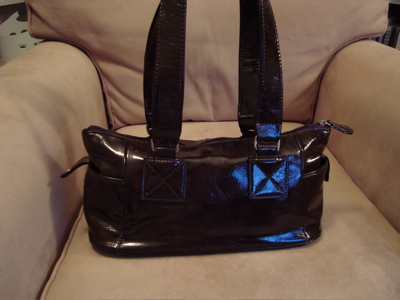
Here it is all zipped up (and full).
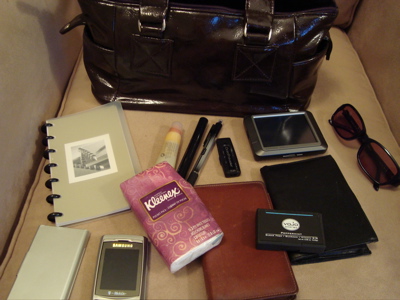
This is what's inside my Butler Bag. I store my camera in it too.
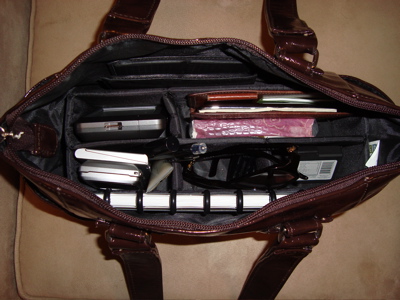
Here's my bag with everything in place.
9 Simple Solutions for Procrastinators
This is a guest post of sorts, from the fabulous Christine Kane, who helps people achieve their dreams. I’m reprinting it, with permission, from her newsletter. It arrived in my mailbox today and I thought it was so great I’d share it immediately. Incidentally, I wish I’d thought of the acronym CRAP for Clutter Removal Action Process!
—Janine
by Christine Kane
Irony: As I started to write this article, I thought, “I’ll just go play one Sudoku game first.” I caught myself in the act and marched to my laptop.
People who say that procrastination is about laziness are probably the same people who think that anorexia is about not eating enough.
Procrastination isn’t about laziness. It’s about fear. It’s about perfectionism. It’s about overwhelm. We all experience it, and there are some tricks to help you get moving again.
Here are 9 ways to break the procrastination habit:
1 – When you get an idea, do some little thing to begin.
When I read Stephen King’s book On Writing, I noticed something. I noticed that when Stephen King gets an idea, he writes it. Immediately and imperfectly.
Most people get an idea. Then they sit there. They wonder if it’s a good idea. Then, they wonder if it’s a good idea some more.
Got an idea? Begin it now!
2 – All hail small chunks of time!
Lots of us complain about having no time. My guess is that we all have lots of time. It just doesn’t happen to be all at once.
Are you waiting for many hours of spare time to begin your idea, your project, or your taxes? Stop waiting! Learn to use the spare half hour that comes up here and there. (I gave myself 45 minutes to write this article just to take my own advice.)
3 – Agree to do it badly.
Set a goal to do it badly. Set a goal to show up. Let go of doing it ALL, or doing it WELL.
Some of my coaching clients’ biggest victories have a lot more to do with getting over perfectionism and fear, than they do about getting it all done perfectly.
4 – Commit aloud.
Call a friend and say something like this: “I’m going to spend the next half hour working on my Law School Essay.” Then go do it.
Call the friend after the half hour and make her congratulate you. Repeat daily.
5 – Define quantities.
Nebulous goals make for nebulous results. “I’m gonna get my office organized” is a lot like saying, “We oughtta do something about Global Warming.”
Most procrastinators have a hard time defining quantities. We think everything needs to be done NOW.
When are you going to do it? For how long? Which part of your office? The file cabinet? Or your desk?
Define the goal and acknowledge its completion.
Note: The Clutter Removal Action Process (or, “C.R.A.P.”) is one of the many bonus elements of my new “Uplevel Your Life Mastery Program” – and it makes this step a BREEZE!
6 – Install this System Upgrade into your Mental Hard Drive: Less is More.
Have fewer goals. Have no more than three priorities for a week.
Why?
Because you’re not lazy. You’re just trying to do too much.
Find out what it feels like to accomplish one thing instead of not quite getting to everything. Wow – what a difference this makes!
7 – Do it first.
My first coach made me write songs first thing in the morning. He told me to schedule the 2-hour chunk as my first activity upon waking.
Why?
“Because you’re telling the universe that this is your priority. And then the universe lines up everything to align with your priority.”
Action grounds your priorities. It makes them real. It also makes your day easier because you’re not wasting energy thinking about this thing you’re supposed to be doing.
8 – Avoid nose-bleed activities.
Email, voicemail, web stats – any activity that bleeds itself into your whole day becomes a non-activity. It becomes a nose-bleed.
When you do it all the time, you never complete it. You just let it slowly drain the very life force from you. Define times for these activities. Then, turn off your email, your cell phone, your web stats, until that time comes.
9 – Don’t ask how you “feel” about doing the activity.
Have you ever committed to getting fit? And then when the alarm goes off, you lie in bed thinking, “Do I really feel like going to the gym?” (Like you even have to ask!)
Change this pattern. Make your decision the night before. Commit to getting up and going right to the gym, the computer, the blank canvas. Don’t have coffee and sigh and think, “I’ll probably feel more like it at lunch time.” You won’t!
If it’s a priority, don’t waste time asking yourself how you feel about doing it. Feelings are an easy out.
——————————————
There. I did it. I wrote this article. And now, I don’t even want to play Sudoku! How about that?
Performer, songwriter, and creativity consultant Christine Kane publishes her ‘LiveCreative’ weekly ezine with more than 4,000 subscribers. If you want to be the artist of your life and create authentic and lasting success, you can sign up for a FREE subscription to LiveCreative at www.christinekane.com.
Do you snore?
This has nothing to do with organizing, but I have to share. I’m a snorer. My husband is a light sleeper. This is a bad combination.
I used to take Sudafed to stop snoring, and I think it worked, but I stopped being willing to take so much Sudafed. I tried Breathe Right strips, which also worked, but it would take little bits of skin off the bridge of my nose when I removed it. I didn’t like that.
Maybe six months ago, I tried out what’s turned out to be a good, if not perfect, solution. It’s the Sona Pillow, a $100 pillow we purchased at Brookstone. It’s a weird-looking pillow, as you can see. (That’s not my husband in the picture, by the way.)

As I understand it, the pillow is supposed to make me sleep on my side. (Like most people, I snore when I sleep on my back.) While it’s supposed to make it less comfortable to sleep on my back, I’m an inveterate back sleeper and the pillow is not stopping that habit. But it’s apparently holding my head at a different angle and the snoring is much, much reduced.
It’s not the most comfortable pillow, and if I slept alone I probably wouldn’t use it. But I’m no longer being awakened by my husband asking me to turn on my side to stop snoring. He’s not being awakened by my snoring. Thanks to the Sona Pillow, we’re both getting a better night’s sleep.
Search
Recent Posts
- Worth repeating: Figuring out what to watch on TV
- The power of incremental progress
- Podcast guest spot on the role of organization for folks with chronic illness
- No excuses series (part 3): "It was a present"
- No excuses series (part 2): "I paid a lot for that item"
- No excuses series (part 1): "But I might need it!"
- Retiring the New Organizer Guides
Tags
About Janine

Hello! I’m Janine Adams — a certified professional organizer based in St. Louis, and the creator of Peace of Mind Organizing®.
I love order, harmony + beauty, but I believe that the way that you feel about yourself and your home is what truly matters.
If you’re ready to declutter with a purpose and add more ease to your life, you’ve found the right blog — and you’ve found the right company.
read more »Links
- NAPO St. Louis
- National Association of Productivity and Organizing Professionals
- Are you interested in becoming a professional organizer?
- Peace of Mind Spending
- Shannon Wilkinson, life coach
- Getting to Good Enough podcast
- Organize Your Family History
- Institute for Challenging Disorganization
- Ravelry