December 2022 tiny projects challenge: Day 5
I went to New York City early Friday morning for a fun weekend with my college besties, which is why I didn’t post my final tiny projects challenge post on Friday. But the trip itself inspired the tiny project, which I did after I got back. I decluttered my travel toiletries bag.
Like many people, I keep a bunch of travel-sized toiletries assembled so I don’t have to pack a lot of them when I travel. On travel day, I add a few things I use daily. Everything fits in my toiletries bag. But it’s all pretty much a jumbled mess.
So while I was unpacking last night, I decided to declutter my toiletries bag.
Here’s how it looked before I started:
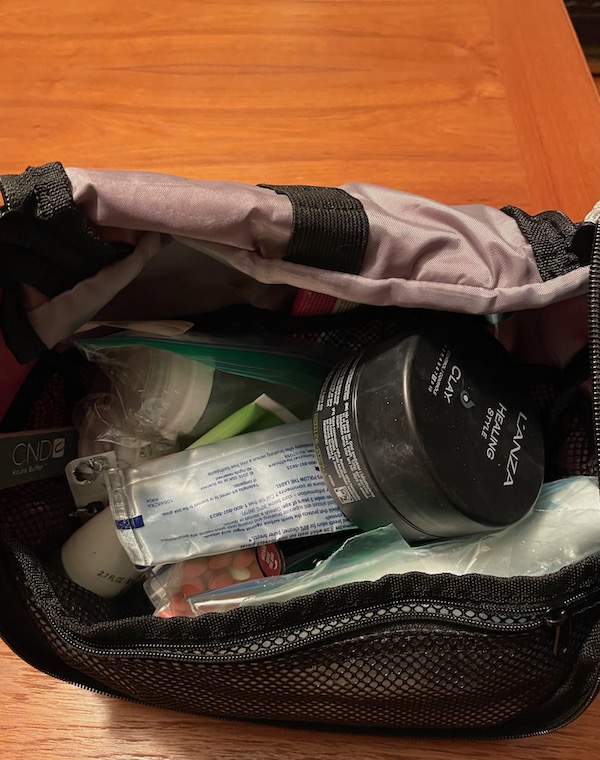
I pulled everything out and gave it a quick sort on the dining room table:
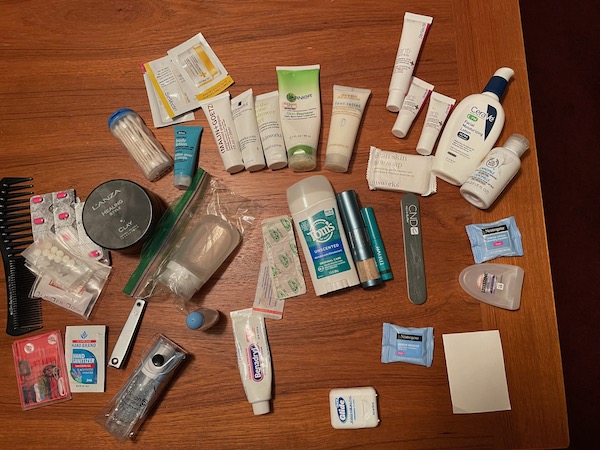
There were many things I didn’t know were in there that I’m sure I put in thinking I’d feel like a genius if I needed them. But if I don’t even realize I have them, they’re not much help.
So I edited out a few items, like duplicate shampoos and creams, a sewing kit, and makeup remover, since I really don’t use makeup any more. I stashed my lipstick in my desk drawer. Then I put back the keepers and called it a day.
Here’s the after photo. (Total time: 10 minutes, tops.)
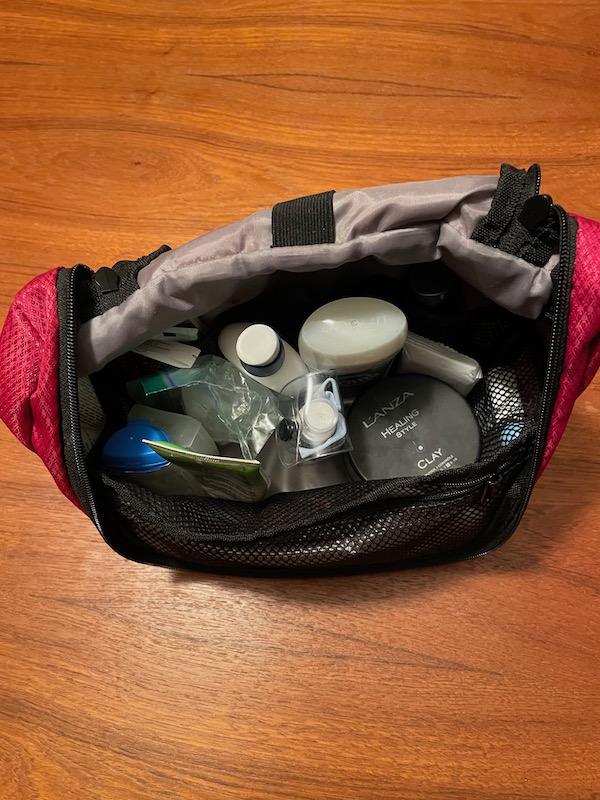
Everything will be much easier to access, which will be wonderful.
It got me thinking about the things that I add at the last minute to that bag when I travel. I think it might be worthwhile to buy an extra set of those things (toothpaste, deodorant, and vitamin C serum fall into that category), so I don’t have to do much of anything to pack. I use an electric toothbrush and I don’t want to invest in a duplicate, but I do keep a duplicate charger for the toothbrush in my suitcase. (I learned that the hard way.)
This is the end of my tiny projects series for this year. I’ll almost certainly do more next year. I love tackling these little decluttering and organizing projects!
December 2022 tiny projects challenge: Day 4
Today’s tiny project is a high-impact five-minute fix. I dealt with my snack chips.
I love chips. My favorites are Wavy Lay’s Hickory Barbecue and Simply Cheetos Crunchy. I also like tortilla chips and pretzel chips. (Please don’t judge.)
When I decided how to store my chips in my new kitchen back in 2016, I underestimated the number of different chips I’d like to have on hand. So, of course, it got very unruly up in there.
Here’s a photo of the ridiculousness I was tolerating:
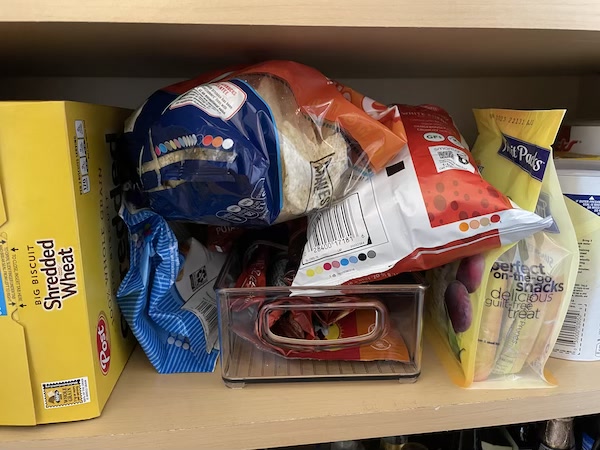
It took me five minutes to bring the chips out and toss the expired ones as well as the bags with measly crumbs. That left me with just four bags to store. I might have squeezed them into the exixting container, but I knew I needed more room. So I grabbed the white bin I formerly used for my bulk spices and put the chips in there.
Here’s the after photo:
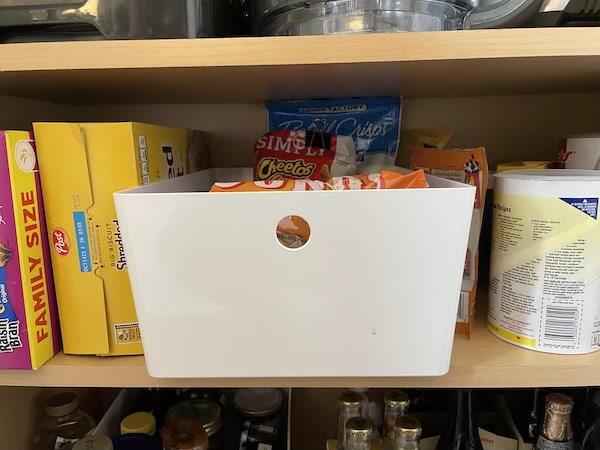
Ahhh, so much better. I’ll pull out the bin to access the chips, which will probably keep them more orderly. And now I won’t have to cram in chips and shut the cupboard door quickly. That was a high-impact five minutes!
December 2022 tiny projects challenge: Day 3
For this tiny project, I turned my attention to winter coats and accessories. We store most of our winter wear at the top of our back steps. (We live on the second floor of a two-family home and my offices and the guest room are on the first floor.) There’s not a lot of space there and it’s just a 36” rod and shelf and no door. It’s not beautiful, but it is functional.
Except it was starting to get crowded.
Here’s a before photo:
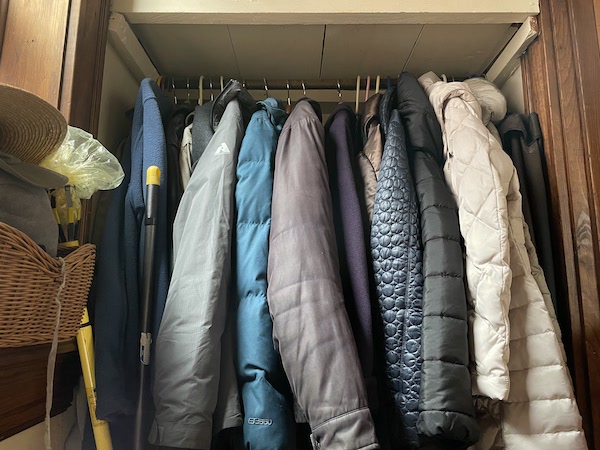
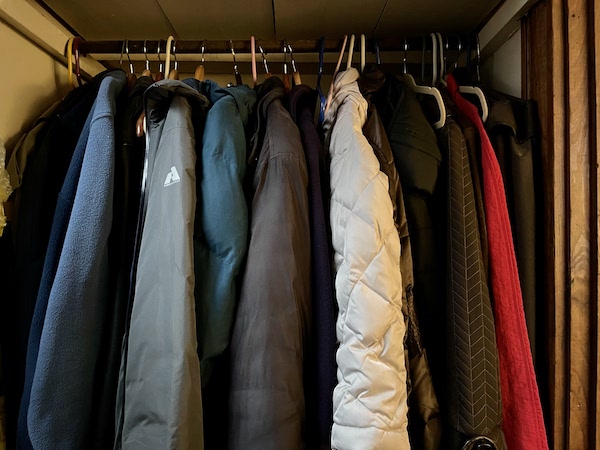
I started with the coats. In just three feet of space, 23 coats were hanging. Fourteen of them were mine and nine were Barry’s. (I was so surprised I had so many!) I focused on my coats and very quickly sorted out seven that I wanted to keep, five that I wanted to donate, and two that I moved to the basement, just in case. That took about five minutes. Barry will go through his coats on his own (I hope).
Here’s how that rod looked after only five minutes of decluttering and another five minutes of moving the donations out.
Then I turned my attention to the hats, scarves and gloves that we store there. Some were in plastic shoe boxes (one sweater box and two large shoe boxes) on the shelf. I knew going in that I would be able to let go of a lot and that I should relocate anything I keep because I hadn’t opened those boxes in probably five years.
Here’s a photo of the shelf:
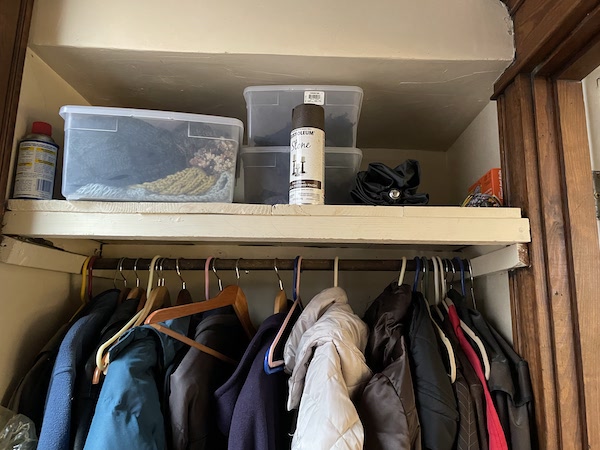
It was a simple thing to pull the plastic boxes onto the kitchen counter. The sweater was full of hand-knitted (by me) scarves. I took a look and my first thought was, “I can’t donate those. I made them.” And I put them right back in the bin. But I sat with it for a couple of minutes and realized that of course I can donate them. I’m not using them, nor will I. I can always make more (and, in fact, have). So I took all the hand knits except one and put them in the donate bag.
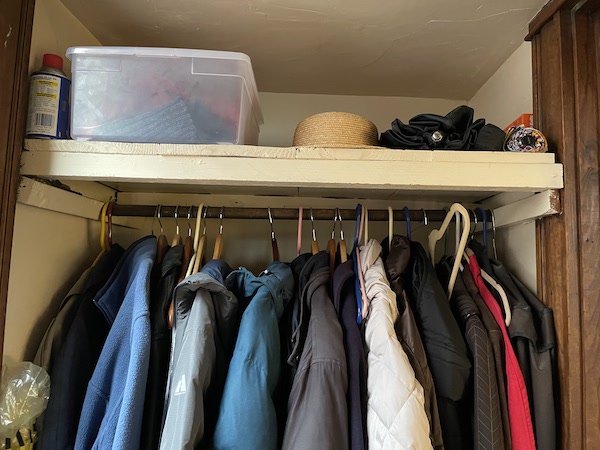
Then I sorted out the other stuff on the shelf, most of it my husband’s, and laid them out on the kitchen counter. (I moved the spray paint to the basement and kept the WD-40 there because that’s where we’d look for it.) On that shelf, there were three left gloves (go figure). We’re going to hang on to those in hopes of finding the corresponding right gloves downstairs. If we find the mates, we’ll donate two of the pairs. Barry let go of a few accessories and we moved a few things to the front door (a project for another day). (Since we walk Bix from the front door and go to our cars from the back door, we store different accessories in each place.)
Here’s a photo of the shelf when I finished. (Definitely a “good enough” finish line.)
But I wasn’t finished, because there were also three baskets of such accessories on the window sill.
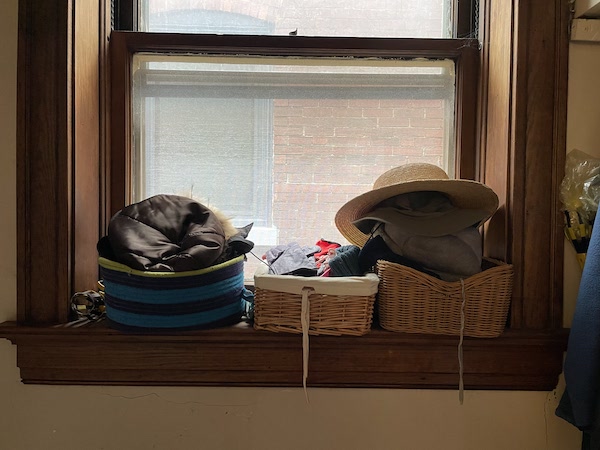
On the windowsill, I found the hood and other accessories for one of the coats I was donating (it felt good to put them all together for donation). I also found a bunch of gardening gloves, which I’ll wash and store more appropriately, and a few hats. All I kept were the detachable hood from my current winter coat, the pussy hat I knit in 2017 and, for Barry, one scarf and one hat. I moved a sun hat to the shelf above the coats.
Here’s how the windowsill looked when I finished.
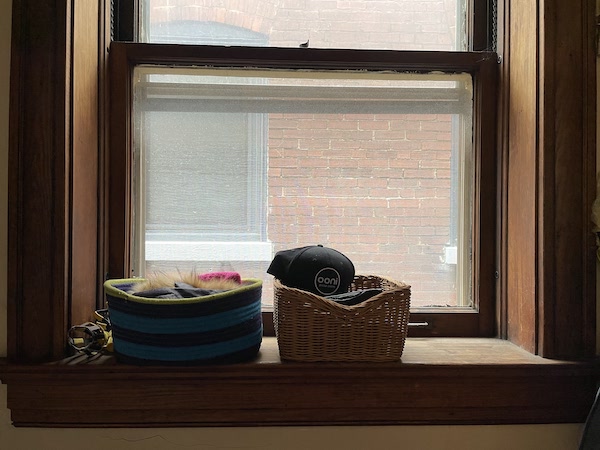
The second part of this project took about 20 minutes. The whole area feels much better and now we can easily put our hands on the items we use. Again, it’s a great reminder of what a half hour of focused decluttering energy can reap! I encourage you to give it a try.
December 2022 tiny projects challenge: Day 2
For today’s tiny projects challenge, I chose the bulk herbs and spices that were outgrowing the container they were stored in in one of our cabinets. In 2016, we renovated our kitchen and at that time chose a Kuggis container from IKEA to store the herbs and spices that came in anything other than a bottle. (The bottles of herbs and spices live in a pull outs next to the range.)
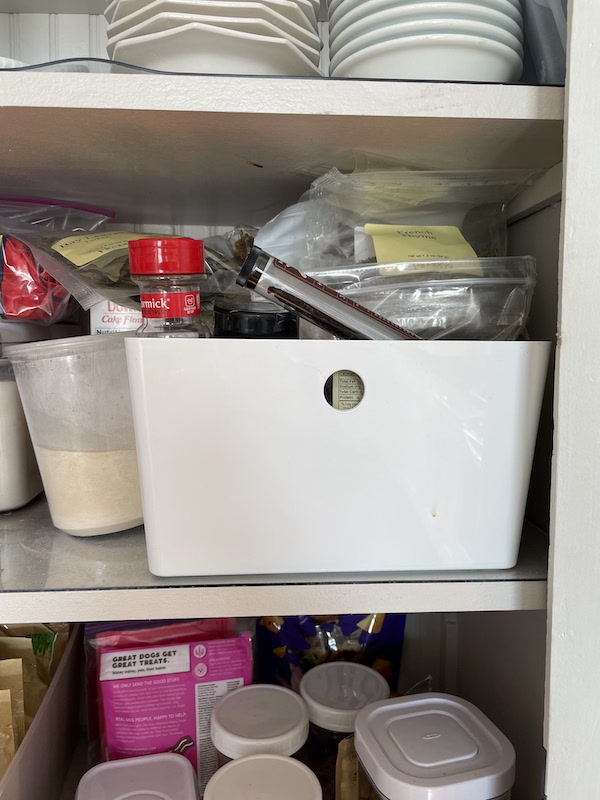
In order to access the bulk herbs and spices, we had to dig through them, which is obviously less than optimal. Last month, I purchased The Everything Organizer XL Cabinet Depth Pantry Bin with Dividers from The Container Store, thinking it would work well for this project. I was very happy when it did!
Here’s the messy before picture, with the bin inside the cabinet.
And here’s how the bin looked when I took it out of the cupboard and put it on the counter.
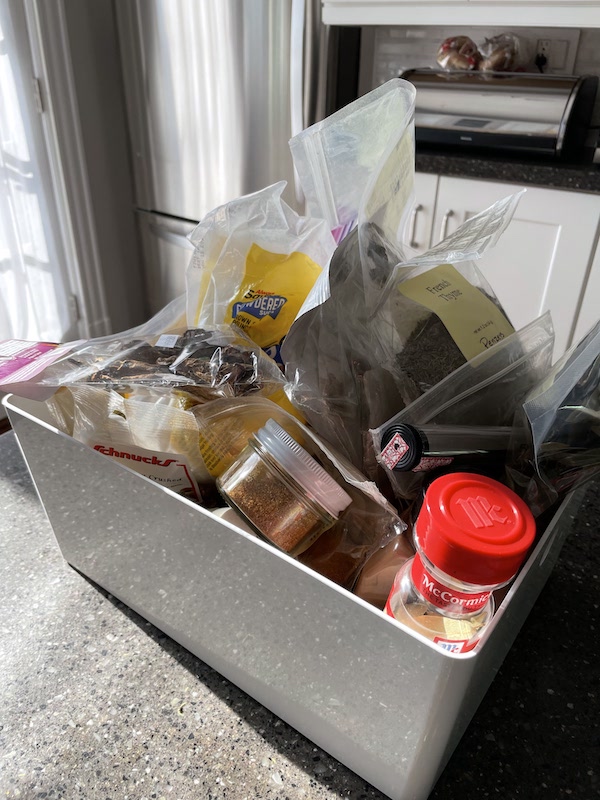
It was a simple job to empty the container, throw out old or unloved spices and sort the remainder into categories. I used the new container I’d purchased for four of the categories, plus a separate pantry bin I had on hand. The project took less than 30 minutes.
Here’s the after picture, with all the herbs and spices stored neatly in the cupboard.
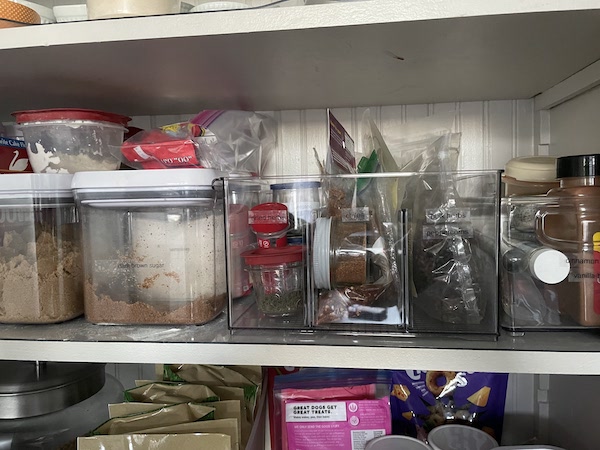
(I know that black-on-clear labels for clear bins isn’t standard, but my husband really prefers less obtrusive labels, so it works for us.)
Everything fits into the categories at the moment, but this may take a little maintenance effort in order to keep the categories from merging.
These are the categories I created in the divided container:
- dried herbs
- chiles
- bulk herbs/peppercorns (combined in one section)
The separate container holds:
- cinnamon sticks
- vanilla beans
My husband is the main cook in this house the main user of the bulk herbs and spices. He says he thinks this will work well for him. It’s certainly an improvement!
December 2022 tiny projects challenge: Day 1
During the lockdown in 2020, I did three tiny projects challenges and blogged about them. These were small organizing projects I could complete in about 30 minutes or less that I did for five days in a row. It was a great way to keep busy and I loved the results. I resurrected it in December 2021 and I’ve decided to make it an annual December tradition. Feel free to join me in challenging yourself to complete one small organizing project a day!
Day 1: Decluttering my monitor riser
I thought I’d kick off this tiny projects challenge with a high-impact project: decluttering and organizing something I look at every day. I use a 14” MacBook Pro, which I love, especially when I travel. But when I’m in my home office, I like a larger monitor. So I have my laptop hooked up to a 27-inch HP monitor. I put the monitor atop an Uprise Monitor Riser so that it’s at an ergonomically beneficial height. The riser has the advantage of providing storage space for small items that I want close at hand. That’s especially great since my 25-year-old IKEA desk doesn’t have any drawers.
The storage seems great, that is, until the riser gets so cluttered that becomes a distracting, disorganized mess. That’s what happened this year. Here’s a before photo.
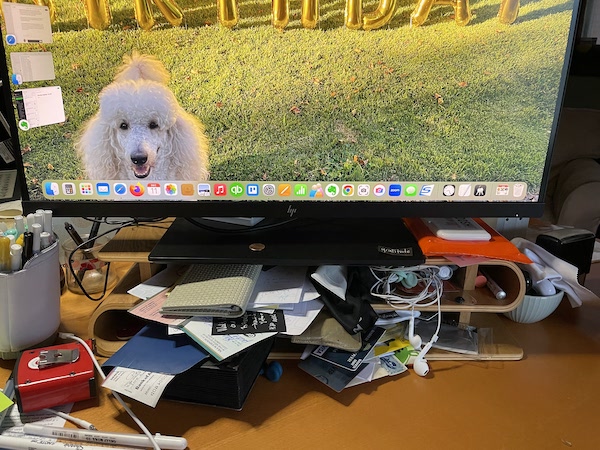
I set a timer for 30 minutes and dug in. I started by emptying everything from the riser into a container. (There were things I didn’t realize were even in there!) Then, I sorted the items into categories, recycled some loose note paper whose scribbles were no longer relevant, relocated a couple of items, and used a shallow box that a journal had come in (plus its lid) to contain the items I really need close at hand.
Here’s the after photo:
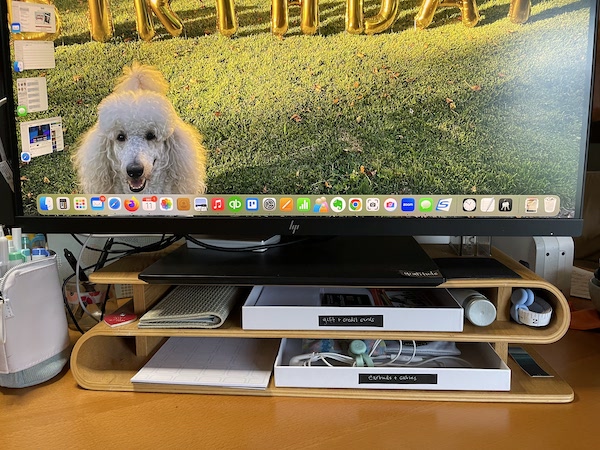
Ahh, so much better. I used black Post-it® Notes and a white gel pen to create labels in a jiffy. (And I didn’t let perfectionism get in the way!) I moved the unsightly check-sized accordion file, which really didn’t need to be on my desk, to a nearby shelf. Everything fits nicely and nothing is spilling off onto the desk. Best of all, I can easily put my hands on what I need.
This ended up taking me only about 15 minutes. What a high return for the investment of 15 minutes! It’s a pleasure to sit at my desk now.
I encourage you to take a look around your house for a tiny project. Is there something that’s bugging you that you could change in just a few minutes?
Sign up open for the next Yoga with Adriene 30-day yoga journey!

I am so excited for this January’s 30-day at-home yoga journey with the fabulous Yoga with Adriene. This year’s theme is CENTER. As always, her adorable companion Benji, an Australian Cattle Dog, will be by her side. (I’m not alone in my adoration of Adriene. Her YouTube channel has 11.5 million followers.)
I did my first 30-day journey in 2018. I blogged about how I got past all my internal barriers to trying out yoga by doing a 30-day journey then. You might also be interested in my blog post about nine things I love about Yoga with Adriene written 18 months later.
Adriene offers hundreds of free yoga videos on her YouTube channel. But the 30-day journeys, which she’s doing for ten years, are special. A new video is released each day of the month and when you do them the day of release, you know you’re doing yoga simultaneously with tens of thousands of people. It’s a fabulous thing.
Here are some of the things I love about participating in the journey (as opposed to selecting a yoga practice from the available videos each day):
- The commitment. I aspire to daily yoga, but sometimes I fall short. In January, I make it a priority.
- The community. I love reading the comments from other users who have just finished the same practice I have.
- The surprise. I never know what the day’s yoga practice will be like.
- The novelty. I have to admit, I’m guilty of doing the same few yoga practices without mixing it up. These are all brand-new videos created for the series.
- The challenge. I don’t ordinarily seek out challenging yoga practices. But I’ll try whatever Adriene puts in front of me during a journey, regardless of length or difficulty.
- I don’t have to choose. I love limiting choices to make decisions easier. In January, I don’t have to decide what yoga video to turn on.
To learn more about the YWA 30-day yoga journey, which is free of charge, watch this announcement video. Here’s a link to the FAQ about the 30-day journeys. If you want to participate, simply sign up here. You’ll receive a confirming email and then come January 1, you’ll receive a morning email with a link to the day’s video. I hope you benefit from it as much as I know I will!
My favorite definition of perfectionism
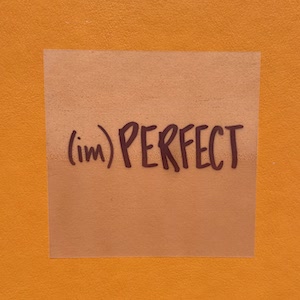
I truly feel lucky that I’m not wired to be a perfectionist. I definitely have a “good enough” mentality, which has served me well. But I do face perfectionistic tendencies on occasion and when that happens, I fall back on this fantastic definition of perfectionism that I learned from Harold L. Taylor when he gave a workshop in St. Louis back in 2011. (I blogged about that workshop in more detail at the time.)
Here’s what Harold said:
A perfectionist is someone who spends more time on a task than it merits.
Let’s face it, some things are worth spending a lot of time on. Many things are not. Being able to differentiate between the two can save you a lot of time and help you let go of perfectionism.
Interested in learning more about letting go of perfectionism? Listen to the podcast I co-host with life coach Shannon Wilkinson, Getting to Good Enough. We publish new episodes every Thursday.
Search
Recent Posts
- Worth repeating: Figuring out what to watch on TV
- The power of incremental progress
- Podcast guest spot on the role of organization for folks with chronic illness
- No excuses series (part 3): "It was a present"
- No excuses series (part 2): "I paid a lot for that item"
- No excuses series (part 1): "But I might need it!"
- Retiring the New Organizer Guides
Tags
About Janine

Hello! I’m Janine Adams — a certified professional organizer based in St. Louis, and the creator of Peace of Mind Organizing®.
I love order, harmony + beauty, but I believe that the way that you feel about yourself and your home is what truly matters.
If you’re ready to declutter with a purpose and add more ease to your life, you’ve found the right blog — and you’ve found the right company.
read more »Links
- Are you interested in becoming a professional organizer?
- Ravelry
- Organize Your Family History
- Shannon Wilkinson, life coach
- Institute for Challenging Disorganization
- NAPO St. Louis
- Getting to Good Enough podcast
- Peace of Mind Spending
- National Association of Productivity and Organizing Professionals