Confessions of a couch potato
I got up early and walked eight miles yesterday morning. I realize that doesn’t sound like something you’d hear from a self-described couch potato. Really, truly all I ever want to do is sit on my butt, watch TV (or DVDs or, especially, TV series on DVDs) and knit. If I won the lottery, I’d probably check into a five-star hotel and do just that for a week.
But since I’ve passed 40, I’ve grown up enough to realize the importance of exercise. I’m blessed with great genes and I’ve never had to exercise in order to keep my weight down. In the absence of vanity as a motivation, it took aging to get me going (well, that and my dogs; but I don’t consider their walks terrific exercise). Probably ten years ago, my college roommate, Ann, who’s a doctor, gave me a mini-lecture on how I need to be working on upper-body strength to stave off osteoporosis. It took me while, but I’ve finally integrated dumbbells into my morning routine.
Another college friend, KC, has gotten into walking half- and full marathons as part of her quest to get fit. She’s amazing—she walked the entire New York Marathon last month in seven and a half hours. Her enthusiasm for this is contagious and, thanks to KC, our entire group of five 40-something college buddies walked the Lewis and Clark Half Marathon in St. Charles, Missouri, on September 18, 2005. While I was sure I’d never do another, I’m actually training for the P.F. Chang’s Rock & Roll Half Marathon in Phoenix next month. Thus, I walked eight miles yesterday.
If you’d told me ten years ago that I would walk eight miles, pretty quickly, and finish by telling my friend and walking companion, “That was fun!” I’d have said you’re crazy. I’m certainly not obsessive about it, but I’m finally getting why people enjoy exercising. It’s so cool to set an exercise goal and achieve it.
Getting back to the upper-body-strength thing, I’m small, fair, and have a mother and grandmother with osteoporosis. So I’m a prime candidate. I’ve used a fantastic book called Quick Fit: The Complete 15-Minute No-Sweat Workout, by Richard R. Bradley and Sarah Wernick. Each day, I spend only five minutes with seven-pound dumbbells doing five weight exercises. (I try to get the cardio portion of my workout by my three-times-daily dog walks.) Not only are they easy, I’m actually a little strong, for the first time in my life. And I have muscles! (Also a first.) My arms actually look pretty in sleeveless tops, which is the goal of most women in their forties and above, I think. I can’t recommend this book highly enough. It’s written for couch potatoes who want to incorporate a quick, no-sweat workout into their daily routine.
If you’re thinking there were an easy way to start exercising, buy this book. Read it, use it, and enjoy feeling proud of yourself—and feeling great.
A little press
My company is included in Sauce Magazine’s holiday Guide to Giving. Sauce is a local tabloid-style monthly newspaper for foodies. In an article about intangible gifts, called “Give Adventure” by Laura A. Hazan, the gift of organizing services is included and I’m the organizer mentioned (and quoted).
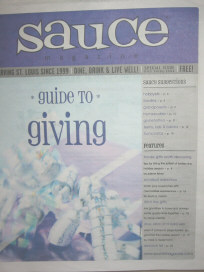
The cover of the gift guide, an insert in the December issue
The article also includes a gift of a glider ride and quotes my husband, Barry Marcus, who is the membership chair of the Silvercreek Glider Club. Barry’s quotation is a call-out quote, in giant letters across two columns. Our friend Kelly called us “St. Louis’ power couple.” Ha!
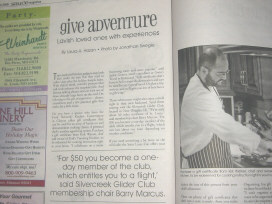
The article. See Barry's name in giant letters?
In any case, it’s always nice to get your name out there and Barry and I are hopeful it will result in some inquiries about his club and my services. Of course, giving the gift of organizing can be tricky, in that the recipient must be very open to it in order the organizing services to be useful. (And for the gift not to be insulting.)
The holiday gift-giving guide isn’t online, but some of the articles in the December issue which contains it, are.
Holiday knitting frenzy
I knit every day, usually while watching TV. It’s how I relax. The bulk of the year my knitting needles have been occupied by Barbara Walker’s Learn-To-Knit Afghan, which has been a wonderful boost to my knitting knowledge, skills and confidence. Even better, it’s a cheap project, when you divide the amount spent on yarn (I’m using Knitpicks’ very reasonably priced Wool of the Andes) by the hours of knitting enjoyment I’ve received. The afghan is made up of 63 8-inch by 8-inch squares, each one a different stitch pattern. I’ve just finished Square 46, and I’ve been working on this since February. One of these days I’ll post photos of the squares in case others who are working on the afghan would find it helpful or interesting.
But then two things happened to impede my afghan progress. Winter finally hit St. Louis (the ice is still here from Thursday’s storm). And the holidays are approaching. So all of a sudden I find myself occupied with thoughts of scarves and hats. I hate hate hate cold weather. So I’m always acquiring warm clothes and accessories. In the last month I’ve knitted myself two scarves. Over the weekend I actually purchased a knitted hat. So now I’m gathering the yarn and trying to decide on patterns for a scarf to go with the store-bought hat and a hat to go with one of the scarves I made. And then there are the friends and family members I’d like to give handknitted gifts for Christmas. I’m starting way too late to even consider anything more ambitious than an accessory. A hat seems sort of personal and hard to surprise someone with (what with having to measure the recipient’s head and all). So scarves it is.
So I’ve just placed yet another Knitpicks order (I think it’s my third in as many weeks). I’m in love with their cashmere/baby alpaca/silk/extrafine merino blend called Panache. I wish it came in more colors! For at least one of the scarves—and probably more—I’m using a stitch pattern I learned from my afghan project. I just looked at the calendar and realized that I’m leaving to visit my parents in just two and a half weeks. I have a lot of wooly comfort to create by then.
I think the holiday knitting frenzy is a common ailment among knitters. It turns a leisurely pursuit into a bit of a pressure cooker. But it’s wonderful to be able to give a hand-made item to an appreciative recipient. And I look forward to doing so!
Snow day!
A winter storm hit St. Louis yesterday. It wasn’t as big as the media hype warned us it would be, naturally. There’s maybe an inch or two of snow at my house. But under that snow is freezing rain and beneath that is sleet. So it’s slick. And pretty:
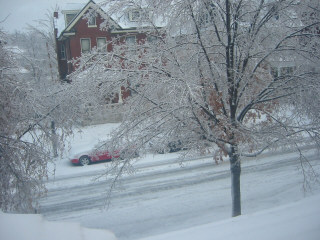
The view from my second-floor window this morning
The ice snapped trees and power lines in various parts of the area, and some households are without power. I feel for them. I remember well the four days we were without power last summer and it was awful. Add cold, short days and roads that are hard to navigate to the mix, and I know I’d be miserable.
But I do have power. And a powerful furnace. So I’m kind of enjoying hunkering in and looking at the beauty outside. The dogs aren’t even going to get walks because it’s too slippery. I wish I could call it a snow day and just knit and watch Grey’s Anatomy all day on DVD. But it’s a workday.
There’s something about it being nice inside and yucky outside that makes me want to nest. So today will be devoted to—wait for it—organizing! My office is once again in disarray. And the room where I store my knitting paraphernalia is also a bit out of control. So the plan is to regain control of my space (and in the process declutter my mind), make some progress on a couple of projects, do a book-related conference call, then knit. And knit and knit.
I’d love a warm wind to come along and melt all this after a couple of days (that’s not supposed to happen), but for the moment, I’m going to enjoy the view of the winter wonderland outside my window and count my blessings that I don’t have to leave the house to work today.
Do it tomorrow
I was a writer for many years (mostly magazine articles and books) and I couldn’t work without a deadline. The deadline would dictate when I started working on a story and, to be honest, there was usually a lot of procrastination involved.
Now I’m running an organizing business and there aren’t deadlines for marketing and professional development, essential but usually not time-sensitive tasks. That can pose a problem for me. But I’ve read a book that’s really made a difference for me. And its title appeals to my inner procrastinator.
That book is Do It Tomorrow and Other Secrets of Time Management, by Mark Forster. It’s an easy-to-read book whose main tenet is that much of what you need to do can wait until tomorrow. That allows you to put together what he calls a “will do” (rather than a “to do”) list—a closed list of tasks that you can actually accomplish in a day. When new things come in, add them to tomorrow’s (or another day’s) list. He urges you to accomplish the least urgent items on your will do list, allowing you to actually do those things that have been hanging around on your list forever. And he offers some great tips for starting and completing tasks.
I started implementing the ideas in the book about a month ago. It’s revolutionized the days that I don’t see clients. Sometimes those days would vanish into an Internet-induced haze where nothing measurable seemed to be accomplished.
Now, I actually have a list that I can realistically accomplish in a day. When I’m finished with one thing I move on, purposefully, to the next. I’m not constantly nagging myself about the things I should do—because I have a daily task diary I write those tasks in and I know when I will do them.
I’m not perfect so the system isn’t yet working perfectly. But it’s given me a sense of control over my time. And some great tools to work with to really feel I’ve mastered time management.
The book’s published in England and takes a little while to arrive from England if you order it through Amazon US. But it’s worth the wait. In the meantime, you can check out Mark Forster’s website, Get Everything Done and his blog to get a taste for what he’s talking about. You can read the first chapter of Do It Tomorrow on his website.
Froggin'
My first big project after I started knitting in 2005 (I knit as a kid, but hadn’t picked up needles in decades) was the Einstein Coat, from Sally Melville’s book The Knit Stitch. This is a multidirectional garter stitch coat. It’s not hard to do, but it’s a big task. I knew next to nothing about knitting, which was okay because it was all garter stitch (just straight knitting, no purling). But there was a little seaming involved, and picking up stitches.
I swear I knit a gauge swatch. Nevertheless, when I finally finished my Einstein Coat, the thing was more like a sweater than a coat. And the wrists were tiny. I’m actually a very small person—sometimes a size 2P shirt is too big for me. But this coat was too small.
I was quite disappointed. So I put it away in a closet. And I pretty much forgot about it. I chose to forget abut the $100 in Lamb’s Pride Bulky that I put into the thing, not to mention the three months of daily knitting.
But one day this fall I started thinking about all that great, feltable yarn tied up in that sweater, which was shoved into a closet. And I decided to liberate it. I borrowed a ball winder from my friend Lisa from my knitting group and last night I unraveled it—what knitters call frogging. Because of the way the sweater was put together, it wasn’t quite as easy to frog as I would have liked, but when it went well, it was very enjoyable. And now I have four big balls of Lamb’s Pride Bulky waiting to be transformed into felted bowls, boxes, maybe a purse, who knows.
Here’s the sweater right before I starting frogging it:
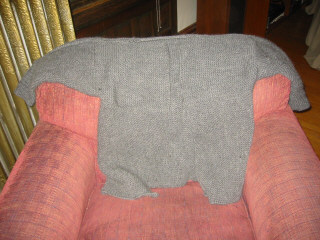
The Einstein Coat in its last moments
And this is as far as I got before I wearied of battling the ball winder:
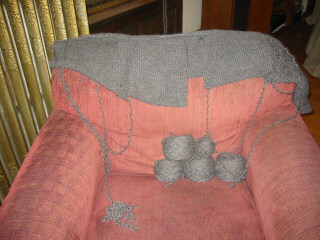
What's left of the Einstein Coat after frogging
I have to say that rather than feel let down by my failed Einstein Coat, I feel really good about reusing that yarn. I’m making lemonade out of lemons. And I’m saving money on yarn.
Now I have to think about what I’m going to do with the sweater I made from Debbie Bliss Cashmerino Super Chunky. It’s a gorgeous yarn but an ugly sweater—again, gauge and seaming problems. I think frogging might be in my future again…
The ritual of holiday cards
It’s November, so my mind starts thinking about the holidays and, more specifically, about holiday cards. My husband and I don’t really do Christmas, but I do always send out cards to a long list of people. For some of those folks, it’s the only time of year I communicate with them.
I’m over 40, I’ve been doing this all my adult life and the list keeps growing. By now, it’s swelled to about 175. On top of that, I have clients and fellow organizers to send a card too, which means I’m doing two sets of cards: business and personal.
There are basically four components to the whole card-sending process: the card itself, any picture I might include, a newsy newsletter about the happenings of the previous year, and the address label.
Before 2001, I wrote a note in each card with the news of the year. It took forever, but I liked the personal touch. But in 2001 there were some canine tragedies in our family and I didn’t want to have write about them over and over so I succumbed and did a newsletter. Wow, did that make life easier. I love receiving pre-printed newsletters from my friends because I’m always hungering for news of them. So I try to make our newsletter light-hearted and informative and I hope that people don’t mind the impersonality of it. Of course, I also hand write a signature on each one.
I’ve also automated the address labels. Because people’s addresses change, I try to stay up-to-date by fixing addresses in the mailing list file as soon as I get notice of an address change (usually because a card is returned or someone sends me a card from a new address). That way, when I sit down with last year’s address list it’s already been updated. Of course, I’m not perfect and sometimes things fall through the cracks.
It’s more fun to think about the card itself and any picture we might include. I used to have prints made of a favorite picture (in our case, it was always a picture of our pets) and put them inside a folded card. Then we discovered we can easily make beautiful folded greeting cards from our own picture, which is what we did a couple of years ago with a shot of Kirby taken by professional photographer Alice Su.
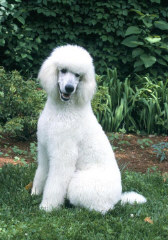
This photo of Kirby was our 2004 holiday card.
Last year we took the easy way out and made one of those rectangular photo cards using a beautiful picture of Joe, our cat, and a new year’s message. We didn’t even bother with a newsletter.
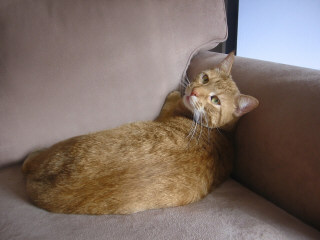
This picture of Joe relaxing was our holiday card last year.
But this year, I need to do a newsletter for our personal list and I want to do a folded card. I’d love to include a photo of all three animals, but that’s hard to make happen. They never seem to be close enough together to get a candid shot and if we force them together they look pained. In 2002, I managed to take an amazing candid shot of Pip and Joe, which looks posed but isn’t.
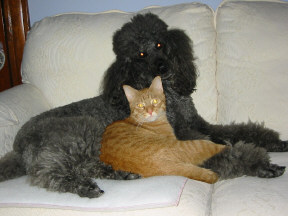
This candid photo was a big hit at Christmas 2002.
That was an insert in our holiday card that year.
So this year I had folded cards made of a photo of Pip that Alice Su took a couple of years ago. It’s Pip’s turn, after all.
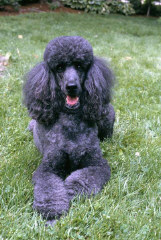
Pip's the star of this year's holiday card.
For my business cards, I’m using a black and white Ansel Adams images, with a vellum insert with my logo.
So what’s the point of this rambling? Good question. It’s that I’ve come up with a system, over the years, to make sending holiday cards a pleasure, not a chore. It boils down to this:
1. Plan ahead so you’re not on a time crunch
2. Come up with a card/photo
3. Update the mailing list and print out labels
4. Decide on paper for newsletter and order it (I like Paper Direct)
5. Write the newsletter and print it out on the special paper
6. Order holiday stamps
7. Address, stuff, sign and stamp
8. Enjoy the cards that stream in from friends
9. Update my mailing list as address changes come in
It sounds like a lot. But keeping in touch with people is really important to me. So it’s a task I enjoy and do mindfully.
If holiday cards are getting you down, try to think about why you do it. If you’re not getting anything out of it, maybe you should stop, or pare down your list. If you do want to send cards but just don’t have the time, you could automate the process. At Hallmark.com you can select a card, have a personalized message printed on it, send Hallmark your mailing list, and they’ll send out the cards for you. (Snapfish will do the same—and you can make a card out of your own photo.) You never even see the cards. That’s a bit impersonal for me, but it might work for you.
Search
Recent Posts
- Our 300th episode!
- Worth repeating: Figuring out what to watch on TV
- The power of incremental progress
- Podcast guest spot on the role of organization for folks with chronic illness
- No excuses series (part 3): "It was a present"
- No excuses series (part 2): "I paid a lot for that item"
- No excuses series (part 1): "But I might need it!"
Tags
About Janine

Hello! I’m Janine Adams — a certified professional organizer based in St. Louis, and the creator of Peace of Mind Organizing®.
I love order, harmony + beauty, but I believe that the way that you feel about yourself and your home is what truly matters.
If you’re ready to declutter with a purpose and add more ease to your life, you’ve found the right blog — and you’ve found the right company.
read more »Links
- Are you interested in becoming a professional organizer?
- Institute for Challenging Disorganization
- Peace of Mind Spending
- Getting to Good Enough podcast
- Ravelry
- NAPO St. Louis
- Shannon Wilkinson, life coach
- National Association of Productivity and Organizing Professionals
- Organize Your Family History