The magic of linking new routines to old
On New Year’s Eve day, the weather was unseasonably warm here in St. Louis (so warm we had a tornado!). At the risk of being indelicate, I’ll share that I spent some pre-storm time picking up the dog poop in our back yard. The snow had melted, revealing many piles.
As I performed this unsavory task, I vowed not to let so much time elapse between clean-up sessions. This is truly the kind of task made worse by volume. My problem was that I would be reminded to do it when I was walking to the garage to get in the car. I never seemed to think of doing it when I actually had time for the task.
But then inspiration hit. I thought about the other tasks I do daily that have made my life easier. I empty the dishwasher each morning as I’m making coffee. I wipe down the fixtures in the bathroom after I finish flossing daily. Maybe I could link poop scooping with another daily task. Then I wouldn’t forget to do it.
I came up with a brilliant plan (if I do say so myself). I walk my dog, Kirby, every morning. And I take poop bags with me. So I decided to link the daily walk with the yard clean up. Now, we come home from a walk and while I still have my coat on, I go right to the back yard and scoop. It’s just one days worth of waste so it takes almost no time. I go out the back gate to the dumpster in the alley, throw away the bag, and I’m done.
I upped the ante a little by adding scooping the litter box to the mix. On my way through the house to the back yard, I stop at the Joe’s litter box and empty the compartment into a poop bag (we have a Littermaid litter box that automatically rakes itself into a compartment that should be emptied daily). I proceed with the cat waste to the back yard, add dog waste and throw it away.
It takes less than five minutes. Today is Day Six and I haven’t forgotten yet. If I keep it up I’ll never have to face the nasty task I faced on December 31.
I think this technique of linking a new routine to something you’re already doing daily can be really effective. Add accountability (I created a habitforge chain for this task, for extra satisfaction), and it can be very powerful.
If you have a New Year’s Resolution that involves daily activity, perhaps you can see if you can link it something you do every day anyway. Let me know if it works!
The debut of the Institute for Challenging Disorganization
As of January 1, 2011, the National Study Group on Chronic Disorganization (NSGCD) is now officially the Institute for Challenging Disorganization! The NSGCD board voted on the name change in July. The tagline Education. Research. Strategies. was approved in September and the new logo in November. Here it is:
We also have new website to go with the new name.
The new name represents new opportunities for growth for this important organization. I’m proud to serve on its board of directors and even more proud to have received really valuable much education through it.
As marketing director, I’ve been working on implementing the name change for the last few months, so I’m used to the new name. Believe me, ICD is much easier to say (and remember) than NSGCD! I’m very excited for this new chapter in our growth.
Starting the year with a clean inbox
Last night, I reached the elusive Inbox Zero. That’s right, I emptied my email inbox. This isn’t to say I don’t have any email messages. It’s just that they’re filed away in folders (or “mailboxes” in Mac Mail parlance).
For the last couple of years I’ve been working on creating the habit of having no more than 15 emails in my inbox at the end of the work day. These are emails that either require some action or, sometimes, just remind me of action I need to take. Keeping them pared to 15 (an effort supremely enhanced by my accountability buddy, Aby Garvey, who is working on the same goal) is hugely helpful. It keeps me on task and keeps things from falling through the cracks.
I had more time at my desk this past, so I pared my email inbox down below 10 on New Year’s Day. Then yesterday, I decided to go for zero. There were a few emails that had been lingering in my inbox for months. These were non-urgent things that I wasn’t ready to let go of the idea of doing. But guess what? Yesterday I did ‘em.
It’s a great feeling to be at zero. Once things start heating up again, I imagine the inbox will creep toward 15. But perhaps in 2011 I’ll work toward keeping my inbox to 10, rather than 15. I don’t think zero is a realistic daily deadline.
Highlight reel for 2010
On this day last year, I posted my highlight reel for 2009. For me, it’s a fun way to reflect on the past year (and remind me a year later what went down), so I’m trying it again for 2010.
Here are some the highlights of my 2010:
I created products! In August, I debuted my Organizing Guides as well as my Make Peace with Your Mail e-course. In addition to creating the content for these products, these projects required me to flex my brain and learn the technology side of e-commerce, so it feels like a real accomplishment. Now I’m all set to create more products.
I gave meaningful talks. I love talking with audiences about decluttering, organizing, and letting go of stuff. I had the chance to speak at some great places this year, including Thomas Dunn Memorials. After that class on letting go of stuff, the executive director, Kathy Bangert, sent me an email that made my heart sing. She wrote, “I hope you feel as fulfilled as I feel about today’s class. You (we) really made a difference in these people’s lives!”
I became marketing director of an organization that’s very important to me. The National Study Group on Chronic Disorganization has given me invaluable education and networking opportunities. I was honored to be asked to join the board of directors. I started in July and got to jump in with both feet as a new name for the organization was selected, then implemented. As of tomorrow, NSGCD will be the Institute for Challenging Disorganization!
I passed the reins of NAPO St. Louis to a great president. I was president of the St. Louis chapter of the National Association of Professional Organizers for almost three years. In May of 2010, I became immediate past president as Tiffany Engler, CPO® took over as president. She’s done an amazing job and is a fantastic leader.
I received my Hoarding Specialist certificate. Working with people who hoard is tough, but fascinating. I loved learning more about hoarding on my way to earning the new Hoarding Specialist Certificate from the NSGCD (soon to be ICD). I took classes, read books and passed a test and am proud to be among the first group of organizers with that credential.
I led some terrific teams. I love working with other organizers and this year I was able to lead teams of organizers who did some wonderful transformations. That is so much fun.
I found a steady paycheck. At the end of 2009, I felt that my income was too unpredictable. I was able to quickly find a terrific part-time job to make things more steady. Since January 21, I’ve worked two days a week for the International Institute of St. Louis, a wonderful non-profit that helps newly arrived refugees and immigrants. The Institute also puts on the terrific Festival of Nations every summer. Believe me, the Festival is an organizational feat. Helping with it was one of my primary duties. I feel really fortunate to have found a job I enjoy with a terrific organization that does so much good.
Here’s to a fabulous 2011.
habitforge: another tool for creating habits
I’m a big fan of accountability and I love trying out tools to help me stay accountable to goals or establish new routines. I’m crazy about Don’t Break the Chain, which I’ve blogged about repeatedly.
I was less crazy about StickK.com, a website that uses a stick (rather than a carrot) to get you to do what you’ve set out to do.
For the last ten days, I’ve been using habitforge to help me create the routine of putting my clothes away properly at the end of the day (something I’ve had trouble with for years). I’ve found it very motivating.
With habitforge, you set a goal or commitment and for 21 days (the amount of time that conventional wisdom says it takes to build a habit, though I quibble with that), habitforge sends you an email asking whether you were successful the day before. In the email you click Yes or No. When you click Yes, your’e taken to this screen:
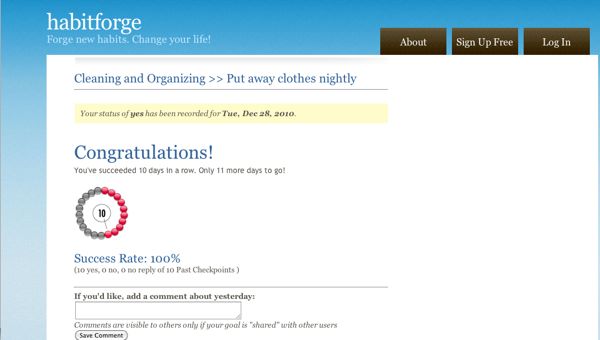
My habitforge screen today
If the answer is No, you start back at Day One. (I’m assuming the screen looks similar, though I haven’t yet clicked No.)
I have to say that over the last ten days, knowing I’m going to be receiving this email has motivated me to throw my clothes down the laundry chute or put away ones that I can wear again. (The default behavior has been to leave the clothes on top of my bureau in a messy pile.) I like that habitforge comes to me—I don’t have to remember to go to a website like I do with similar services, like Joe’s Goals. Whether the habit will be ingrained in 11 more days remains to be seen. If it’s not, I can always set up another 21 days of emails.
Habitforge is great for daily habits. Obviously, it won’t work well for something you want to do, say, three days a week. But if you have something you’d like to do daily in the new year, I encourage you to give it a try!
A study in contrasts
I had a couple of customer-service experiences in December that have given me food for thought.
First the good:

I purchased my holiday cards from Paper Source, the fabulous online store. I needed more cards and placed a second order in early December. I received a shipping notification, but left town to visit my parents a few days later and didn’t notice the cards hadn’t arrived.
When I returned and discovered no cards, I checked the UPS tracking site and saw that they’d been left on the porch. It was apparent that the package was stolen from my urban porch (the first time that’s happened in 19 years of living here).
So I called Paper Source, explained the package had been stolen and asked what could be done. The kind customer service agent offered to send them to me again, overnight, at no charge.
I was blown away. The company was at no fault, yet they were willing to invest about fifty dollars in creating an extremely happy customer. The box arrived the next day as promised, with a hand written note inside saying how sorry they were that the package had gone missing.
Contrast that story with this one:
I ordered a wireless headset for my landline from 101phones.com. It arrived a week later with a part missing that rendered it unusable. I called the company and was told I’d have to return it for exchange, which meant it would be another week before I’d have a working headset. The kicker: I would have to pay for shipping to return it. They messed up, I’m paying for shipping. I argued. They insisted. I was angry. So I asked for a refund, rather than an exchange. I’ll never shop there again.
Paper Source invested fifty dollars and got a raving fan in return. 101phones.com wasn’t willing to invest five dollars to pay for shipping the return and therefore lost the sale and the customer. They’ll never get an order from me (or probably anyone who reads this).
For my business, I want to be Paper Source.
I have policies for my business that provide important boundaries and accountability for my clients. But I do make exceptions on occasion and this customer-service experience will help inform those exceptions.
I’ve never been one to nickel and dime clients, and Paper Source has taught me what an impact that can have.
So there’s a business lesson here, but mostly I just wanted to tell you how much Paper Source rocks. If you need beautiful paper products, by all means shop there.
Change
Change is hard. But it’s not necessarily bad.
I was reflecting on this in light of the passing of my 12-year-old standard poodle, Pip, on October 27. Her death, from cancer, was swift. She died just two weeks after a tumor was discovered. Within a week of that discovery, we knew how extensive the cancer was and that there was nothing we could do. She didn’t seem to suffer much and she didn’t leave us any question that it was her time.
When you have an ill or aging dog, you can’t help but think about what life will be like without her. Sometimes it’s unbearable to even think about it. (And, indeed, probably the worst thing about having dogs is the near-inevitability that you’ll experience life without them.)
Learning Pip’s diagnosis, watching her decline, and then letting her go was really difficult. In that time, I fretted over what life would be like without her, particularly for Kirby, our seven-year-old standard poodle who is somewhat insecure and who had never known life in our home without Pip.
But here it is almost two months later and I’ve begun reflecting on the fact that there have been some positives about this change. First, Kirby is doing amazingly well. He seemed to say his goodbyes to Pip a couple of days before she died. He was there at the time of her passing (our wonderful vet, Patrick Tate of Webster Groves Animal Hospital came to our house to do the euthanasia) and he carried on well afterward.
As our grief subsided, the positives started to emerge. With our senior citizen dog gone, our walks with Kirby have become faster and longer. I’m able to work on training him during walks, now that I have an extra hand. (And we both love that.) Pip was very sound sensitive and would bark at the sound of a car door slamming. Kirby would react to her bark and carry on as well. Now Kirby sleeps through some of those little triggers, so our house isn’t as noisy. Taking one dog along on errands, like trips to the airport, is easy. With two, it was a hassle and usually didn’t happen. And, of course, one dog is much less expensive than two. (The food, treats, and grooming add up.)
Please don’t take this to mean I’m not sorry Pip is gone. I miss her terribly. But it’s caused me to reflect on an important aspect of change. It’s something we often dread, but there can be good aspects to it, when we pause to consider them.
If you’re facing some change and find the prospect unsettling, perhaps you can consider the up side to the change that’s about to happen.
I’d like to close this with a picture of Pip (she’s the grey one) and Kirby (who’s white) playing with my friend, Sally’s border collie-great pyrenees cross, Amos, at the dog park a few years ago. We miss you, Pip!

Search
Recent Posts
- Worth repeating: Figuring out what to watch on TV
- The power of incremental progress
- Podcast guest spot on the role of organization for folks with chronic illness
- No excuses series (part 3): "It was a present"
- No excuses series (part 2): "I paid a lot for that item"
- No excuses series (part 1): "But I might need it!"
- Retiring the New Organizer Guides
Tags
About Janine

Hello! I’m Janine Adams — a certified professional organizer based in St. Louis, and the creator of Peace of Mind Organizing®.
I love order, harmony + beauty, but I believe that the way that you feel about yourself and your home is what truly matters.
If you’re ready to declutter with a purpose and add more ease to your life, you’ve found the right blog — and you’ve found the right company.
read more »Links
- NAPO St. Louis
- Peace of Mind Spending
- Institute for Challenging Disorganization
- Shannon Wilkinson, life coach
- Ravelry
- Getting to Good Enough podcast
- Organize Your Family History
- National Association of Productivity and Organizing Professionals
- Are you interested in becoming a professional organizer?