Three quick projects: great advice from Unclutterer
One of the themes of Declutter Happy Hour, the e-course I offer with life coach Shannon Wilkinson, is to capture small blocks of time to work on decluttering.
Today’s blog post from the fabulous Unclutterer fits that theme nicely. In Three quick organizing projects you can do right now Erin Doland suggests several three-to-five-minute decluttering projects.
I love this! If we just snatch little tiny bits of time we can chip away at the clutter and pave the path for easy living.
Be sure and read the comments on this post—savvy commenters suggest other micro-projects you can do.
Thanks, Erin!
Peter Walsh's new "you·organized" collection
As I’ve made no secret, I’m a unabashed fan of Peter Walsh. A professional organizer and author, Peter was on TLC’s Clean Sweep and can now be seen on Oprah cleaning up America.
He’s also been busy developing products with Office Max. I blogged about his paper-management system called [IN]PLACE, which I love (and use). Now he has a new collection called you·organized that consists of a very affordably priced all-in-one desk collection (a desk, file storage ottoman, desk caddy, file sorter, and charging station for under $200!) as well as a series of wall-mounted boards for visual organizing. I’m very excited by this stuff, though I haven’t yet seen it in person.
I had the opportunity to interview Peter on Wednesday for this blog. I was really excited to get the scoop on this new collection straight from the horse’s mouth. I spoke with him on the phone and could see him via a web link as he responded and demonstrated features of his new products. Click below to watch the video.
Here are some photographs in case you’re itching for another look:
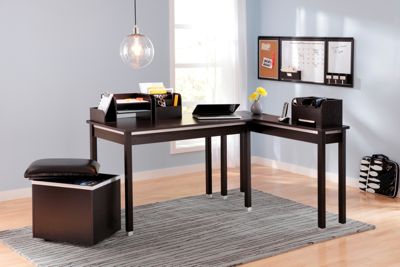
The desk collection helps create zones.
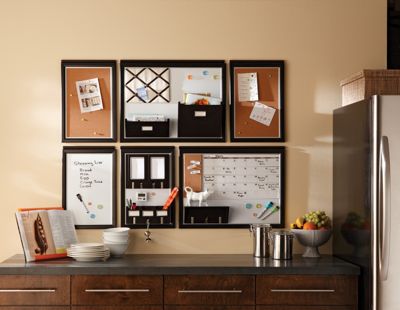
Vertical organizers make use of wall space.
Peter promises new additions to this collection at the beginning of next year. I’m really happy to see well-thought-out, good-looking and affordable organizing supplies to help us help our clients. And how charming of him to reach out to bloggers to help us spread the word!
Rubbermaid video tip
At the NAPO conference last week in Columbus, the good folks at Rubbermaid had a video camera set up in their booth and they asked professional organizers to share their favorite tips.
They put the videos up at YouTube and shared the links through Twitter. I was happy to record my tip (which was about storing food-storage containers). Here’s the video. You can tell it was a busy trade show!
I think my favorite part is my friend Terry Capehart of Your Life Organized in the background suddenly noticing that she knows the person doing the video tip.
To view all the professional organizers’ videos, visit Rubbermaid’s NAPO 2010 Organization Tips YouTube playlist.
You don't have to do it alone
Having just spent four days with professional organizers, who are among the most supportive and helpful groups of people I can think of, I’m pausing to think about how important support is.
Before I became an organizer, I struggled with creating systems for getting my messy self to stay organized. I bought, read and learned from many books on organizing. (My friend, the Mississippi garden writer Felder Rushing once looked at my bookshelf and drawled, “Janine, you’d have a lot less clutter if you’d just get rid of these books on clutter.”)
But since I’ve become an organizer, I’ve seen that what I bring to the table (and I’m sure this is true of my colleagues) is not just expertise. It’s support. If all you need is expertise, then reading about a topic might be sufficient.
But when it comes to organizing and dealing with clutter it can be really hard to get started on your own. That’s where finding a buddy or a professional to help can make a big difference.
By hiring a professional organizer you:
- Make a time commitment to working on your organizing goals
- Make a financial commitment, which can be very motivating
- Become accountable to someone
- Benefit from the organizer’s expertise
- Have some fun with it, because you have company
I know that not all my prospective clients can afford my one-on-one rates. That’s one reason I developed Declutter Happy Hour with life coach Shannon Wilkinson. With this e-course (which started as a teleclass), participants receive help and support from us at a lower fee.
I’m working on another e-course (the first of many, I hope) that will launch soon that has a live support option built in. (This class will help you deal with your mail.)
If your clutter or organizing challenges feel like more than you can handle alone, don’t be afraid to reach out for help. If you can afford one-on-one help with an organizer, believe me it will be worth the investment. If you can’t, look around the internet…there are some great lower cost options that can still give you the support you need.
Off to organizers' heaven!
I’m leaving this morning for Columbus, Ohio, to attend the annual conference of the National Association of Professional Organizers. This will be my fifth NAPO conference in a row and I’m as excited as ever.

There will be hundreds of smart, friendly, interesting organizers there to talk with. There’s an expo of organizing products (be still my heart), there are amazing educational sessions. The chance to see old friends and make new ones.
This year I actually contemplated not going, since 2010 is the year that I’m investing in my business by not spending money. But I just couldn’t stay away. And I know that the payback will be great.
I’ll return on Saturday night tired, but energized and empowered. I’ll face head on the challenge of doing conference follow up while trying to catch up with goings-on in my absence. I love this stuff.
I hope to blog on Friday from the conference.
On discipline
Discipline is an interesting word, isn’t it? When it’s used to express how one person interacts with another (a parent disciplining a child, for example, or an employer disciplining an employee), it has negative connotations. It’s no fun to have someone discipline you and, I can imagine, it’s not fun disciplining someone else.
But when you apply it to yourself—that is, when you have self-discipline—it has positive connotations. At least it does to me. In fact, as a fairly lazy person, self-discipline is something I strive for. And the older I get, the easier it is to achieve.
I was talking with a friend the other day who said that her dentist sometimes reprimands her for not flossing. So I asked her why she didn’t just floss, rather than be subject to reprimand. I pointed out that flossing is good for her gums. It seemed simple enough to be me, but that’s because I’ve developed the habit of flossing daily (and I have a childhood-based fear of being yelled at by the dentist).
Born organized people can’t understand why clutter-prone people don’t just pick up their stuff. To them, it’s natural and takes neither effort nor thought. But for cluttery people it’s another story. It takes effort and forethought. Or it least it does until a habit is created to make it automatic.
Creating a new habit takes self-discipline. But it can be so worthwhile. Say you have an area in your home that attracts clutter, one that bugs you every time you look at it. Even though it bugs you, it’s hard to muster the energy to deal with it. (I’m speaking from personal experience.) Here’s my suggestion: Try focusing in on that one spot and creating a habit to keep it clutter-free. Tell yourself you’ll put stuff away every time the thought goes through your head that you need to. Or, even better, create the habit of clearing that spot on a daily basis. Maybe before bed. Or before dinner. Or after dinner. Just make it a habit.
I’ve written here before about some great tools that can help you create the habit. My favorite is Don’t Break the Chain . I’m successfully using the Don’t Break the Chain method at the moment to create the habit of properly dealing with my clothes every night after I take them off, rather than piling them on the dresser.
Self-disclipine. It’s a beautiful thing. Use it to get a new habit going. Once that habit has become automatic, use your mighty power of self-discipline to create another. This is how I, a naturally messy person, have managed to live with less mess.
Extreme small-space storage solutions
File this under “Only in New York.” Via Twitter, I saw a link provided by Sharon Lowenheim, the Organizing Goddess, to a New York Post article about people who use their refrigerators and ovens to store clothing. Storage space is at such a premium in tiny NYC apartments and these people never cook, so this makes sense to them.
I wanted to share the article, since it made me shake my head in wonderment. It’s a great example of why I love Twitter is. You get to find tidbits like these that you might not find any other way.
If you’re not on Twitter, I encourage you to check it out. And if you do sign up, follow me!
Search
Recent Posts
- Worth repeating: Figuring out what to watch on TV
- The power of incremental progress
- Podcast guest spot on the role of organization for folks with chronic illness
- No excuses series (part 3): "It was a present"
- No excuses series (part 2): "I paid a lot for that item"
- No excuses series (part 1): "But I might need it!"
- Retiring the New Organizer Guides
Tags
About Janine
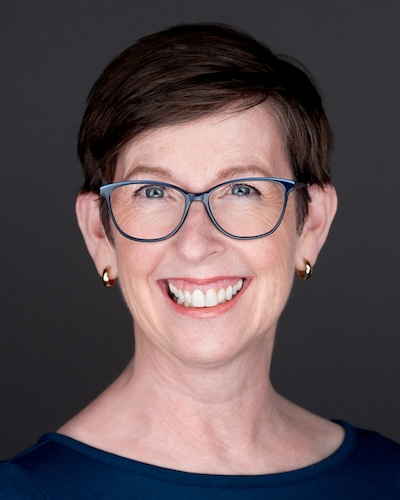
Hello! I’m Janine Adams — a certified professional organizer based in St. Louis, and the creator of Peace of Mind Organizing®.
I love order, harmony + beauty, but I believe that the way that you feel about yourself and your home is what truly matters.
If you’re ready to declutter with a purpose and add more ease to your life, you’ve found the right blog — and you’ve found the right company.
read more »Links
- Organize Your Family History
- NAPO St. Louis
- Shannon Wilkinson, life coach
- Getting to Good Enough podcast
- Peace of Mind Spending
- Are you interested in becoming a professional organizer?
- National Association of Productivity and Organizing Professionals
- Institute for Challenging Disorganization
- Ravelry