Knitting Olympics: Half-way there!
I promise I won’t write about knitting every day during the Olympics. I’m just so pleased with my progress that I have to report it. Tomorrow I’ll try to write something relevant to organizing.
I’m happy to report that I since Friday morning I’ve finished and blocked three lace squares. I thought Square 51: Faggoting and Fancy Rib was gonna kill me…it’s the one that made me give up on the project for almost a year. I think I started over on it about six times and at one point had to unravel eight rows after I realized I’d made a fatal error. Happily, the other two squares were easier, probably because I used lifelines, which I didn’t actually end up needing.
Here are photos of the three I completed this weekend.
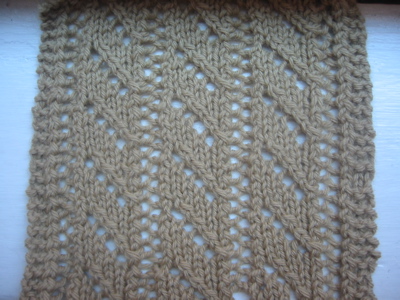
Square 51: Faggoting and Fancy Rib
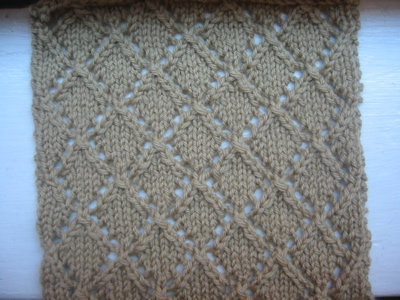
Square 52: Lace Diamonds
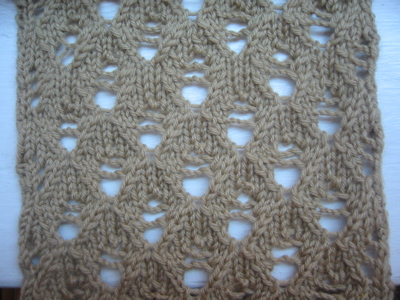
Square 53: Bumblebee Pattern
I’m halfway through the fourth lace square, well on my way to achieving my goal!
The games have begun!
The 2008 Summer Olympics started today with the Opening Ceremonies at 8 p.m. Beijing time. That’s 7 a.m. in St. Louis, my official start time for the Ravelympics 2008. More than five thousand (5,651 to be exact) knitters and crocheters have signed up, taking on the challenge of completing a project of their choice during the Olympics.
I set my alarm for 6:15 and was up, morning routines completed and caffeinated by 7:00. At exactly that moment I turned on the Today Show (it appears the Opening Ceremonies won’t come to my tv before this evening) and heard the Olympic Anthem. I cast on 32 stitches for Square 51 (called “Faggoting and Fancy Lace”) of the Learn-to-Knit Afghan and within 15 minutes had knit two rows, unraveled both and cast on again. By 8:00 I had completed one pattern set of eight 8 rows, though I’d had had to unknit and reknit a few rows to get there. This reminded me of why I’d put down the lace section of this project on more than one occasion.
I stopped to walk the dogs and post here, but I’m jazzed to get back to it. I’m fully confident I’ll complete the lace section of the afghan by the end of the Olympics.
I took some pictures of some of the squares I’ve made over the past 2.5 years of working on this afghan. I’m going to share, but first let me remind you that some of these squares were knit years ago, before my technique improved.
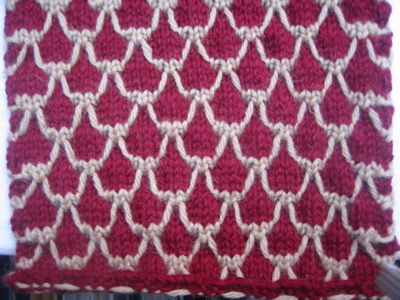
Square 20: Scale Quilting
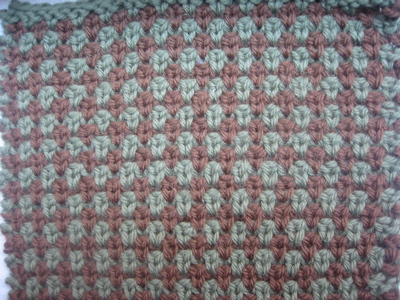
Square 8: Rose Fabric
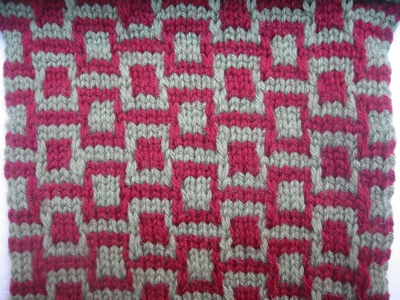
Square 9: Horizontal Chain
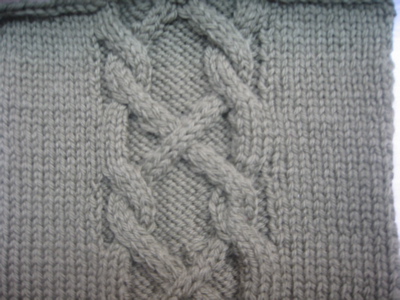
Square 35: Lacing Cable
I’ll plan to post the lace squares as I finish and block them.
What's stopping you?
Most of my clients have a to-do list for organizing tasks. (Some clients can’t figure out where to start, but we take care of that in the first session.) At the end of a hands-on organizing session, we talk about what they plan to do between sessions to further their goals.
When I arrive at the next session and ask for an update, chances are pretty good that they didn’t do the things they thought they would. Why is that?
Of course there are many reasons. Sometimes getting organized, or decluttering, is highly emotional. Some of those clients just can’t do it on their own. But often it’s more mechanical than that.
Take something as simple as sorting the mail as it comes in and getting rid of the junk mail. For some people, the mail is scary. There may be notices from creditors, reminders of past failures, fear that a spouse will see a credit-card expenditure. That pile of mail becomes emotionally charged and it’s easier to just tuck it away or ignore it. Even though the client’s rational mind knows they’re just delaying unpleasantness and undermining their efforts to get organized, her irrational mind wins. Getting past these types of issues can require the help of a therapist or a great life coach or, sometimes, a terrific organizer.
More often, though, there are no emotions involved with the mail. Maybe a little obstacle is getting in the way. I like to work with clients to identify those obstacles. Sometimes it’s surprisingly simple. In the case of the mail, it may be that the client knows that credit-card offers need to be shredded, but the shredder’s in a different room. Or the desk where she’s sorting the mail isn’t near an outlet, so the shredder’s across the room. Rather than walking to the shredder, she’ll put down the pile and say, “I’ll shred this later.” So the piles persist and multiply.
The solution? Move the shredder or move the area where mail is processed (or both), so the two are near one another. Same goes for a trash bin or a recycling bin. Have the necessary tools nearby, to make accomplishing the task as effortless as possible.
This hit home to me recently when I set out to sort and weed the guest-room closet, which typically houses bedding and fancy dresses and shoes that aren’t worn often. I was up for the task when I discovered that the closet’s light bulb, which is way out of reach in a high ceiling, was burned out. That required my getting out the step ladder, finding a light bulb and changing the bulb. By the time I contemplated that, my enthusiasm for the project waned. And guess what? It didn’t happen that day. (It eventually happened and the closet looks great.)
The solution? One option is to muster up a “just do it” attitude and get out the step ladder and light bulb and carry on. Another is to store the stuff where you use them. In our case, we have a big house so we purchased an extra step ladders and more light bulbs so that we’d have them on each floor. That way, we lessen the risk of putting off the job out of a reluctance to run up or down the stairs for the item.
If you’re faced with an item on your to-do list that never seems to get crossed off, ask yourself why. If it’s something that you know would further your goals, see if you can identify the obstacles to your doing it, then address those obstacles.
In his book, Do It Tomorrow and Other Secrets of Time Management (link at right), Mark Forster offers all sorts of tricks to overcome obstacles to productivity. I blogged about his advice for getting started and keeping going on projects. It’s interesting reading.
Christine Kane's Blog: Blog of the Week
This week’s Blog of the Week isn’t an organizing blog per se, but it’s full of fabulous, inspiring information that can certainly be applied to organizing (and professional organizers).
Christine Kane is a singer/songwriter whose blog encourages living creatively and consciously. She took a leap of faith when she decided to pursue her music career. In the process, the things she learned about herself, the shifts, the revelations, all became fodder for helping others. So, in addition to creating music, she writes and speaks about personal development, encouraging people to act in spite of their fears.
Today’s post, “Expand When You’re Tempted to Shrink,” about expanding your business (or your life) in the face of contracting economic times (in other words, taking risks in the face of constant doom-and-gloom from the media), really spoke to me.
In addition, her recent post, How to be an Extreme Encourager is very powerful. (And don’t miss her follow-up post, The Anatomy of Extreme Encouragement). As a professional organizer, I know how important encouraging my clients is and I really enjoyed her guidance on how to encourage effectively. Personally, I’ve been the lucky recipient of some extreme encouragement as well.
I’ve just started reading Christine’s blog but plan to make it a daily visit. I’ve started digging into the archives a bit and especially enjoyed this post on creating a vision board, something I’ve been meaning to do.)
By the way, if you visit the blog, be sure to download her free song, The Real World, which I’m listening to as I write this. It’s lovely.
I'm melting!
It’s hot and humid here in St. Louis. Yesterday’s high was like 98 with a heat index of 112, according to the local paper. We have central air, but our a/c is having a hard time keeping up with this heat.
Today’s supposed to be just as bad. In fact, there’s a heat advisory in effect until 7 pm.
The result? After spending the morning with a client whose air conditioning is even spottier than mine, my brain’s a bit scrambled. I thought of going to a movie to cool off, but I think I’m going to try for a nap.
So that’s my explanation for this poor excuse for a blog post. I’m off to vote (we have a primary here) and then, if I’m lucky, I’ll take a siesta.
With any luck, I’ll have something more meaningful to write tomorrow!
Who needs to check a bag?
Over at Unclutterer today, professional organizer Monica Ricci has written a guest column about travelling light. She offers some great tips on packing so that you don’t have to check a bag and incur extra charges.
I have one little tip to add to hers. Monica recommends not carrying liquid toiletries like shampoo and conditioner and rather using those provided by the hotel. I know that I can’t always count on my hair looking great if I use another shampoo, so I like to carry my own. I purchased at Bed, Bath and Beyond this great carry-on bottle kit. It’s a quart-size zippered vinyl cosmetics bag that holds 15 small (all under 3 ounces, of course) containers for various lotions and potions. It even includes three small spray bottles. My favorite part is that it contains 36 pre-printed labels so you can easily label the contents of the clear containers. All this for only ten bucks (or less if you use the ubiquitous BBB 20 percent off coupon).
If you have any travel in your near future, do check out Monica’s Unclutterer article. I’ve always been one to check a bag because I don’t like hoisting my carry-on into the overhead bin (I’m petite), but armed with this info from Monica, I think I’ll give it a try on my next tripl
Get organized. Lose weight.
Organizer Peter Walsh received a lot of press earlier this year upon the release of his book, Does this Clutter Make My Butt Look Fat? that explored the connection between getting organized and losing weight.
One of my favorite organizers in the world, Geralin Thomas, of Metropolitan Organizing was making this connection before Walsh’s headlines. Her organizing work with a couple of clients who, between the two of them, lost more than a hundred pounds in the process, was highlighted earlier this month in an article on Lifetime TV’s website. The article is called Get organized and get thin: How controlling the clutter in your life can help you lose weight.
If you’re dealing with both weight and clutter issues, this is a must read. It offers concrete advice from Geralin (with feedback from he clients) on creating new habits that can lead to both organization and weight loss.
Congratulations, Geralin!
Search
Recent Posts
- Worth repeating: Figuring out what to watch on TV
- The power of incremental progress
- Podcast guest spot on the role of organization for folks with chronic illness
- No excuses series (part 3): "It was a present"
- No excuses series (part 2): "I paid a lot for that item"
- No excuses series (part 1): "But I might need it!"
- Retiring the New Organizer Guides
Tags
About Janine

Hello! I’m Janine Adams — a certified professional organizer based in St. Louis, and the creator of Peace of Mind Organizing®.
I love order, harmony + beauty, but I believe that the way that you feel about yourself and your home is what truly matters.
If you’re ready to declutter with a purpose and add more ease to your life, you’ve found the right blog — and you’ve found the right company.
read more »Links
- Institute for Challenging Disorganization
- Shannon Wilkinson, life coach
- NAPO St. Louis
- Getting to Good Enough podcast
- National Association of Productivity and Organizing Professionals
- Are you interested in becoming a professional organizer?
- Ravelry
- Peace of Mind Spending
- Organize Your Family History