Stop thinking about it: Do it!
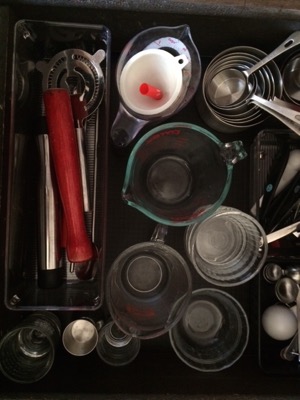
My newly lined drawer
Do you have little organizing projects around your house that are constantly taunting you? Do you walk through a room, see a pile and say to yourself, “I need to file.” Then just keep walking?
I do that all the time. It’s such a waste of mental energy when I could just do the task, rather than thinking about it. This really struck home this weekend. I had two little tasks (get my food storage containers in order and line a couple of kitchen drawers with non-skid drawer liner) that I have been telling myself to do for ages. I bought that drawer liner—and left it in plain sight!—a couple of months ago.
So yesterday, I promised myself I’d accomplish these two tasks. And do you know how long it took? Less than five minutes each. Seriously, the food-storage containers took a minute. A minute! And lining the drawers with this super easy Zip ‘N’Fit liner took five minutes. And now my drawer dividers don’t slide around. It’s a great thing.
Take a look around your house. Are there little tasks that you keep meaning to get around to doing? Do one of them! Or set a timer and do one of them for just ten minutes then come back it later. (That’s what I need to do with some filing.)
It’s crazy how I let these tasks tweak my brain rather than just relieving my brain by accomplishing the task. I think my motto this week is going to be *Just Do It!&
Transpose helps you create forms easily

I love creating forms and have been making them for years. I used to use Word, then I moved to Excel. But now I have a much easier way to create forms: Transpose.
This free website is a drag-and-drop form creator. It started its life as an Evernote extension called KustomNote and has branched out on its own. with a new name. I’ve used Transpose to create a dozen form templates so far, four of which I use on a regular basis. Here are some ways I’ve used Transpose:
- I created a form for my independent contractors (ICs) to fill out after a client appointment.
- I created two different forms I use for my own task management
- I created three forms for helping me keep track of genealogy data
- I created a blog post planner
- I created an inventory form for the containers I take to clients’ homes
When you create a form, you can create a link to it to share with others. For example, I sent a link to my ICs and they just click n the link and fill out the form, which ends up in my Transpose account. I can see using Transpose to create a form for clients or others to fill out. (Right now I send a feedback survey to clients through Fluid Surveys…I may shift to Transpose.)
So far, I’ve just scratched the surface with Transpose. When you fill out your forms (or have others fill them out), you’re creating a database, which I have not taken advantage of much yet. It has real potential as a contact management system. You can add all manner of fields in your forms that I haven’t even touched yet. Transpose seems to have a lot to offer.
Another terrific feature of Transpose is that you have option to make your form templates public. It’s a great way to share your form template (as oppose to just a fillable form) with others. And those public templates are a great way to find new forms to adapt for your own use.
So far, I’ve made four forms public.
I encourage you to check them out and also to “browse the public templates” that Transpose has available. There’s some great stuff out there. (I’m currently trying out 5 minute journal, which I find very appealing.
Of course, Transpose has an iOS app, so I can use it on my iPhone and iPad. (An Android app is in development.)
I’ve just been playing with Transpose for less than two months, but I’m really excited by the potential! I’m sure I’ll write future blog posts about Transpose as I delve further into its capabilities.
Introducing Operation: Relocation!
One of the many rewarding things I do as a professional organizer is help clients move and settle into their new homes. Since I have amazing team members at my disposal, I can put together a team that can help clients get their new homes unpacked and organized within just a few sessions. That takes away so much of the stress of moving.
On a recent unpacking/organizing project I noticed (we all noticed!) that our work was hampered by the poor labeling that the mover’s packers did of the boxes. Boxes had labels that had little to do with the actual contents. As a result boxes were placed in the wrong rooms in this large house and it hampered our productivity and effectiveness. (We thought we had everything that belonged in a room and more would show up.)
It got me thinking that I could make moving a lot easier if I were helping on both ends of the move. So I decided to formalize it as a service offering and have created OPERATION: RELOCATION. (That’s a play on my main service offering, OPERATION: PEACE OF MIND.)
If you have a move in your future, I encourage you to check out the services my team and I can provide to make your move so much smoother!
How do you relax?
I think regular rest and relaxation is very, very important. It’s so easy to get caught up in work and chores and family and never take time for yourself. That’s particularly true, I think, when you struggle with disorganization and feel like you should spend all your spare time “getting organized.” (That’s a fallacy, of course.)
I think it’s wonderful when we can have some sort of outlet that allows us to relax. That can be going to movies, doing crafts, meeting with friends, exercising. For the last ten years or so, that outlet for me has been knitting, which I can do while I watch tv. But in the past year or so, I’ve been knitting less and less. I’m not sure why; I think I just needed a break. I suspect I’ll get back to it when the weather gets colder.
Recently, I’ve hopped on board the coloring craze. I had no idea that coloring books were being produced for grown ups. Their designs are more intricate than what we remembered coloring as kids. I visited a friend who had a coloring book she kept for relaxation, I jumped at the chance to color again.
When I got home, I went on Amazon and bought a coloring book called Creative Coloring Inspirations, by Valentina Harper and a set of Prismacolor Premier colored pencils.
Here are some of the favorite pages I’ve colored. Even though my husband makes fun of me a little, I find it very relaxing to consider the colors to use and to gently color in the shapes. I also love that I get a little twinge of satisfaction when I finish a page.

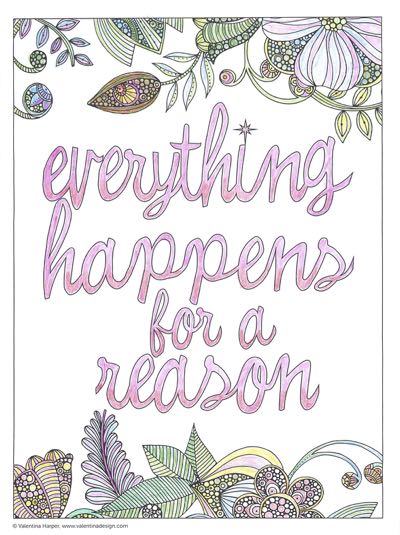

(These are all done with Prismacolor Premier pencils, though I’ve just ordered a small set of Tombow art markers to play around with.)
I’ll be starting a new knitting project soon, I’m sure. But in the meantime, I’ll continue with my coloring. Yesterday, I ordered Sonic Blooms from St. Louis artist (and friend) Kat Kissak’s etsy shop. And next month I think I’m going to order this Secret New York coloring book when it comes out.
What about you? What activity relaxes you?
Today's truth
This phrase keeps coming to mind and I’ve probably said it to five clients this moth. So I thought I’d make it into a graphic to share with you here. (I used the website Canva to create it.)
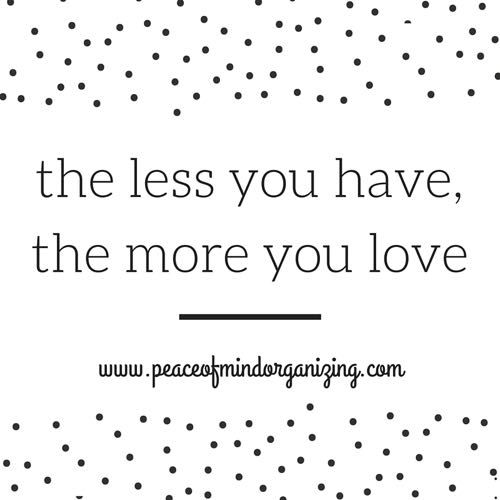
If you keep everything, nothing is special. If you keep just a few things, you can love it all.
Worth repeating: Making your move easy(er)
This past weekend my team helped a wonderful client get her spacious home unpacked after a move. It was fun and stressful simultaneously. And it was made more stressful by the fact that the movers, who packed the home, did a terrible job of labeling the boxes. So this morning I thought I’d blog about best practices to make a move easier, and then I saw that I did that a year ago. Instead of reinventing the wheel, I’m presenting last year’s blog post, written after we did a couple of unpacking jobs. If you have a move coming up, please read this!
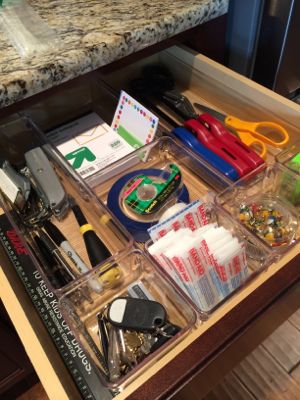
A supply drawer we created while unpacking a client
Moving is stressful. There’s pretty much no way around it. Even if an employer is paying for the move and you have the movers pack you, there are a lot of details with which to contend and it’s a hassle. Working with a professional organizer can help, but even so, the process is stressful.
I’ve recently helped several clients settle into their new homes by bringing in teams to unpack and organize their belongings. All of them were packed by the movers. Observing how the unpacking and organizing process went, I’ve identified a few ways to make the move easier:
- Start early. It’s easy to procrastinate on decluttering, packing, and making logistical arrangements. But the more time you can give yourself, the less stressful the process will be—and the more likely you are to avoid last-minute crises.
- Declutter before the move. If an employer is paying for the move, you might be inclined to delay decisions about letting go of stuff until after you see how it might fit into your new home. But believe me, by the time you’re in the unpacking phase of the move you’re going to be tired. And the fewer decisions you have to make when you unpack, the happier you’ll be. Less stuff = easier move.
- Go through the unopened boxes from the last move. If you’ve been in your home awhile and there are still unopened boxes in your storage area, don’t just move them. Open up those boxes and find out whether the items inside merit the space you’re giving them and the effort and money involved in moving them.
- Categorize before packing. If each box contains a category of items, unpacking is much more streamlined, and less frustrating. It can also make it easier to find an individual item before you’ve finished unpacking. If you don’t organize before you pack, you’ll end up with a hodge podge of items in each box, which can create headaches when you’re unpacking.
- Mark the boxes for the destination room. If the layout of your new home is different from the old one, try to mark the boxes for delivery to the appropriate room in the new home, rather than the room it came from. That way you’ll be able to stay in the room that you’re unpacking.
- Try to unpack as much as possible as soon as you move in. I’m typically a big fan of little and often, and if you need to break down unpacking into tiny chunks in order to get it done on your own, so be it. But if you can power through the unpacking process so that you get rid of boxes and get settled, the transition will be easier.
- Unpack the kitchen first. I think it’s hard to get a semblance of normalcy until your kitchen is unpacked. When you can make coffee in the morning and fix yourself a snack, life is better. Eating off of real plates rather than paper plates will make you feel like you’re home.
- Let go of perfection. Don’t get bogged down in the unpacking process trying to decide the perfect place to store items. You can always improve on it later. Just choose a location and see how it works.
- Enlist help. Unpacking a home on your own can be overwhelming. Enlist the help of friends, family or a professional organizer (or organizing team). In the last two unpacking jobs we did, we were able to get the entire homes unpacked in two days. It felt like a miraculous transformation—from a sea of boxes to a comfy home in two days. The clients still had tweaking to do, certainly, but they were able to get in with their daily routines.
Yes, moving is stressful. But it doesn’t have to be a nightmare. With a little planning and forethought, you can make it relatively easy.
Worth repeating: 5 questions to ask yourself before getting rid of paper
Paper is one of the toughest things for people to make decisions about. Three years ago, I wrote this post to guide you on letting go of paper. It’s still relevant today.
Sometimes when I work with clients, I realize that they’ve hung onto a lot of paper out of fear. They’re afraid that they’ll toss or shred a piece of paper and find out later that they need it.
When you’re afraid to let go of paper, before long you get overrun. Then you add a feeling of overwhelm to the fear and becomes really hard to go through the paper.
So to make things a little easier (and perhaps take away some of the fear), here are the five questions I suggest you ask yourself when you’re trying to make a decision about whether or not to keep a particular piece of paper (particularly paper related to finances):
- Can I get this information online?
- Can I replace this paper if necessary?
- Have I kept this type of information in the past and, if so, did I reference it?
- Can I scan this document and keep it electronically?
- What’s the worse that can happen if I get rid of this?
The fact of the matter is that very few papers are irreplaceable. So fear of getting rid of them is pretty unwarranted. You can always ask your tax advisor or your financial planner for advice. But hanging onto unneeded paper can weigh you down.
Why not take a few minutes now to go through your file cabinet and get rid of some outdated paper? (Don’t forget to shred anything with identifying information like social security numbers or account numbers.)
Search
Recent Posts
- Worth repeating: Figuring out what to watch on TV
- The power of incremental progress
- Podcast guest spot on the role of organization for folks with chronic illness
- No excuses series (part 3): "It was a present"
- No excuses series (part 2): "I paid a lot for that item"
- No excuses series (part 1): "But I might need it!"
- Retiring the New Organizer Guides
Tags
About Janine

Hello! I’m Janine Adams — a certified professional organizer based in St. Louis, and the creator of Peace of Mind Organizing®.
I love order, harmony + beauty, but I believe that the way that you feel about yourself and your home is what truly matters.
If you’re ready to declutter with a purpose and add more ease to your life, you’ve found the right blog — and you’ve found the right company.
read more »Links
- NAPO St. Louis
- Getting to Good Enough podcast
- Are you interested in becoming a professional organizer?
- National Association of Productivity and Organizing Professionals
- Institute for Challenging Disorganization
- Peace of Mind Spending
- Ravelry
- Shannon Wilkinson, life coach
- Organize Your Family History