Ode to a swift
There are certain essential pieces of equipment you need when you’re a knitter. You need yarn, obviously. And you need knitting needles. (The longer you’re a knitter, the more amazing your array of needles). You’ll also need a few notions like stitch markers, tapestry needles, perhaps a stitch holder or a cable needle. All these things, though they add up, don’t cost much individually.
For me, there was a bigger-ticket item I wanted, one that felt decadent because it was so much a matter of convenience, not necessity.
I wanted my own swift and ball winder. If you’re not a knitter, you have no reason to know what those things are or why you’d use them. I’ll explain. When you buy yarn, it’s often already wound into ready-to-use ball. But sometimes the yarn you want will come in a skein, a loosely coiled length of yarn that you can’t knit from. Skeins are usually twisted into an easy-to-display hank like this:
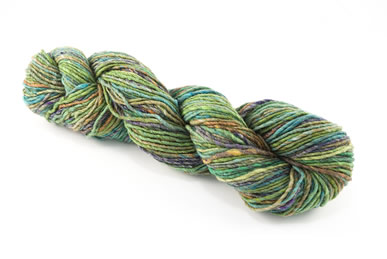
A skein of Noro Cashmere Island yarn
Untwist the skein and you have a loop of yarn sometimes yards wide. You need to wind it into a ball:
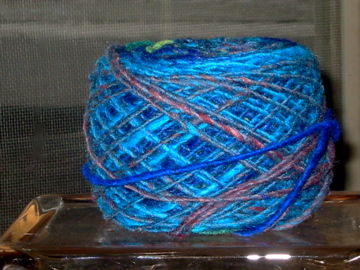
A ball of Cashmere Island yarn (in a different colorway)
The old-fashioned way to do it (you may have seen your grandmother or mother do this—I know I did), is to have a helper hold his or her hands a few feet apart with the skein looped over them. Then you wind, by hand, the yarn into a ball. That requires an assistant (though you can use a chair back, or your own feet instead) and the hand-wound ball isn’t very neat. Or at least it never was when I tried to do it. Another alternative is to have the store where you bought the yarn do the winding for you. But that’s time consuming and sometimes I would forget to ask.
A swfit and ball winder automates the process. And I now own one. In fact, I used it to create the ball of yarn pictured above. Now I don’t have just any swift. I have a new-fangled vertical squirrel-cage swift. Here it is:
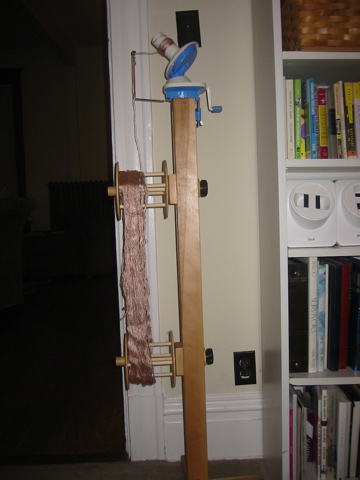
My squirrel-cage swift and ball winder
As you can see, you loop the skein over the little barrels that resemble hamster wheels. They’re adjustable, so you can get just the right tension (skeins of yarn are of variable widths). Then you thread the yarn onto the ball winder, which rests on top of the swift, and wind away.
One thing I love about this particular type of swift is that I don’t have to put it away and set it up. The more traditional umbrella swift clamps onto a table, as does the ball winder, and has to be put away (unless you have a dedicated table for it). My swift is tucked into the corner of the room in which I store my yarn and is ready to use at all times.
My husband gave this swift to me for my birthday. It’s handmade and he got it here. (It’s the “Alternate Vertical Swift.”) I’d be lying if I said I didn’t guide him toward that decision and this style of swift. It’s nicely made and makes my knitting life just a little bit easier—and it saves time. I’m one lucky knitter!
ETA in 2018: Please read the comments below. While I loved the swift when I got it, it’s proven to be problematic over the years. Ten years later, it is pretty much unusable, except as a place to mount the ball winder.
Tagged with: ball winder, knitting, skein, swift
Comments
Rosi,
That’s interesting. Mine does make some noise when winding, though that hasn’t concerned me. But I haven’t had a problem with tightly wound balls. The only trouble I’ve had is with a couple of skeins that became tangled (I don’t think it was the fault of the swift). You’re threading the yarn through the little loopy thing before starting it on ball winder?
Janine
Janine Adams January 18, 2008 02:05 PM
Do you still like this swift?
Cath October 19, 2010 12:22 PM
Cath, it’s a little loud. And I do sometimes have problems with yarn tangling…I don’t know if that’s because of the way the skein was wound, the swift, or user error. But yes, I do like it. I especially like that it just stands in a corner and I don’t have to get it out and attach it to a table like I would with an umbrella swift.
Janine Adams October 19, 2010 07:10 PM
Where did you buy your vertical swift, please?
Joan Garrison December 29, 2014 06:18 AM
Joan, my husband gave it to me and I don’t remember where I got it. But here’s a link to where you can buy one that looks just like it.
Janine Adams December 29, 2014 10:13 AM
I got one of these vertical swifts and I, too, find it wobbly and terribly difficult to work with. It pulls the yarn too tight and stretches the yarn out of shape. I am searching the web for tips on how to use the swift properly, but so far, I am really disappointed with it. (And I have wound hundreds of skeins using other types of swifts, so I am not a novice!) Any insight will be deeply appreciated!
Reyna June 13, 2015 08:16 AM
Reyna, I wish I had some insights! I loved it at first and figured the foibles were human error or problem skeins. But really, more often than not I have difficulty. Sorry I can’t be more helpful.
Janine Adams June 13, 2015 03:24 PM
I too have a squirrel cage swift that I’m having problems with. I’ve tried contacting the makers of it, but they are an older couple and apparently are having health issues. I can’t figure out what I’m doing wrong! The only way I can get my swift and ball winder to work properly is to pull a bunch of yarn off the swift and then operate the ball winder! I’m about ready to throw in the towel on the swift and buy something else. HELP!
Julia June 14, 2018 11:14 PM
Julia, I’m having the same problem. Plus some of the wooden dowels have come loose in the squirrel cage part. It’s disappointing, but I remind myself that I’ve had the swift for ten years. From here on out I’ll probably have the yarn store wind my yarn. I’m pretty much shopping out of my stash now, so it’s not a big deal. Sorry to hear you’re having the same problems.
Janine Adams June 15, 2018 05:25 AM
I recently acquired a squirrel cage swift as an accessory to a loom I bought, and would like to share the process I used to remove squeaks and get better use out of it.
I found that by loosening the adjustment knobs and parts that looked like they should move, I could reach in the crevices and wipe the accumulated dust away. This removed most of the loud squealing I heard from mine when I turned the cages. I then checked the axles and cage alignment, like I would on an old spinning wheel or bike: the axles were straight (if they were bent, I’d replace them before going further) and the cages were noticeably wobbly. The wobbliness doesn’t bother me now, but if it does in the future, I’ll lengthen or shorten the outer cage rods until the circular ends of the cage sit perpendicular to the axle without wobbling too much.
Next, I oiled the place on the cages where they sat on the axle. I used machine lubrication oil designed for paper shredders because it doesn’t go bad easily and it is viscous enough to stay on the axle. I would have been just as happy with spinning wheel oil or sewing machine oil. After shifting the cages up and down the little extra bit of axle and spinning the cages a few times, they stopped squeaking entirely.
Finally, I noticed that the sides of the cages were touching the supports of the axle and slowing it down when I spun them. I have some nylon washers that fit on the axles, so that will reduce that friction by just a little bit more.
I hope this helps!
Flora November 22, 2021 04:12 PM
Thank you so much for your generosity in sharing this information, Flora!!
Janine Adams November 22, 2021 06:08 PM
Search
Related Posts
Tags
About Janine

Hello! I’m Janine Adams — a certified professional organizer based in St. Louis, and the creator of Peace of Mind Organizing®.
I love order, harmony + beauty, but I believe that the way that you feel about yourself and your home is what truly matters.
If you’re ready to declutter with a purpose and add more ease to your life, you’ve found the right blog — and you’ve found the right company.
read more »Links
- Getting to Good Enough podcast
- Organize Your Family History
- NAPO St. Louis
- Institute for Challenging Disorganization
- Peace of Mind Spending
- National Association of Productivity and Organizing Professionals
- Shannon Wilkinson, life coach
- Ravelry
- Are you interested in becoming a professional organizer?






I recently received the same exact swift for Christmas and I’ve set it up in the same way. I’m experiencing a whole lot of racket (noise) while winding and I’ve had a terrible time with the balls coming out way too tightly wound. I thought maybe there was a secret to using this swift, that I’m not aware of. Any tips would be most appreciated.
Rosi
rosi January 18, 2008 09:49 AM