Worth repeating (again): The beauty of vertical storage
I originally wrote this post in 2019. I moved earlier this year and all the photos in this post are from my old home. But I replicated the vertical storage in my new home whenever I could (which was most places). Five years later I’m still a big fan of vertical storage!
To the extent possible, I love storing things vertically, rather than horizontally. Think about how files are stored in a file cabinet—it’s much easier to access folders in a file cabinet than in a stack.
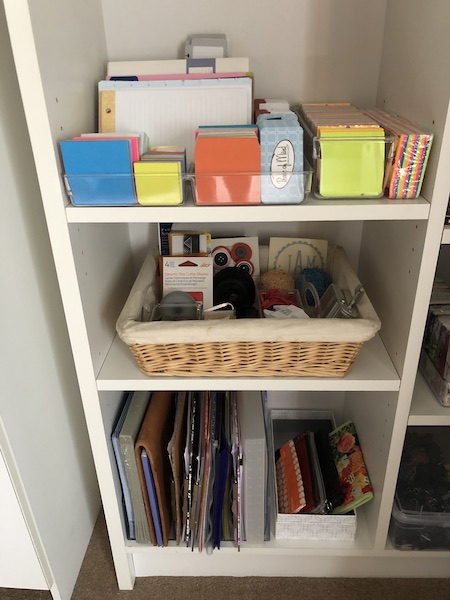
But vertical storage isn’t just for files. I love using the principle all around my house (and with clients). For my office supplies, for example, I have three shelves in my office supply closet where I store supplies vertically (see the photo below). Notice how my Post-it® notes and other supplies are stored vertically using acrylic containers (a divided one similar to this Linus 4-Section Drawer Organizer and a 4 × 12 × 3 Linus Deep Drawer Organizer) on a shelf. I used small containers inside a basket so help me store as much as I can vertically on the middle shelf of the photo. And on the shelf, this magazine sorter allows me to store clipboards and portfolios vertically. I repurposed a box from Bare Minerals so store a small collection of handy pouches.
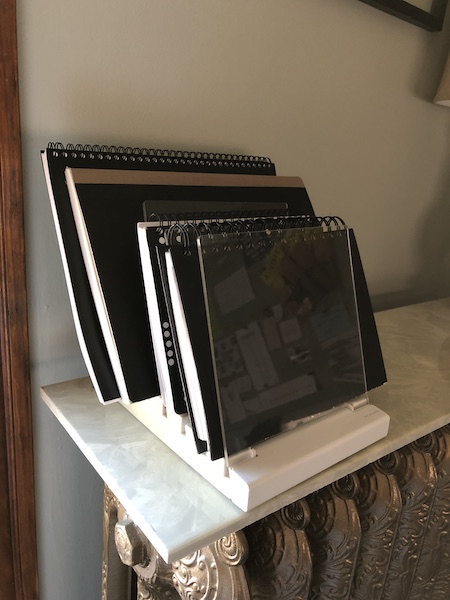
I have some notebooks I like to keep handy on the radiator behind my desk. One of them is the one grab when I’m on the phone on a business call. By using a desktop file holder, I can store notebooks vertically so I can easily (and silently) grab the right one when I need it.
Long before Marie Kondo was telling us how to fold, I was folding my t-shirts in half again and storing them vertically in the drawer. I love that it enables me to see the shirts and just pluck out the one I want. I do the same thing with my leggings—I store them vertically and use this closet drawer organizer to keep them upright.
When you’re organizing in your home, I encourage you to think about how you might integrate vertical storage. I think you’ll find it life-enhancing!
Is it time to declutter your car?

My new car!
The lease on my Nissan Leaf is up and I’ve replaced it with a Nissan Ariya, another electric vehicle. (This one’s a slightly larger crossover, rather than a hatchback, and it’s a beautiful copper color.)
Before I turned in the Leaf I had to clean it out. I was surprised to see how much stuff I was storing in that car! It wasn’t cluttered—everything was put away. But it was like a clown car of little items!
The thing that struck me was that while my center console was admirably organized, I rarely if ever, accessed those items, with a few exceptions. And my glove box was crowded enough that sometimes I couldn’t find stuff when I was looking for it, even though it was in there.
I appreciated the opportunity to take a look at what I was storing in my car and decide what I really needed. Just like inside our homes, the more items we cram into a storage space, the harder it is to find anything. My new car’s center console has less storage (but it does have wireless phone charging!), so I was mindful in my choices. These are the things I elected to put back in the car:
- small first aid kit
- small manicure kit
- emergency automotive escape tool (something I hope I never use!)
- my husband’s disabled parking placard
- reusable grocery bag
- insurance card
- my NAPO-St. Louis name tag for chapter meetings
- small umbrella
- ice scraper
- hand-knit wastebasket (the one I had in my CR-V)
It took very little time to empty the car, sort the stuff and put back in what was needed. Since I returned so little to the car, I was able to put it away in no time. I once had the opportunity to help a client organize his car—he had more space and more stuff. I blogged about the process at the time, if you’re interested.
Helping democracy, one postcard at a time
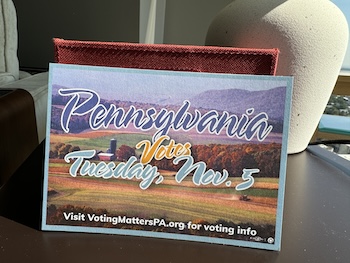
Back in 2018, I signed up to write postcards to voters to help get out the vote. I did it through Postcards to Voters, an organization that gives you the opportunity to sign up for a postcard campaign and send postcards with prescribed messages to voters whose addresses you are sent. You must mail the number of postcards you selected within five days of asking for the addresses.
Between 2018 and 2024 I’ve sent over 4,000 postcards through this organization. I pay for the postcard and for the postage for each card and of course it takes some of my time. For me, it’s a great way to help get out of the vote since I don’t have to leave the house. It also helped me practice my hand lettering skills. (Postcards don’t have to look fancy, though. In fact you’re encouraged to make sure they look grassroots so they don’t want you to get fancy!)
This summer, I switched post-card writing organizations, which has streamlined the effort for me. I’m writing postcards through the group Postcards to Swing States. I signed up for two batches of 200 cards. The organization sent me the cards and the addresses and a choice of three messages to write on the card. Each batch of 200 is for voters in a specific state (in my case it’s Pennsylvania and Georgia) and each batch is to be mailed on a specific day in October. I supply the postage and, of course, my time.
Since this is a stressful summer for me, between moving and my husband’s health challenges, I needed to make postcard writing easier. The Postcards to Swing States route has worked out well. I try to do a batch night (or every other night). I have the message memorized and I don’t have to worry about running out of postcards. (And I was smart enough to order sufficient postcard postage stamps before the rate increase last month so I know I have enough stamps.) I keep a little kit containing everything I need on a shelf on the end table so I can easily pull it out when I sit on the couch. I usually write cards while I enjoy watching TV.
If you’re looking for some way to help during this election, you have legible handwriting and you enjoy writing by hand, I encourage you to check out either of these worthy organizations (and I’m sure there are others!). For me, it’s an easy way to do my part.
Edited to add: A day after posting this, I received an email from Postcards to Swing States that they have given out all 36 million addresses for the November election. If you’re interested in writing postcards, though, Postcards to Voters has ongoing campaigns.
Prioritizing during stressful times
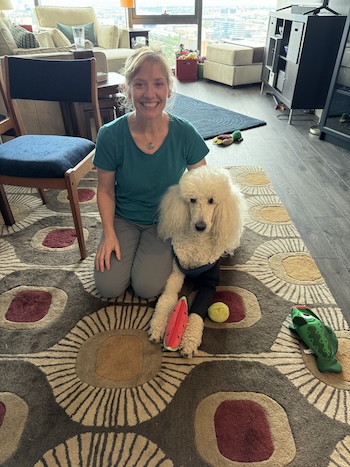
Shannon and Bix!
I haven’t been blogging much this summer, due to a variety circumstances, which I explained in my most recent blog post, Giving myself grace. In that post, I danced around the specifics of my husband’s illness that has had him hospitalized since June 24. But I can reveal it now. On July 29, he had a heart transplant.
The five weeks in the hospital waiting for the transplant were stressful, which probably goes without saying. The first week, in which he was evaluated as a candidate for a transplant, was particularly difficult because his future was bleak if he did not get put on the list.
Once he was put on the list, he was moved to the Cardiac Intensive Care Unit. He actually felt pretty good but was tied to machines. I visited at least once a day, while I was trying to get our new apartment unpacked. (We moved in two days before Barry was hospitalized.)
Then, on July 28, we got word that there was a heart for him and the transplant would take place on Monday, July 29. Thankfully, in the time he was hospitalized prior to the transplant I was able to get the apartment unpacked (with the help of professional organizers) and make the guest room (which is also Barry’s office) functional.
Just two days after the surgery, my friend and former podcast co-host, Shannon Wilkinson flew from St. Louis to Portland to help and support me. She is making sure that Bix (and lots of other things) are taken care of so that I can spend my time at the hospital with Barry.
Between Barry’s health crisis and moving (oh, and getting our old house renovated to sell), I’ve had a lot on my plate. I’m still running the business, but my employees are doing all the heavy lifting. What’s really helped me is being very clear about my priorities.
They are:
- Barry
- Bix
- Peace of Mind Organizing
- Settling into our new apartment
- Getting our house ready to sell
- Everything else
Right now, there’s little time for more than #1. Thanks to Shannon, #2 is taken care of. Thanks to my employees, #3 is being taken care of without too much effort from me. As for #4, my team members and friends helped me get the apartment unpacked and I need to keep plugging away at getting my change of address disseminated. (I did manage to vote yesterday, which felt like an achievement!) Our real estate agent, Mike Palermo has coordinated the renovations (#5), making it as effortless for me as possible.
The key to maintaining my sanity throughout these last two months has been two things: knowing my priorities and accepting help. We are fortunate to have lots of caring friends who have offered help all along the way. (My college friend, Denise, flew here from Virginia right after Barry was hospitalized to make sure I was okay and that I was well fed.) It can be tricky to know what help to ask for but specific requests from me are always well received. I’m actually getting pretty good at accepting help, which sometimes feels challenging.
As I’ve navigated this, a lot of things have fallen through the cracks. My car insurance lapsed without my knowing it. I haven’t made the time to go to City Hall and take my notary oath (though I did manage to get the application in before my notary commission expired last month), a lot of places still think I live at my old address. But nothing devastating has happened. And I just give myself grace.
I know I have finite capacity. And when I’m in crisis, focusing on the most important things lets everything else fall away. Barry is making progress every day as he recovers from major surgery. In a matter of months, he will be better than before. And that’s when I’ll catch up on my Quickbooks and whittle down my email inbox. But until that time, I’m keeping my eye on the prize: my family’s health and well being.
Giving myself grace
You may have noticed that I haven’t been blogging. For the first time in almost 18 years of writing this blog, more than a month has passed since I last posted. I’m trying not to beat myself up about that. I did send out my monthly newsletter as usual on the 15th. In it, I explained a little about what’s going on with my life (which accounts for my lack of presence here) and how I’m trying to be kind to myself about it. People sent me some lovely emails about how it helped them, so I thought I’d post it here as well.
My life has become more stressful than usual. Way more stressful. As a result, I’m dropping balls, forgetting to do things, and making mistakes big and small. It’s a constant reminder that I need to give myself grace.
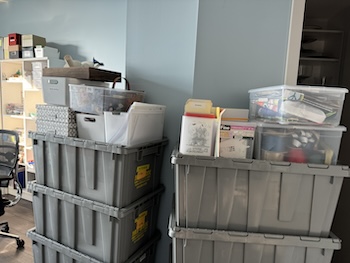
We moved three weeks ago. We downsized from a 3200 square foot house to a 1700 square foot apartment. And of course, like anyone else, we took more stuff than we can comfortably store here so unpacking is not without challenges.
Two days after we moved my husband was hospitalized and will remain in the hospital for at least a few more weeks. We’re very hopeful for an excellent, life-changing outcome but in the meantime it’s definitely adding to the stress. (Silver lining: our new apartment is only a few blocks from the hospital so I can walk there on my daily visits.)
The one-two punch of the disruption of a move coupled with a family health crisis has meant that my brain is a bit scrambled and I’m just not functioning as well as usual. (Case in point: I put a light bulb in my pocket for some reason, then washed that garment. Broken glass in the washing machine is no fun.)
I’m trying so hard to give myself credit for what I am able to accomplish and forgive myself for the stuff that’s not getting done. The apartment is about 75% unpacked and functional (thanks to the help of professional organizers) and I absolutely love living here, which helps a lot. I’m proud that I’m getting this newsletter out and I’m forgiving myself for not having blogged in the past month.
I hope if you’re struggling at all that you’re giving yourself grace and showing yourself kindness. Taking breaks for stillness or just mindless relaxation is so important, especially when it feels impossible. You’ll get through this!
_ETA: I was able to open up a little me about the family health crisis in this post, Prioritizing during stressful times
What to do with old journals?
Way back in the day, in the 1990s and 2000s, I used to write in a journal fairly regularly. It’s how I handled stress. But I found that I would just beat myself up when I journaled and feel worse. So I stopped. Since I had room in a file cabinet, I tossed the old journals in the back of a file drawer.
Now I’m moving. (Which is why I haven’t been blogging.) When I cleaned out that file cabinet, I found the large stack of journals. I glanced through a few and really didn’t enjoy what I read. So I put them aside for disposal.
Two days ago, The Shred Truck came and shredded all those journals (and a lot of other stuff). It felt great!
I told my neighbor that I shredded them and she touched her chest and gasped. She seemed genuinely shaken that I would destroy them. But I saw no need to keep them; they contained nothing I’d want others to read and I don’t have room to store them.
These journals are distinct from my Bullet Journals the blank journals in which I’ve been keeping track of my daily life for the last 2.5 years. I’m just finishing up my 14th journal since I started in December 2021. They’re an invaluable resource (right now) and I do refer to them. The journals I destroyed were more personal and emotional.
I am very much at peace with my irreversible decision, but I know it’s not for everyone. What do you do with your old journals?
Worth repeating: 10 things you can throw away right now

10 years ago (almost to the day!) I wrote this post which I think offers sound advice. I’m happy to say that I’ve heeded this advice over the last decade, making my current downsizing project easier than it otherwise would be. Now seems like a good time to run this again!
It’s basement season for my business. I’ve been in a lot of basements recently and my teams have helped make them much more enjoyable and functional spaces. I keep seeing the same sorts of items, so I decided to a create a quick list of items that I frequently see people unnecessarily hanging onto in basements (and other parts of the house).
Are any of these items cluttering up your home?
- Empty boxes for items you’ve had over three months (possible exception: the box your giant TV came in)
- Packing peanuts and air pillows if you haven’t used any in six months or more
- Paid bills (non-tax-related) that are more than a year or two old (if that)
- Supporting paperwork for taxes filed more than seven years ago
- Clothing that doesn’t fit you or you don’t feel fabulous in
- Supplies for pets you no longer own
- Outgrown games and toys
- Supplies for hobbies or crafts you no longer do (or never actually did)
- Expired over-the-counter medications or beauty/personal hygiene products
- Leftover holiday cards from years gone by—especially dated ones
Do a quick sweep of your house this week. If you spot any of the above items, consider letting them go!
Here are some ideas for disposing of these items:
- Take the old paperwork to a commercial shredding service (the big-box office supplies stores offer this service as well)
- Donate clothing, toys and craft supplies. Consider using the app iDonatedIt to keep track of donations for tax purposes.
- Give your unneeded pet supplies to a local animal shelter
- Take the unwanted packing material to a UPS Store (or similar establishment) for reuse
The longer I do this work, the more I believe that less stuff = more happiness. A good place to start is with these no-brainers!
Photo by alan.stoddard via flickr.
Search
Recent Posts
- Worth repeating: Figuring out what to watch on TV
- The power of incremental progress
- Podcast guest spot on the role of organization for folks with chronic illness
- No excuses series (part 3): "It was a present"
- No excuses series (part 2): "I paid a lot for that item"
- No excuses series (part 1): "But I might need it!"
- Retiring the New Organizer Guides
Tags
About Janine

Hello! I’m Janine Adams — a certified professional organizer based in St. Louis, and the creator of Peace of Mind Organizing®.
I love order, harmony + beauty, but I believe that the way that you feel about yourself and your home is what truly matters.
If you’re ready to declutter with a purpose and add more ease to your life, you’ve found the right blog — and you’ve found the right company.
read more »Links
- National Association of Productivity and Organizing Professionals
- Institute for Challenging Disorganization
- Are you interested in becoming a professional organizer?
- NAPO St. Louis
- Organize Your Family History
- Peace of Mind Spending
- Getting to Good Enough podcast
- Shannon Wilkinson, life coach
- Ravelry