Project clean computer desktop complete!
On Friday, I blogged about my desire to clear off my computer desktop every day so that it would be as clean as my physical desk top.
I thought I’d do it a little at a time. But instead, while I was flying between Las Vegas and St. Louis on Saturday, I did it in one fell swoop. It took about 50 minutes. I thought it would take longer.
Here’s a screenshot of my newly cleared off desktop:

Check out Friday’s blog post to see how bad it looked before.
The process was actually pretty painless. I deleted a bunch of stuff. And I filed a bunch of stuff. Most of the saved files went into my Documents folder. But I did discover some genealogy-related documents I had forgotten about (they’d gotten lost there on that messy desktop). So I filed those in the appropriate genealogy folders, creating new ones as needed.
My intention is to use my computer desktop as a temporary holding place only. At the end of each day, any documents put there will be filed or deleted, just like physical desktop.
I love the visual peace this is giving me. It was a joy to boot up my computer and see my lovely clear desktop!
The clean computer desktop
I write all the time (most recently, here) about how important it is for me to clear off the top of my desk each evening. That habit, which takes just a few minutes at the end of the day, makes it so much easier for me to function in the morning.
But I never think about my computer desktop. Mine is cluttered, and that hasn’t bothered me. In fact, I’ve barely given it a thought.
I just read this excellent article on Lifehacker called, How clutter affects your brain and what you can do about it. There’s lots of great stuff in there. You really should read it.
The item that really captured my imagination was the very last in the article’s list of four things you can do to master clutter: Remove all files from your desktop daily.
It’s the same habit I’ve created for my physical desk, only it’s for the computer desktop. The article’s writer, Mikael Cho, showed a screenshot of his desktop, which contains just one folder he calls Home. Here it is:

By contrast, here’s a screenshot of my desktop:

As I said, my messy desktop hasn’t bothered me before. I use my Mac’s Finder to find everything and don’t really even know what’s kept on the desktop. But I’m so enamored of Mikael Cho’s desktop that I think I’ll give it a try. My plan is to work on it a little at a time (I love the little and often approach) and report back here in two or three weeks with the results.
I’m curious: Is your computer desktop neat and tidy or is it a jumbled mess like my current desktop?
Worth repeating: Finding the best place to donate
I see so many clients get caught up in finding the perfect places to donate their items. I think this post, which I originally published in April 2012, bears repeating.
It can be easier to let go of items if you think they’re going to just the right charity. If you feel like the item wlll used, even loved, you can release it with fewer twinges of regret.
I get that. I’ve experienced it in my own decluttering and I see it in my clients all the time.
But I think looking for the best charity is actually a bad idea. That search can keep you from actually getting the stuff out of your house. You hang on to it while you do your research. That research can take awhile, since you’re looking for the very best place. Soon, the boxes or bags become part of the landscape and the urgency to make the donation recedes.
You know what’s better? Getting the stuff out of your house in one fell swoop. Preferably the day you make the decision to let it go. Call a charity to pick it all up. Or take it all to a place like Goodwill that will make sure that nothing ends up in the landfill. If you hire me to bring in an organizing team, the team members will take away your donations.
The best charity for your donations is the one that makes it easy to donate. Once you’ve made the decision, the best thing you can do for yourself is to act on your decision to let something go and actually make the donation.
Getting past the fear of rejection
I attended the World Domination Summit this weekend in Portland, Oregon. It was a wonderful two-day conference for entrepreneurs who want to do good for the world. (Its central theme is “leading a remarkable life in a conventional world”.)
The speakers were excellent and each one was inspirational. One of my favorite speakers was Jia Jiang who created the blog, !00 days of rejection in an effort to desensitize himself to the pain of rejection. Using hidden video he recorded his efforts to create 100 rejections. The result is a remarkable blog. Check it out.
In his low-key, humorous talk (which garnered a standing ovation), Jia talked about how he overtly tried to be rejected by asking outlandish requests. (Among them: He asked a police officer if he could drive his car, a private pilot if he could fly his plane, and knocked on a door in soccer garb and asked a man if he could play soccer in his back yard.) And you know what? he wasn’t rejected—he flew that plane, drove that police car, and played soccer. We saw photos.
His video went viral when he asked a Krispy Kreme donuts employee to create a custom donut in the shape of the Olympic rings—and she did it.
Jia’s talk made me ponder the crippling fear of rejection, and how off-base it often is. He made me think about how much we can accomplish if we simply let go of our natural fear of rejection.
I’m so grateful to have seen this talk. (And you can watch his Tedx Austin talk to experience something like it yourself.) When I contemplate new directions or strategies for my business (or anything else in my life), I’ll remember Jia’s talk. And I hope I’ll ignore my natural fear of rejection and realize that if I don’t ask for something I can’t hope to get it!
BookBub: It makes my Kindle even better
When I bought my Kindle Paperwhite
But then I read in the New York Times about BookBub. This website is my new best friend. When I registered (which was free), I designated the genres of books I’m interested in and I chose the Kindle format. (It’s also available for Nook, Android Sony Reader, iPad and Kobo.) Now each day I receive an email with a list of Kindle books that are either very low cost (like $2.99) or free. They’re available that day only at that price.
So pretty much every day I download at least one book that I might want to read. It literally takes me two clicks. And now as soon as I finish a book, I have a bunch of new books to choose from. And I’m not cluttering up my bookshelves.
It’s heaven. It doesn’t cost me a dime. And I’m reading like crazy.
I love technology!
Worth repeating: My secret to saving money on knitting
Thanks to my well-organized and well-stocked stash of yarn, I spend very little money on yarn and knitting supplies. Three years ago, I wrote about Ravelry, my secret weapon for saving money on what can be a very expensive hobby. This post is as true today as the day I wrote it, with one exception. There are now 3 million members of Ravelry!
When I started knitting five years ago, I tentatively started projects and slowly learned new techniques while gradually buying nicer and nicer yarns. I kept all my yarn in one bag.
About a year into it, I was all about the shopping. Going into a yarn store is a wonderful thing for a yarn-o-phile. The yarn is lovely to look at and even better to touch. Though I think of myself as someone who doesn’t buy yarn without knowing what I’m going to do with it, I quickly amassed a sizable yarn stash.
I spend some money on yarn, people. I don’t really want to go into Quicken and see how much. But luxury yarn can be expensive, which is why it costs so much to purchase a hand-knit sweater and why knitting garments for yourself is rarely a decision based on saving money.
For several years, I struggled with the best way to organize my yarn. I had yarn that I’d purchased for projects, some yarn that I bought on impulse without a project in mind, and then yarn leftover from projects. I used pop-up bins and knitting bags quite ineffectively.
Then in 2008 I bought my Elfa drawer system and organized my yarn stash in it. It’s bliss.
So what’s my secret to saving money on knitting? It’s the combination of an organized yarn stash and the amazing social networking site for knitters, Ravelry.
Thanks to this secret weapon, I purchased very little yarn in 2009. Every time I wanted to start a project, I’d think about what I was in the mood to knit (or come up with something that I needed, like a hat). Then I’d log into Ravelry to find a pattern. I’d look at the recommended yarn for the pattern and go to my yarn stash to see if I could find anything similar. Thanks to Ravelry, which has a database of yarns, I can easily compare the yarn in my stash to the recommended yarn. I can see if other people have used that yarn for that project. Ravelry even has yarn suggestions for each project, based on what other people have used.
Once or twice, I’ve gone to my yarn stash, identified a ball or two of a yarn that I felt like knitting with, then used Ravelry to find something to make with it. I can see the projects that other Ravelry users have knit with that yarn. Or I can click on “Pattern ideas” for each yarn. It’s amazing.
If you’re a knitter and you’re not already shopping from your yarn stash (assuming you’re looking to save some money on yarn), I encourage you to figure out a system of organizing your yarn so that you can find yarn easily. There’s no right or wrong way to do it—just think about your stash like it’s your favorite yarn store and organize it like they do (or like you wish that they did). I organize mine primarily by yarn weight, but sometimes by fiber. For example, I like having all my cotton yarns together without regard to weight. Don’t ask me why.
Once your yarn is organized, you an use Ravelry to give you great ideas on how to use it. If you don’t already belong to Ravelry, stop what your doing and go there right now to sign up to join the 644,000 knitters and crocheters who are already using it. It’s the greatest thing since sliced bread as far as I’m concerned. Once you’re there, please friend me. I’m kramerscout.
I need to do some photographing of finished projects and then I’ll do a knitting post with some photos!
My evening routine: It's how I stay on my game
I do three things almost every weeknight at the end of the work day that help me to stay on top of my business, start the day feeling productive, and reduce the stress in my life. These three habits have a lot to do with my really enjoying being an entrepreneur. They are:
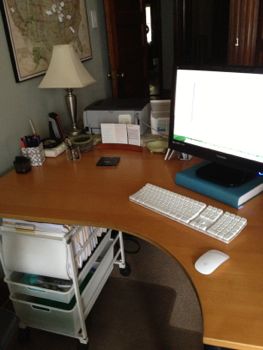
- I clear my desk off at the end of each work day. It’s easy to do, because there’s only one day’s worth of stuff out. And everything has a place. In the morning, thanks to my clean desktop I can hit the ground running.
- I write down the four priority tasks for the next day. Why four? It’s a number that works for me because it’s realistic to expect I can do it all. And it doesn’t make me feel overwhelmed. I use a form I created for that purpose and I hang the list on a pretty clipboard on the wall next to my desk.
- I empty out my email inbox. This is probably the most important thing I do to stay in control. I’ve been doing this daily for a couple of years now and it’s become very easy. Last year I wrote a post detailing exactly how I do it . The result? Every email that requires a response is dealt with in a timely manner. Decisions aren’t delayed. Emails don’t scroll away out of sight. And I only have a few emails greeting me in the morning.
These three habits, rolled up into one tidy routine, are key factors in the success of my business and, indeed, in my happiness. They keep me calm and in control and they really take very little time. What could you add to your evening routine that will make your life easier?
If you’d like to l earn more about creating habits and routines, sign up for my Simplify Your Life with Habits + Routines online workshop for Simplify 101. (Now through July 7, use the coupon code DECLARE to get 15 percent off the tuition.)
Search
Recent Posts
- Worth repeating: Figuring out what to watch on TV
- The power of incremental progress
- Podcast guest spot on the role of organization for folks with chronic illness
- No excuses series (part 3): "It was a present"
- No excuses series (part 2): "I paid a lot for that item"
- No excuses series (part 1): "But I might need it!"
- Retiring the New Organizer Guides
Tags
About Janine

Hello! I’m Janine Adams — a certified professional organizer based in St. Louis, and the creator of Peace of Mind Organizing®.
I love order, harmony + beauty, but I believe that the way that you feel about yourself and your home is what truly matters.
If you’re ready to declutter with a purpose and add more ease to your life, you’ve found the right blog — and you’ve found the right company.
read more »Links
- Institute for Challenging Disorganization
- Ravelry
- National Association of Productivity and Organizing Professionals
- Are you interested in becoming a professional organizer?
- Shannon Wilkinson, life coach
- Peace of Mind Spending
- NAPO St. Louis
- Getting to Good Enough podcast
- Organize Your Family History