Eliminating the extraneous
I recently signed up for the fabulous Workspace and Studio Redesign program offered by Jen Hofmann of Inspired Home Office.
In the eight years since I last rearranged the furniture in my home office, I’ve spruced it up a couple of times (with the help of friends), but I’ve been feeling like I’d like to change it up a bit more. When I read about this program, I hopped on board.
Jen and I had our first session last week and she helped me realize that I have a lot of extraneous stuff in my office. While I had worked on clearing out and organizing the two closets in my office, I hadn’t done a thing about my desk, which was starting to close in on me. Stuff was there by default.
(Incidentally, I think one of the reasons I’ve been having trouble keeping up my clean desk habit is that so many things actually were residing on my desk that the clear space felt like it was shrinking.)
My assignment from Jen was to touch everything on my desk, as well as the stuff I can see while I’m working, and evaluate it based on the question, Does this represent who I am and where I’m going?
On Saturday, I got to work and it was absolutely liberating! I have a teak desk organizer that we bought in the early 90s. It’s been on various desks in the house, and on this desk in particular since at least 2001. I realized in talking with Jen that there were only about four things in it that I actually used on a regular basis.
So I took it off my desk. Now my desk contains only the essentials. I did keep a little decorative dish that contains sea glass I picked up on my trip to Barbados in November. And I added a felted-wool bowl I knit that at the moment contains my Valentine’s candy. Those two things make me happy.
Here’s a set of before and after photos.
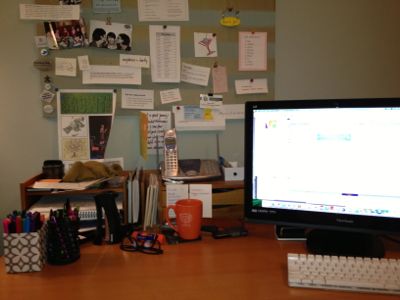
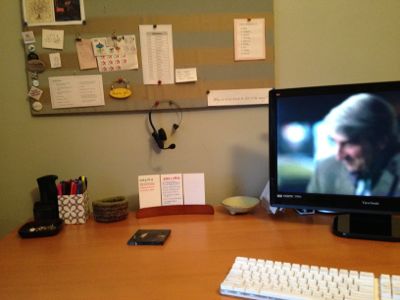
Talk about more visual peace! As you can see, I also cleared off much of the stuff on the bulletin board above my desk, though I haven’t exactly artfully arranged it.
There will be more evolution (I have two more sessions with Jen), but I had just to share the progress I made in a just a couple of hours on Saturday.
It’s been amazingly easy to keep my desk clear since then. (I’m so motivated!) In the morning, my uncluttered desk greets me with open arms.
Pictures speak louder than words
As I mentioned on Monday, our orange tabby cat, Joe, passed away a week ago. Friends have been asking us whether our standard poodle, Kirby, is missing his little buddy.
Perhaps.
But I can show you one thing he’s not missing: Joe The Intimidator’s practice of staring at Kirby in order to bully him out of his favorite chair on a nightly basis. I documented it a month or so ago.
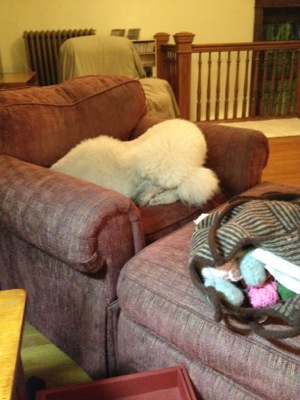
Kirby's enjoying a nap in his favorite chair.
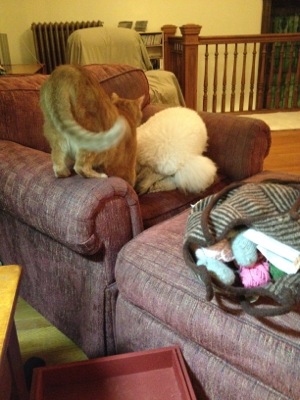
Joe makes his move
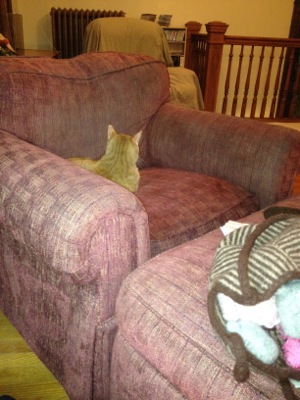
Joe is the victor.
The 60-pound weight difference didn’t matter to Kirby. Joe was someone to be respected. We miss you, Joe, but it’s nice to see Kirby enjoying his chair again.
Come see me live and in person (or on the phone)!
There must be something in the air. In the four weeks between February 28 and March 28 I have five speaking engagements. You can read all about them on the Events page of this website.
If you live in St. Louis, you can come see me at the following venues on the following topics:
- “Clear the Clutter and Create the Closet You Crave,” The Resale Shop, February 28, 5 to 7 pm (It’s also a shopping event—my talk is just 15 minutes or so.)
- “Letting Go of the Tough Stuff,” Thomas Dunn Memorials Adult Education Program, March 6, 10 to 11:30 am
- “Declutter and Organize Your Home,” St. Louis Public Library central branch, March 21, 7 to 8 pm
- “Tackle the Clutter and Organize Your Basement and Garage,” March 23, 9 am to 12 noon (part of the Get Organized St. Louis Expo—my talk will be an hour)
The fifth event is over the telephone, so you attend whether or not you’re in St. Louis:
- “Stress-free Habits + Rewarding Routines,” March 28, 1 to 2 pm central time (it’s part of the Thrive2013 teleconference series)
Again, visit the events page to learn more. In some cases, reservations are required.
I hope to see you at one of the events!
A tribute to Joe
My orange tabby cat, Joe, died on Friday. I know that when we bring pets into our lives part of the bargain is that they’ll probably die before us. And it will feel way too soon. But that knowledge doesn’t make losing them any easier.
Joe’s death was sudden. He died in the hospital, two days after being admitted, while we were still trying to figure out just what was wrong with him and how to treat it. He was a very sick cat (lymphoma is suspected), but we didn’t realize he wasn’t feeling well until about three weeks before he died.
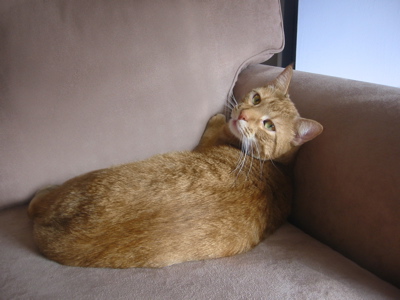
Joe, awakened from a catnap
Today I want to post a little tribute to Joe and honor him. We got him in 2002 after I’d signed a contract to write a book about cats, called How To Say It to Your Cat
So Barry became a reluctant cat owner. And before too long, he and Joe were devoted to one another.
I don’t know how such a small animal can:
- be so annoying
- shed so much hair
- leave such a giant hole in my heart
Like most cats, Joe lived life on his own terms. When he wanted attention from us, no matter what we might have been in the midst of doing, he got it. Barry and I both work from home and Joe didn’t care if one of us was intently working on something. If he wanted lap time, he hopped in our laps. In my case, he liked lying on my desk, often on my keyboard, or standing between me and my monitor.
He inspired a couple of blog posts. I blogged about his being my role model in persistence and about how he hampered my productivity.
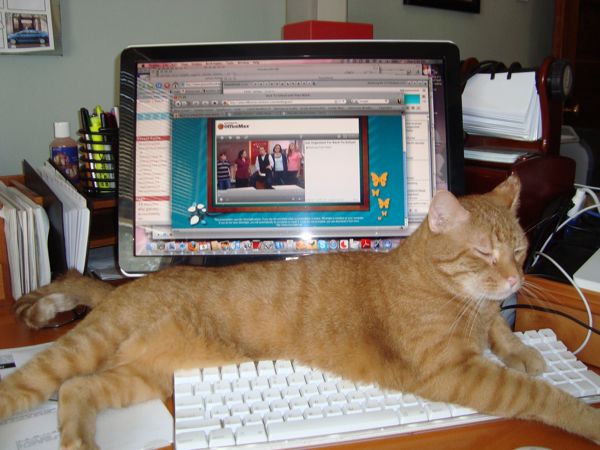
It's hard to type when Joe does this.
One time, shortly after we got him, back when I made my living as a pet writer, Joe walked across my keyboard and in doing so selected everything in the Word document I was working on and replaced it with the word “hi.” That’s how clever he was. And, no, I’m not making that up.
Now that he’s gone, we don’t have to worry as much about keeping doors closed. We were able to take coverings off furniture (an attempt to keep all the furniture from being covered in cat hair). We can have cut flowers. (Joe enjoyed knocking over vases and eating flowers.) I can wear cashmere sweaters without worrying he’ll snag them.
But of course I’d trade those conveniences for having his warm little body curled up on my lap. I’d love to be able to look in his eyes and see his devotion. I’d even like to take a long sniff of cat breath.
Rest in peace, sweet Joe. Thank you for being such a wonderful part of our family. We’ll never forget you.
It's Elfa sale time again!
I love Elfa, the shelving/drawer system from The Container Store. I use it in my own home, in a closet in my office and to store my yarn stash. (I used an Office in a Closet kit for the office closet and a bank of mesh drawers for the yarn and knitting supplies.)
Every year, the Container Store has a sale on Elfa from just before Christmas to about Valentine’s Day. That means there’s just four days left to get 30 percent off on Elfa and on installation.
If you’ve been pondering some Elfa, now’s the time to act!!
Rededicating myself to the clean desk
On January 5, 2008, I cleared off my desk. And I kept it cleared off, on a daily basis, for about four years. I’ve blogged about the effort and the rewards of maintaining a clean desk. I’m a huge advocate.
Then something happened in 2012. Disorder started to creep in on my desk. I allowed myself to use the lower left corner to store current papers, which just turned into an ugly pile. My pen collection outgrew my pen holder and random pens would lie around on the desk, but I still considered it cleared off. This unruly “clear” desk didn’t give me the productivity boost in the morning that the truly clear desk had. So then I stopped even trying and I’d come downstairs to my office in the morning to an unsightly desk.
After four years of success, I backslid in a big way. That made my mornings more difficult. It actually made making time for family history research more difficult.
So this past weekend, I decided to do something about it. I went through that unruly pile on my desk. And I went through the file sorter on the radiator next to my desk, a logical place for me to store the papers that formerly resided on the lower left corner of my desk. Once the file sorter was emptied (some of those papers, which had languished there for about a year, went into my file cart, but most were tossed), I put the active papers, like tomorrow’s to-do list and social-media checklist I’d created for myself, right in front of the file sorter.
Here’s a photo of the file sorter with my to-do notebook and my clipboard with social media checklist and my daily task list forms right in the front of the file sorter. I also decided to add my To-Do List Bingo board next to it. I think it looks nice and it’s very handy, since the radiator is within arm’s reach of my desk.
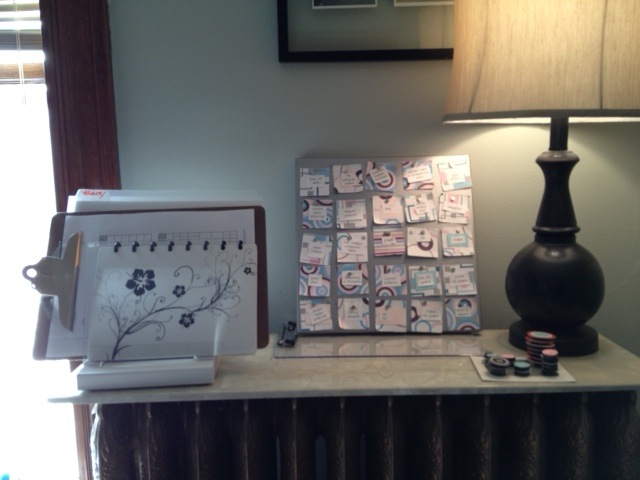
So each night as I clear my desk, I put those papers away in the file sorter. I know they’re there. They’re in sight. Nothing’s getting lost. And everything looks nice.
It’s feeling good. Yesterday, I had a very busy day and I needed to go upstairs for dinner. But I took two minutes to clear off my desk. It was so easy to put everything away. And it was so wonderful to be greeted by a clean desk this morning.
Clearing off your desk at the end of each work day is one of those daily habits (like running and emptying the dishwasher daily, in my world) that reaps huge dividends. It’s interesting to me that I’d let it slide. But the reward is so instant that I’m going to consciously make the effort—just like I did back in 2008—to keep it going.
If your work gets off to a slow start in the morning because your desk is a mess, I encourage you to try implementing this habit! It also makes work throughout the day easier, because you only have a day’s worth of stuff, at maximum, to negotiate around.
Worth repeating: Handy tool for organizing your taxes
I originally posted this endorsement of Smead’s Tax Organizer almost a year ago. I was back helping the same client with her taxes this week, and we used the tax organizer again. We actually bought a new one and she stored her supporting documents in the old one. Consulting last year’s organizer made this year’s taxes even easier. If you’re compiling documents for your tax preparer, you might find this product handy.
The good folks at Smead sent me their Tax Organizer a six-pock letter’-sized file that helps you assemble your tax information.

I didn’t have a use for it myself, since I use Freedom Filer odd year/even year tax files to gather my taxes year-round and then I do my own taxes with Turbo Tax.
But yesterday I helped a client assemble her tax documentation for her accountant. I’d set her up with a Freedom Filer system, so her documents were all in one place (hooray!), but I brought along Smead’s Tax Organizer in case it might be helpful.
As we went through the workbook her accountant provided and gathered documents into the categories he designated, we used the Tax Organizer to hold everything. It comes with pre-printed labels (which I supplemented with hand-written removable labels as necessary) and we were able to compile a very organized, portable packet of information.
My client was pleased and she’s sure her tax preparer will be pleased as well. When she gets the organizer back, she’ll store it for the same use next year (because the Freedom Filer hanging file folders are working so well for her for year-round filing of tax documents and receipts).
If your taxes are simple, you could use the Tax Organizer go gather your documents as they come in throughout the year. Even if they’re more complex the Tax Organizer might help you, like it helped my client and me, in terms of creating portable document storage to hand off to your accountant.
Search
Recent Posts
- Worth repeating: Figuring out what to watch on TV
- The power of incremental progress
- Podcast guest spot on the role of organization for folks with chronic illness
- No excuses series (part 3): "It was a present"
- No excuses series (part 2): "I paid a lot for that item"
- No excuses series (part 1): "But I might need it!"
- Retiring the New Organizer Guides
Tags
About Janine

Hello! I’m Janine Adams — a certified professional organizer based in St. Louis, and the creator of Peace of Mind Organizing®.
I love order, harmony + beauty, but I believe that the way that you feel about yourself and your home is what truly matters.
If you’re ready to declutter with a purpose and add more ease to your life, you’ve found the right blog — and you’ve found the right company.
read more »Links
- Institute for Challenging Disorganization
- Ravelry
- Getting to Good Enough podcast
- Shannon Wilkinson, life coach
- National Association of Productivity and Organizing Professionals
- Peace of Mind Spending
- Organize Your Family History
- Are you interested in becoming a professional organizer?
- NAPO St. Louis