Organizing + Knitting = My idea of a good time
I’m an avid knitter. I’m certainly not an expert knitter, but I knit virtually every day. One thing that every knitter knows is that you can acquire a lot of things with this hobby. There are the knitting needles (straight needles in different lengths and sizes, circular needles in different lengths and sizes, double-pointed needles in different lengths and sizes…you get the idea), the notions, the books, magazines, patterns printed off the internet and, of course, the yarn. Ah, the yarn.
The thing is that you have to be able to find what you need in order to use it. And you need to know what you have. When you’re in your LYS (local yarn shop) and you fall in love with a certain type of yarn, you can’t use it unless you have the right needles. So it’s really helpful to know what needles you have. And to have a portable list. I just made a chart of my circular needles in anticipation of a trip to Knitorious, my favorite LYS. I could make one for my straight needles, but I pretty much have all sizes of straight needles.
As I gathered up my inventory of circular needles, I reorganized them. I moved my good ones (the Addi Turbo and Crystal Palace bamboo circulars) into a binder full of resealable bags that’s sold to fisherman for their flies and worms and so forth. Mine’s called a Finesse binder. I read about the concept here on Knitter’s Review and I just love it. The binder is soft-sided nylon, it’s small, it has handles and it easily accommodates my 20 circular needles. The only downside is the big Bass Pro Shops logo embroidered on its side.
Organizing my stash of yarn is a whole different matter. I’m actually someone who doesn’t usually buy yarn unless I have a project in mind. Otherwise, the yarn weighs down on me. My current project, the Barbara Walker’s Learn-To-Knit Afghan required a lot of yarn up front, which I’m storing in a file box. I have a pretty box from Restoration Hardware (I received a gift in it) that holds other yarn. There are lots of ways to think about organizing your stash—by weight, by color, by fiber, to name a few—and I enjoy thinking about that. But for now I don’t need more than afghan and non-afghan.
I have to mention the wonderful purse organizer I purchased from Kangaroom Storage that I’m using to store works-in-progress, as well as a couple of my bulkier finished projects (a poncho and a shawl). It hangs in a closet and is set up perfectly to hold my WIPs. It makes me so happy to look at it.
I’d actually rather knit than organize my knitting, but part of the joy of being a professional organizer is that I can organize my needles and call it work, whereas I feel guilty knitting during the workday. But apparently I have no qualms shopping during the workday. Now that my needle inventory is complete, I’m off to the yarn store to see about some yummy yarn to make some winter scarves.
Backsliding
In the organizing field, particularly for organizers who work with chronically disorganized people, backsliding is all too common. You leave a client with systems in place, skills transferred, attitudes and motivation high, and then you stop hearing from her. You try to contact the client and when you finally reach her she admits that she’s lost control again. She’s ashamed of this and rather than reaching out to get more help, she just doesn’t call. What she probably doesn’t realize is that this happens all the time and it’s nothing to be ashamed of.
As I stare at cascading stacks of paper on my desk, I understand this all too well. I don’t think I’m chronically disorganized—though sometimes I feel like I am—but oh I struggle with the piles. At this moment, I have a project I need to be working on and I can’t find the papers I need. They’re not in the appropriate file and I can’t immediately find them in the pile.
I’m a backslider. Sometimes my desk is beautifully neat; in fact, I try to make sure it is every night before I stop work. There’s a place for everything. But for whatever reason, I have a hard time making myself put things in their place. I love doing this with clients. But my own piles of stuff are a huge drag.
If you’ve experienced backsliding, where you get everything in place and before you know it it’s all messy again, take heart. It might mean that your systems aren’t right for you. But it might say more about your attitude and motivation than anything. I know what a pleasure it is to have a clean desk. I know for a fact that it helps my productivity. But I can’t get myself to maintain it all the time.
So right this minute, I’m tempted to turn a blind eye to my messy desk and start in on the writing project that’s on the top of my list. But I think my day will be more productive if I take 15 minutes and put everything away. When I write it like that, it seems like a no-brainer. So I’m going to try it. But first I’m going to take a picture of the mess.
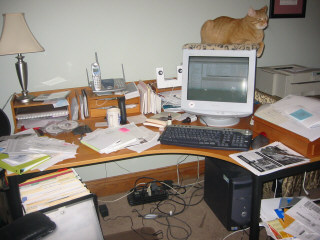
This desk was making me nuts.
Well, it took 30 minutes not 15. But at the end of that half hour, my desk looks like this.
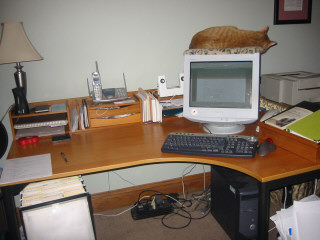
The cleaned up desk 30 minutes later
Notice that my cat, Joe, is unimpressed by the whole process.
I have to say that I’m feeling incredibly empowered. I can face my work with a clear head. I’ve accomplished something tangible. I made the right decision by taking the time to clear my desk. I’m going to try very hard to make sure it’s clean at the end of the workday. I’m on the road to the peace of mind I always crave.
What is Organized?
How many times have you heard people say, “I need to get organized”? But what do they mean by that? How do they measure, “organized?” As a professional organizer, I think about this a lot. To me, organized means being able to put my hands on what I need when I need it. As long as I know where things are and can find them easily (and that includes finding appointments in my calendar), I feel organized and in control. Even if something’s in a stack, as long as I can grab it swiftly, that’s organized. So for me, organized doesn’t mean that everything is put away and that all surfaces are clear. And in fact, neat spaces aren’t necessarily organized.
You might not agree. I’ve had clients who feel out of control if they have a stack or two on their desk they can’t seem to get rid of. That’s okay—I’m happy to help them figure out how to get rid of those stacks.
I’ve come to the conclusion that “organized” is a state of mind. It’s great to feel organized. I think people who feel organized are happier, with less stress and higher self esteem. Is there such a thing as too organized? No, as long as the level of organization of the individual feels right to them. I’m pretty casual, so sometimes I feel uncomfortable around or overly controlled by a Type A super-organized person. But as long as they’re happy (and they’re not making the people they live with crazy), that’s okay.
The bottom line is that “being organized” is an individual thing. I shouldn’t impose my standards of organization on anyone (which can be a challenge in my line of work). Likewise, you shouldn’t judge me because an occasional stack of paper languishes on my desk and it doesn’t bother me. Perfectionism can be the enemy of the organized person. I encourage my clients to be “organized enough.” If it’s desirable and achievable for you to have a house that would make Martha Stewart proud, go for it. But if not, don’t beat yourself up. Strive to find the level of organization that makes you feel comfortable and in control, then work to maintain it.
What’s your definition of organized?
Search
Recent Posts
- Our 300th episode!
- Worth repeating: Figuring out what to watch on TV
- The power of incremental progress
- Podcast guest spot on the role of organization for folks with chronic illness
- No excuses series (part 3): "It was a present"
- No excuses series (part 2): "I paid a lot for that item"
- No excuses series (part 1): "But I might need it!"
Tags
About Janine

Hello! I’m Janine Adams — a certified professional organizer based in St. Louis, and the creator of Peace of Mind Organizing®.
I love order, harmony + beauty, but I believe that the way that you feel about yourself and your home is what truly matters.
If you’re ready to declutter with a purpose and add more ease to your life, you’ve found the right blog — and you’ve found the right company.
read more »Links
- National Association of Productivity and Organizing Professionals
- Shannon Wilkinson, life coach
- NAPO St. Louis
- Are you interested in becoming a professional organizer?
- Peace of Mind Spending
- Organize Your Family History
- Institute for Challenging Disorganization
- Getting to Good Enough podcast
- Ravelry