My hands-down favorite bullet journal
I’ve been bullet journaling since January 2022. I use my handy journal to write down everything that happens in my day. I use it for my task list and to capture any information that I don’t want to forget. (Click here for links to more of my blog posts about bullet journaling.)
I’m so glad I started bullet journaling when I did because it helped me keep everything together when I had to move my dad into assisted living and sell his house. After he passed away a few months later, my bullet journal helped me keep track of all the information about his estate. (I was the executor.) I did not have another system in place that would have handled all that information as well.
I kept on with the bullet journaling and it came through for me again in 2024 when my husband and I decided to sell our house and move to an apartment. My bullet journal allowed me to capture all the information needed to downsize our belongings and move and then renovate and sell our house. I took care of the bulk of that while my husband was in the hospital for nine weeks getting a new heart. I’m telling you, there was a lot of information to keep track of. The bullet journal kept me sane.
When I fill up on journal, I start another. I’m currently on my 20th bullet journal. It took me ten tries to identify a journal that I really love and my most recent ten are all the same (with different colored covers). I wanted to share the details of that journal for the curious because my love for them has not lessened in the slightest.
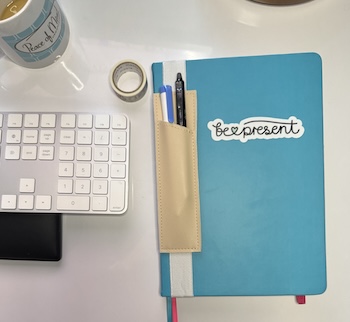
My bullet journal of choice is the B5 Dotted Journal Pro from Scribbles That Matter. I prefer the 120 gsm paper weight.
Why do I love it? For so many reasons:
- The 120 gsm paper is heavy enough to prevent ink from bleeding through but not so heavy that the journal itself is hard to carry around.
- The B5 size (7 inches x 10 inches) is spacious enough for me to write freely without feeling cramped.
- The subtle dot-grid pattern helps me write in a straight line but doesn’t hem me in.
- It has page numbers.
- There are four pages at the front with a pre-printed form for an index, a critical component of using the journal
- It has a nice leather-like hard cover and opens flat (and stays open).
- It comes in lots of fun colors.
Each of my otherwise identical journals has a different colored cover (though I’m starting to repeat colors) and I put a fun sticker on the cover of each. I keep a running note (in Apple Notes) with a timeline of the journals so I can easily pull the right one (identified by color and sticker) off my shelf.
These 215-page journals are not inexpensive—$35 each when bought on Amazon. But for me they are well worth the cost.
I have not been tempted to look beyond Scribbles That Matter for my next journal. In fact, I’m relieved that my search is over. If you’re a bullet journaler (or an aspiring one), I urge you to give this one a try! If you want more info on my bullet journal supplies, check out this post from 2025 on my other go-to BuJo supplies. If you’d like to learn more about how I bullet journal (everyone does it differently), check out my 2025 BuJo series.
Worth repeating: Furthering your goals one tiny step at a time
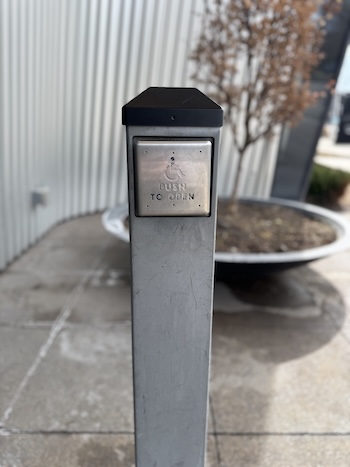
I originally wrote this post just over a year ago. I’m happy to say I’m still working with my trainer every week and I’m growing stronger! I’m also happy to report that opening the door myself instead of pushing a button is one small behavior change that’s now fully entrenched. I love tiny changes like this that make a difference so I thought I’d share this post again.
I’ve been trying to exercise more and build strength, balance and flexibility. I’ve hired a trainer, who has been really helpful. But I’m also on the lookout for small changes I can make that will contribute to that goal.
I created one for 2025 that’s been amazingly easy to implement and that I hope will make a difference:
I stopped using automatic door openers.
I live in a high-rise apartment building and, naturally, there are buttons to press to open the building’s heavy doors to the outside and to the elevator lobby. (They’re intended for people with disabilities to use.) Going in, you hold your fob to the lock, then when the light turns green, you can push a button that will open the door. Going out, it’s the same thing but you don’t have to use your fob.
I decided at the beginning of the year to pull or push open the doors, rather than pushing the button. There are, I think, six doors in our building that have automatic openers. When I first moved in, I would push the button without thinking about it. Now I never use it. I can’t help but think that using my arm muscles this way six or eight times a day will help me become more fit!
The thing that amazes me is how easy it was to make the change because it’s such a small thing. It was more of a mindset shift than anything.
Are there tiny things you could do to help further your goals? Maybe it’s parking further away from the store to get more steps in. Or taking the stairs instead of the elevator.
Or maybe it’s putting your keys in a designated spot each time you enter your home so you don’t have to look for them when it’s time to leave. Or putting your dirty clothes in the hamper, rather than leaving them on the floor. That’s a small thing that can make a big difference.
I encourage you to keep your eye out for little changes you can make in your daily life to help you reach your goals more easily!
Getting to Inbox Zero (again)

I tend to consider myself someone who’s good about staying on top of email. (I’ve certainly blogged about it enough.) But in 2026, I’ve let the email in my peaceofmindorganizing.com email inbox pile up. (I use an iCloud address for shopping and other personal things and I don’t mind that it’s always voluminous.) I think part of the problem is that I’m doing a bunch of administrative work around implementing a new costumer relationship management system for the business and my brain is fried by the end of the day. And then, of course, the bulging email box feels overwhelming.
But today I decided to get serious about it.
I wrote on my task list, “Spend 30 minutes on email.” I started the day with 331 emails, 165 of which were unread. My goal was that by the end of the 30 minutes, I’d have fewer than 20 emails in there. (I read and process my email in my MacBook’s email client.)
Here’s how it went:
- I set a timer for eight minutes. Then I sorted my messages by sender. That allowed me to do some bulk deletes, like the many-times-a-day emails I am sent by the Washington Post. I’m not great about deleting those in real time. So in my first eight minutes, I deleted a ton of messages pretty easily. At the end of those eight minutes, I had 131 messages left, 29 of the unread.
- I set a timer for four minutes and continued going through my inbox. I deleted and archived a lot of messages. At the end of the four minutes, I had 47 messages, none of them unread.
- A little while later, I tried again, setting my timer for four minutes. By then, some emails had come in, so my starting point had gone up to 52 messages. These messages were tougher—they actually required some effort. They either needed a response or they served as reminders for actions I needed to take. So I only whittled my box down by 6 messages in that four-minute burst, to 46 messages. (But I got stuff done that had been languishing!)
- I stepped away for a few hours and when I came back, I set my timer for 10 minutes. (I forgot to look at the new starting point.) At the end of the 10 minutes, I was down to 21 messages.
You may recall that my goal had been 20 messages so I almost stopped there. But 21 isn’t 20 and I decided to spend a little more time and close to zero I could get it.
I didn’t set a timer and I don’t know how long it took (maybe 15 minutes?), but I got my inbox down to ZERO messages! Break out the champagne! Now that I’m at ground zero it will be so much easier to keep up.
To recap, in 26 minutes of focused effort today, I reduced my inbox from 331 messages to 21 messages.
And then I went ahead got rid of the rest.
For me, the real key to dealing with accumulated emails is sorting by sender because it makes it so easy to bulk delete or archive messages. And of course this is a great opportunity to unsubscribe from newsletters that you don’t read. I did some of that too.
I don’t think Inbox Zero as a daily practice is sustainable for 2026 me. I did it for months back in 2011 and maybe I’ll surprise myself. In any case, I’m hopeful that the effort I made today will motivate me to at least delete the low-hanging fruit every day.
Compensating for a fading memory
I miss my excellent memory. When I was in my twenties, I had a mind like a steel trap. Oh, the things I could keep in there and recall in a nanosecond! It made me a valuable employee and my ability to keep details straight and handle logistics well allowed me to work on some great projects. For example, I organized—and attended—a small conference in Kenya with participants from all over the world. I organized it from my office in Washington, D.C.. And I did it without the internet. It boggles my mind.
I was 42 when I started Peace of Mind Organizing in 2005 and now I’m 63. Believe me when I tell you that I’ve had to come up with ways to compensate over the years for the fact I’m not able hold a zillion facts in brain like I used to. So what do I do? I ease the stress on my brain by not even trying to remember.
Here are some of the tools I use instead of relying on my memory:
- I’d be lost without my Bullet Journal. I keep task lists and chronological notes about everything in it. And I update an index in the front of each journal every week to make it easy to find my notes.
- For money-related questions (like “what did I pay for that thing?” or “did I really subscribe to that app?”) I can count on YNAB the amazing spending app that I update daily. FYI, that’s a referral link; if you click on it and end up subscribing, we’ll each get a free month added to our description.
- I put all my appointments in my electronic calendar on my Mac (which syncs with my iPhone). I can’t even imagine trying to keep track of my schedule in my head!
- I find myself consulting emails and text threads to remind myself of communications. It’s one reason I prefer email or text to the phone—it means I don’t have to rely on my memory of a conversation.
- I set alarms a lot on my phone. For me, alarms have more impact than reminders. If I need to reach out to somebody in an hour (or in a few minutes), I will set an alarm (with an appropriate label) rather than just try to remember. My husband and I drive an electric car and there are only two chargers in our apartment building. So it’s important for us to move the car from the charger in a timely manner. The alarm is a life saver!
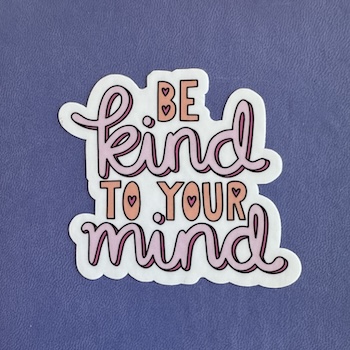
At 63 though I’ve become more forgetful, I’m still going strong. Thanks to these tools, I’m doing great. I’m not going to lie: I do miss the amazing memory I used to have. But I also cut myself a lot of slack. I’ve earned the right to ease up on my brain and be kind to my mind!
My latest productivity boon: The Big Three
These days my team members work with clients while I run the business (and do YNAB coaching). That means I have a lot of time at my desk and a very long to-do list. Over the last (gulp) 30 years of self employment I have gotten better at being self motivated and productive. (When I was a writer from 1995 to 2005 I turned procrastination into an art form.)
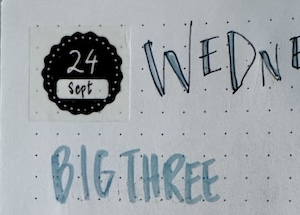
A few months back (on September 9, 2025, to be precise), I started coming up with three tasks that I wanted to accomplish before lunch. The header for that list of tasks is Big Three. I make them the first entry for the day in my Bullet Journal. I try to come up with the three items before I go to bed at night. Then, once I’m at my desk in the morning I have a clear roadmap for what I need to do.
It’s been a game changer for my productivity and for making sure the urgent items are accomplished. I try to include at least one non-urgent but important item in there as well.
More than that, my Big Three practice frees my mind of the pesky, “What should I work on?” question. And it helps me get right to work after I get back from walking Bix rather than, say, checking out Facebook.
I leafed through two Bullet Journals to figure out what day I started doing this and noticed that, in the first month or so, there were quite a few days where I didn’t list a Big Three. It clearly took me awhile to get into the habit and remember to come up with it. Now it’s ingrained (though I give myself the weekend off).
The Big Three practice coupled with the habit of clearing off my desk at the end of the work day (something that’s so easy to do if I do it every day) make my work day so much more pleasant. If you’d like to improve your productivity, you might give it a try!
Meet my newest employee!
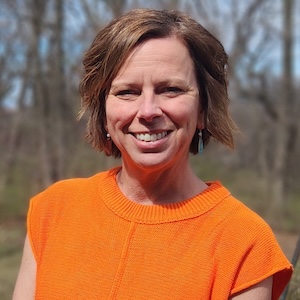
I am excited to introduce you to the newest member of the Peace of Mind Organizing team: Jen Schroer.
Jen joined us last month as an Assistant Organizer, and I think she’s going to be a great addition to the team. She’s calm, compassionate and non-judgmental. And she’s a hard worker. She’ll be working alongside Beth and Lydia as an integral team member.
Jen has a background as a nurse and a wellness coach and she has an abiding love for organizing. She’s great at listening and helping people break overwhelming situations into manageable steps. That’s so important in our work, because organizing goes way beyond the physical stuff. It’s about helping people feel less stressed in their own homes.
Jen is a big believer in outer order, inner calm (shout out to Gretchen Rubin!), and she loves seeing how a more organized space can help someone feel lighter and more at ease. She’s particularly drawn to organizing the spaces where daily routines happen, like kitchens and bathrooms, because small changes there can make a big difference.
I asked Jen for a small change she likes to make in a kitchen or bathroom that has big impact. She said she loves wrapping boxes in fun contact paper and using them to store items—especially in open cabinets—because it keeps things tidy and also stylish. I love how that turns everyday storage into something that feels intentional.
A few fun facts: Jen moved to St. Louis from Overland Park, Kansas when she was just six months old. She’s a world traveler and a homebody wrapped into one package and is always dreaming about the next vacation. She lived in New Zealand for a year, has enjoyed a sailing trip in the USVI/BVI, and checked Greece off her bucket list last year. Next up on her wish list: Switzerland, Iceland, and Croatia (and honestly, I bet there aren’t many places she wouldn’t like to go!).
Jen shares her life with her husband and her beloved dog, Emmy, a husky/pitbull mix. Emmy’s favorite toy is Pinky. She carries Pinky around at all times, just in case someone might play catch. Jen says it’s the only toy Emmy hasn’t destroyed.
Jen says, I meet people where they are with no judgment, no pressure. Life gets busy and seasons change. My goal is simply to help things feel easier and more peaceful. I love helping clients see possibility where they used to feel stress and make big tasks feel less intimidating.
Jen is going to make a great addition to the team and I’m so happy to have her. If you’d like to learn more about Jen (and Beth and Lydia), you can visit our Meet the Team page.
Worth repeating: My perfect Bullet Journal pen
Today I was setting up a new Bullet Journal and started thinking about how much I love the Pilot Frixion Synergy 05 clicker erasable pen. I absolutely love that I can write with a pen without worrying about making mistakes. And I love the quality of the writing experience. I’ve been using them for more than two years and in March 2024 I wrote about why I love them. Since my love is still going strong, I want to share again. Here’s that post.
I have been using a Bullet Journal to keep track of everything in my life since December 2021. I’m on my 13th handwritten journal. (I love B5 size dot grid journals. My current favorite is from Scribbles That Matter 120 GSM Dotted Journal – Pro.)
I like making my Bullet Journals pretty without going overboard. I tend to write with a black pen but use a lot of Zebra Mildliner highlighters (I use both brush and chisel points) and Sharpie S-Note Duo for color when I need it. (Check out this October 2022 post about my bullet journals for more details on how I journal.)
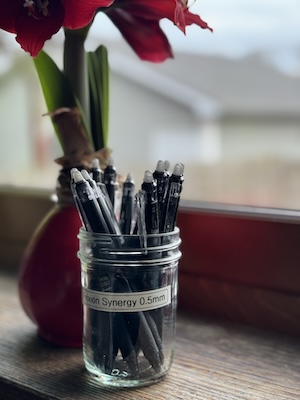
After careful trial and error, I have found what for me is the perfect black pen for bullet journaling. It is the Pilot Frixion Synergy 05 clicker erasable pen with black gel ink. There’s so much to love: It’s an extra-fine point pen that writes smoothly. It’s completely erasable—it uses a special thermosensitive ink that disappears when rubbed with the pen’s “eraser” because of the heat generated by the friction. (There’s no eraser dust!) This pen comes in colors, though I primarily use black. And it’s refillable.
I go through a lot of these pens and on Amazon I buy this set, which comes with refills
Pilot has a variety of Frixion pens, including erasable highlighters. I have some, but I find they don’t erase completely and seem to leave a little bit of a residue. I’ve also enjoyed this set of Pilot Frixion Waai retractable pens from Japan that come in pretty, soft colors. I bought them at JetPens, my favorite purveyor of Japanese stationery supplies.
One thing worthy of note is that since the Frixion ink is thermosensitive it could disappear if exposed to high heat (like in a hot car). The JetPens website says that putting the paper in a freezer will magically bring back the ink. I’m glad to say I have no personal experience with this. I do avoid using this pen to address envelopes.
My quest for the perfect pen for bullet journaling ended when I found this particular Frixion pen (the Synergy 05 clicker), which glides nicely over the page and erases without any dust. I just had to share with other pen-and-paper enthusiasts!
Search
Recent Posts
- Worth repeating: Figuring out what to watch on TV
- The power of incremental progress
- Podcast guest spot on the role of organization for folks with chronic illness
- No excuses series (part 3): "It was a present"
- No excuses series (part 2): "I paid a lot for that item"
- No excuses series (part 1): "But I might need it!"
- Retiring the New Organizer Guides
Tags
About Janine
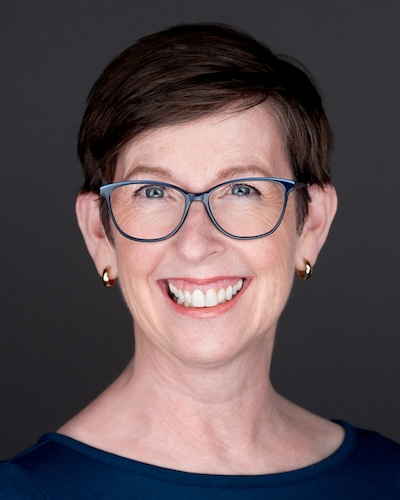
Hello! I’m Janine Adams — a certified professional organizer based in St. Louis, and the creator of Peace of Mind Organizing®.
I love order, harmony + beauty, but I believe that the way that you feel about yourself and your home is what truly matters.
If you’re ready to declutter with a purpose and add more ease to your life, you’ve found the right blog — and you’ve found the right company.
read more »Links
- Getting to Good Enough podcast
- Ravelry
- Shannon Wilkinson, life coach
- NAPO St. Louis
- Institute for Challenging Disorganization
- Peace of Mind Spending
- National Association of Productivity and Organizing Professionals
- Are you interested in becoming a professional organizer?
- Organize Your Family History