Kitchen Stickin' makes labeling easy
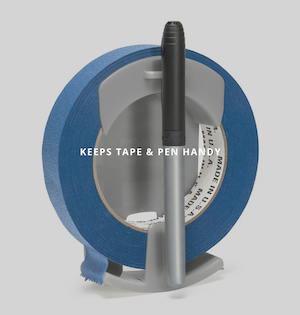
Recently, I was asked to try out Kitchen Stickin, a new product that makes labeling easy. The entrepreneur behind it lives here in St. Louis and I was happy to say yes. I’m glad I did!
Kitchen Stickin’ is a simple product: It’s a dispenser for painter’s tape with a place to hold a marker. It comes with Command strips so you can easily adhere it to a cabinet or the refrigerator so that you always have an easy way to label something. (It comes with the tape and a marker!)
I absolutely love simple solutions to common problems and Kitchen Stickin’ fits the bill. As soon as it arrived, we used the Command strips to put it on the side of the refrigerator, where it’s actually out of view. I can now easily pull off a piece of blue painter’s tape to label leftovers or other containers. I’d never labeled my leftovers before, but I find it so handy! For less ephemeral items in the kitchen, I would typically use my beloved Brother P-touch Cube label maker, which connects with an app on my phone. But using painter’s tape is so much easier than getting the label maker out and fiddling with technology.
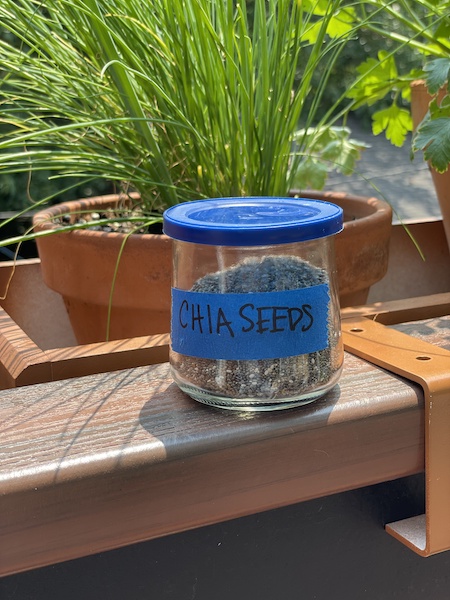
I recently started eating overnight oats for breakfast and one of the ingredients is chia seeds. I bought a large container of chia seeds at Whole Foods and since I only use a teaspoon at a time, I decanted some into one of my favorite small containers, a Oui yogurt jar so the seeds would take up less room in my kitchen cabinet. (I stored the bulk of the chia seeds in overflow storage.) I quickly made a label for it using Kitchen Stickin’. So gratifying. Here’s a photo of that labeled jar.
Its uses aren’t limited to the kitchen, of course. I’ve used it for a label on a container of a particular collection of lettering pens, for instance. Having the tape and marker together in an established location makes labeling anything easier. And I’m all about ease (and labels!).
In case you’d like to try it, Kitchen Stickin’ has offered Peace of Mind Organizing blog readers a discount! Use the discount code PEACEOFMIND at checkout to get a 10% discount on your entire order. Or click on this link to go to the website and automatically get your discount.
The storage items organizers can't live without
Consumer Reports recently published a story on its website called 10 Organization Pros on the Storage Items They Can’t Live Without. The writer contacted ten professional organizers and asked a simple question: “What is the one storage item you can’t live without?”
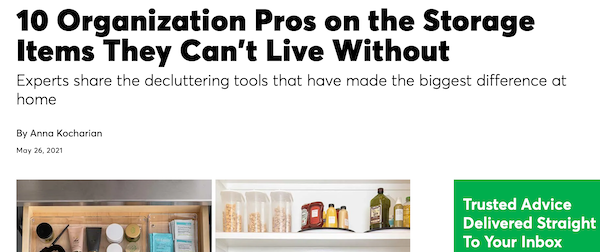
I was tickled to be one of those ten organizers. I didn’t agonize over my choice because it was obvious to me. I chose the Linus drawer organizers I use all over my home. But when I read the article and saw the choices of the organizers, I kept nodding my head because I have (literally) all of those things in my house too! I think this is a great compilation of suggestions and I urge you to check it out.
My Inbox Zero challenge
I love the feeling of an empty inbox. The goal of Inbox Zero can feel elusive. For some people it may feel impossible. I know some people who think it’s a laughable goal. Not me. To me, Inbox Zero is not only achievable, it’s highly worthwhile. I’ll admit, it’s a wagon I fall off frequently. But once I get back to Inbox Zero, it feels so good.
It’s worth the effort to take a little time at the end of each work day and empty my email inbox. Here are just a few of the benefits I see:
- I have only one day’s worth of email to deal with
- I respond to messages more quickly
- I take action more readily
- My inbox is much more welcoming and less overwhelming
So why is it so hard for me to maintain Inbox Zero? I think like so many things, it’s a habit that’s relatively easy to maintain on a daily basis. But if you let a backlog build up, it quickly becomes overwhelming. I don’t tend to let my janine@peaceofmindorganizing.com email inbox get really full. It rarely tops 100 for any length of time. But unless I’m focused on achieving Inbox Zero, I usually stop at about Inbox Twenty. Those last 20 messages are typically reminders to do something or they’re emails whose responses require thought.
One morning last week I woke up and told myself I was going to achieve Inbox Zero that day. I did it before noon. All it took was actually doing a few of those tasks, adding a couple to my task list then archiving the messages, and writing a few responses. (A couple of the emails had even aged out.)
Since then, I’ve emptied my inbox every day. It feels great starting the day with just those emails that came in since the close of business the day before. (If you’re interested in some tips about whittling down your inbox, check out this post, Slaying the email dragon that I wrote at the end of 2019.)
Today is July 12. I know the value of public accountability to keep me focused on something. (Witness the 30 × 30 challenges I do on my genealogy blog about six times a year.) So I am making the following pledge to you (but really to myself, because you probably don’t care):
I will empty my inbox every day for the rest of July.
At month’s end, I’ll write a post and let you know how it goes. And if you care to join in any commitment toward making email easier for you, please do!
Less stuff = more freedom
We’re celebrating Independence Day here in the U.S. and, as I do almost every year, I’ve been reflecting on what freedom means to me.
I created a graphic.
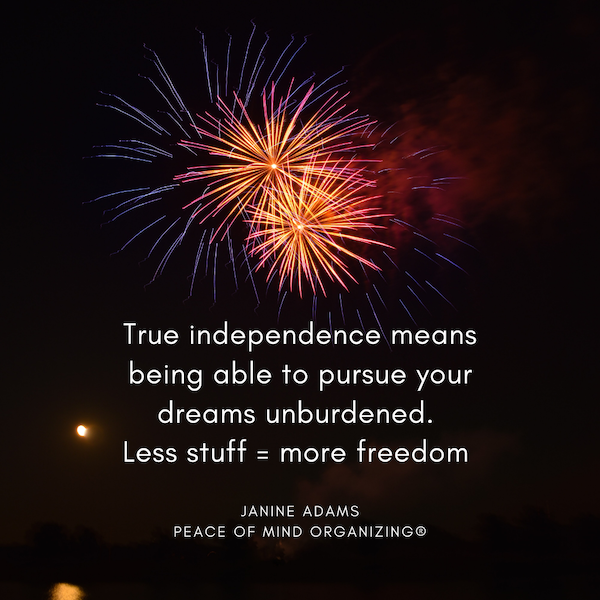
This month marks the 16th anniversary of Peace of Mind Organizing®. I’ve worked with hundreds of clients. And this simple truth continues to be reinforced with each one of them.
Worth repeating: Nine things I love about Yoga with Adriene
I’ve been doing yoga every day for over a year. I went from April 1, 2020 to May 12, 2021 without missing a single day. Then travel disrupted my routine and I broke the chain. But yoga is so beneficial that I got right back into it and I can count the number of days I’ve missed on one hand. I wrote this post about a year ago. Since then, my love for Yoga with Adriene has only grown.
Back in December 2018 after a visit from my niece, Miranda, who does a yoga workout on the Yoga with Adriene YouTube channel every morning, I decided to give yoga a try. I’d been toying with it for eons but had been paralyzed about how to get started. And I knew I really wanted at-home yoga.
I did daily yoga for three months before I broke the chain and my practice became more sporadic.
Then along came COVID-19. Since I’ve had fewer demands on my time, I have been able to incorporate yoga into my daily routine. I am so grateful for that. This morning, when I finished my practice, I jotted down some of the things I love about doing yoga, particularly doing it with Adriene. I thought I’d share them with you in hopes that I might inspire you to give it a go!
- I’m getting stronger and more flexible. I’m 57 years old. I am absolutely thrilled to be getting stronger and more flexible, not the other way around.
- It’s good for my body and my mind. Stilling my mind, breathing deeply and moving my body are absolutely what I need right now.
- It’s gentle. Adriene is such a kind and gentle communicator. Her workouts are full of love and body acceptance. She suggests modifications for every pose and normalizes the idea that you might be not able to do all the stretchy bendy things she can do.
- Adriene is funny. She’s a yoga goddess with a beautiful body but Adriene is self-deprecating and makes funny comments all the time. (Today she bowed her head, then commented, “I see toothpaste on my shirt. Class act.”)
- There are many options, but I don’t have to make a choice. I’m easily overwhelmed by options. Adriene offers 30-day yoga journeys every January where you just do the workout designated for that day. (You can start any time.) No choice necessary. She also offers a themed calendar every month, so you can do the workout for that day. (This month the theme is, appropriately enough, Courage.) So far, I’ve done three different 30-day journeys, two of them twice. I’ve done 2020’s Home twice, 2015’s 30 Days of Yoga twice and 2019’s Dedicate once. [In January 2021, I did Breath, which was fantastic.] I love that I don’t necessarily have to choose which of her many videos to do!
- The workouts are varied but there’s continuity. Each workout has some sort of theme—it might be for a certain part of the body (today I did neck and shoulder relief) or it might be to create a certain feeling, like “Soften.” After doing it this long, the yoga poses are familiar but there endless ways to put them together and each workout feels fresh to me.
- It’s free! Adriene does have a paid community, but all the workouts on her YouTube channel are free. And they’re not interrupted by ads.
- I get to do yoga in my pajamas. I know if would be very hard for me to leave the house to do yoga. Now, I just have to take a few steps from my office to my guest room to do yoga in the morning. And most mornings I do it in my pajamas. Talk about letting it be easy!
- Benji. Adriene’s Australian Cattle Dog, Benji, is present in almost all the videos. He’s calm and zen and adorable. Usually he’s extremely well behaved but occasionally he does something funny (like the time he sat on Adriene’s head when she was in child’s pose.) Adriene always acknowledges him and treats him with love.
The bottom line is that I’m really glad Adriene Mishler is part of my life. I wish I knew her in real life but I will settle for welcoming her into my home via my computer every morning. I truly feel love for her. Thanks to her, I’m healthier, stronger, and calmer. I wish that for you, too!
The importance of joining a NAPO chapter
Five years ago I wrote a post on the value of joining a local NAPO chapter for professional organizers. Since then, I rotated off the board of NAPO-St. Louis and joined again this year. So it seemed like a good time to update this article. After being an active member of NAPO-St. Louis for fifteen years, I still wholeheartedly believe in its value!
If you’re a professional organizer, I hope you’re lucky enough to live where there’s a local chapter of the National Association of Productivity and Organizing Professionals. And if you do live near one, I hope you’ve joined it!
When I started Peace of Mind Organizing® in 2005, the first thing I did was join NAPO. The second thing would have been to join NAPO-St. Louis, except it didn’t yet exist. Thanks to the hard work of others, the chapter was established in 2006 and I was lucky enough to be a founding board member.
Through the last 15 years I’ve remained involved with the chapter, serving on the board for the first six years of its existence, then taking three years off before joining the board again for another two-year stint from 2015-2017. After four years off, I rejoined the board this year as Director At Large. So clearly I’m invested in the chapter.
Here’s the pandemic-style photo collage of our members from the chapter website. This is a terrific group of people.
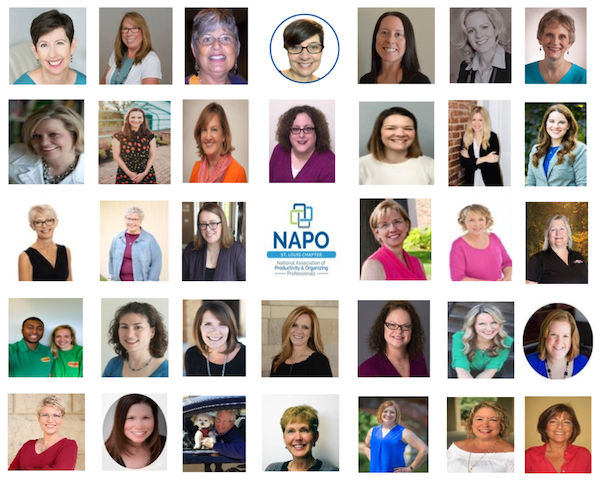
Why do I devote so much time and energy to the chapter? Because it gives so much back to me. Here are a few of the benefits of chapter membership:
- Camaraderie. For new and veteran organizers alike, the opportunity to spend time with like-minded people sharing advice and experiences is invaluable.
- Leadership experience. I’m pretty sure I wouldn’t be as good at leading my organizing teams or managing my business if I hadn’t had the experience of being president of the chapter from 2008-2010 (and again from 2015-2016). It helped form the kind of leader I’ve become.
- Education. NAPO-St. Louis meets in person 11 times a year and the chapter’s programs are really valuable. (Since May 2020, we’ve been meeting on Zoom but look forward to going back to in-person meetings.) We use both outside speakers and have programs presented by chapter members—there’s an amazing wealth of knowledge among our membership! The chapter also makes conference recordings available to its members as a membership benefit. (I’m certain this is a common chapter benefit.)
- Visibility. All chapter members are listed on the NAPO-St. Louis website, giving them another exposure to prospective clients.
- Referrals. When chapter members receive inquiries from clients they might not be right for, they’ll sometimes send them to me. And vice versa.
- Client resources. We have nine Business Partners of NAPO-St. Louis and I refer clients to them all the time. I can also look for resource recommendations from fellow members of the chapter on our online forum. The chapter makes me a better resource for my clients.
- Business development. My business model focuses on providing organizing teams. I have one employee, and the rest of my team members are independent contractors. All my team members are NAPO-St. Louis members. I’ve made membership in NAPO-St. Louis a requirement for my independent contractors, because, to my way of thinking, membership shows professionalism and a dedication to their businesses. I want to use contractors who are in it for the long haul. (Some of my independent contractors have been working with me for 13 years!) I can assure my clients that all my team members abide by NAPO’s Code of Ethics.
I honestly don’t know where my business would be without NAPO-St. Louis, but I’m pretty sure it would not have grown like it has. If you’re a PO or an aspiring PO I urge you to get involved with your chapter. It will reap huge dividends!
If you’re a NAPO member who doesn’t live near a local chapter, I urge you to check out the NAPO Virtual Chapter. If you’re a member of a NAPO chapter, please feel free to comment on what you get out of your chapter!
Go-bag to the rescue!
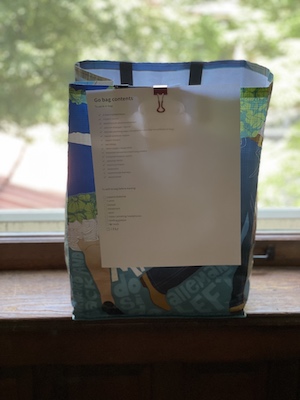
One of the tiny projects I included in my November Tiny Projects challenge was putting together a hospital go-bag. My husband had been hospitalized in October and then again in November with heart issues, so I took the time after that second hospitalization to create a go-bag that I could grab in the event of a sudden trip to the hospital.
I had clipped to the front of the bag a list of the contents of the bag, plus a second list of things I needed to add to the bag that he didn’t have duplicates of (like noise-canceling headphones and prescription reading glasses).
About a week ago, we made the decision to go to the emergency room. (I drove Barry this time, no ambulance necessary.) While he got dressed, I grabbed the go bag, consulted the list clipped to it and added a few things. It was so nice not to feel frantic about what to bring! It was a moment of calm in an otherwise disrupted day. When he was admitted to the hospital from the emergency room, he had everything he needed.
I felt so smart to have clipped the hospital parking pass I’d purchased to the bag itself. It offers significant parking savings ($4 vs $15 for a single parking session) and it was so great not to have to look for it.
Barry was in the hospital for two nights this time and when I got home, I replenished the go-bag and updated the list that’s clipped to the front. If you have someone in your life who is occasionally hospitalized, I encourage you to take 15 minutes and put something like this together. I am so glad I did!
Search
Recent Posts
- Worth repeating: Figuring out what to watch on TV
- The power of incremental progress
- Podcast guest spot on the role of organization for folks with chronic illness
- No excuses series (part 3): "It was a present"
- No excuses series (part 2): "I paid a lot for that item"
- No excuses series (part 1): "But I might need it!"
- Retiring the New Organizer Guides
Tags
About Janine

Hello! I’m Janine Adams — a certified professional organizer based in St. Louis, and the creator of Peace of Mind Organizing®.
I love order, harmony + beauty, but I believe that the way that you feel about yourself and your home is what truly matters.
If you’re ready to declutter with a purpose and add more ease to your life, you’ve found the right blog — and you’ve found the right company.
read more »Links
- Organize Your Family History
- Ravelry
- NAPO St. Louis
- Getting to Good Enough podcast
- National Association of Productivity and Organizing Professionals
- Shannon Wilkinson, life coach
- Peace of Mind Spending
- Institute for Challenging Disorganization
- Are you interested in becoming a professional organizer?