Happy surprises might be hiding in your mail

Over the years, I’ve encountered many clients who don’t open their postal mail. Some take it to extreme levels. I get it. Mail can be scary. I remember back when I was dealing with credit-card debt I would be afraid to open the mail and see my statements.
But I’ve learned that the truth is the truth whether or not you know about it. And ignoring your mail never helps.
Moreover, when you open your mail, you may find happy surprises. This happened to me recently when I received a letter from my health insurance company. (I get my health insurance on the marketplace.) I fully expected it to be a notice of a rate increase for 2026. But I cringed and went ahead and opened it.
It was a check in the amount of $1,119.26! I was incredulous so read everything in the accompanying letter. Come to find out, by law there is an audit every three years of companies who offer health insurance through the marketplace. If a company doesn’t spend at least 80 percent of its proceeds from premiums on health care, its members are due a rebate. (I’m paraphrasing from memory and probably grossly oversimplifying.) I’d never heard of this rebate, so wasn’t expecting it. And if I hadn’t opened my mail, I wouldn’t have known about it!
Three weeks later, I received an email from my health insurance company telling me I should have received a rebate, so I eventually would have opened the envelope if I hadn’t thrown it away.
Just like clearing off your desk, putting away your clothes or emptying your email inbox (and lots of other things), opening your mail is easier if you do it every day before it becomes overwhelming. And who knows? Maybe your effort will be rewarded by a surprise check in the mail! (Or something equally nice.)
Photo by Wolfgang Vrede on Unsplash.
20th anniversary reflection: The power of working with a professional organizer
Even after 20 years of helping others get organized, I still need help myself sometimes! This 2023 story reminds me why I fell in love with this profession in the first place—and why I still believe deeply in the transformative power of having support. (That’s why I had whole teams of organizers helping me when I downsized to an apartment in 2024.) Here’s a personal reminder of what we do…”
I’m always amazed at how often I put off dealing with clutter in my own home. If I give it some focused attention, I’m able to declutter and organize pretty easily. But if I add a professional organizer to the mix and the process is supercharged!
Last week, I asked one of my employees, Lydia, to help me declutter and organize four spaces: one of my bathroom closets, my food-storage containers and two of my pantry cupboards. I am so glad I did.
My house is 115 years old and most of his not been renovated. If you are a lover of old houses, you’d probably really like my house. It has plenty of “character.” The bathroom closets are functional but not at all customized for storage. I reorganized my primary bathroom closet a few years ago (again) and I just let disorder creep in to the point where I could barely stand it any more. So I reached out for help. And I’m so glad I did.
In two hours, that closet went from this:
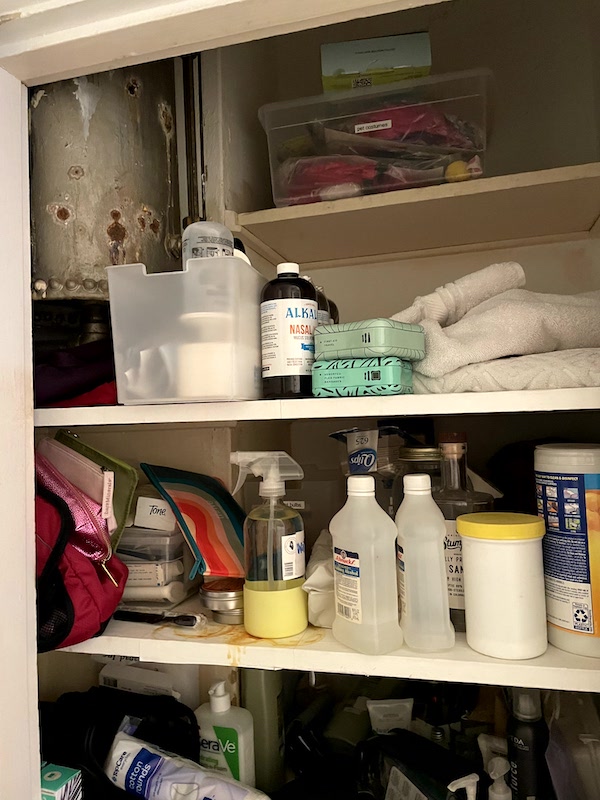
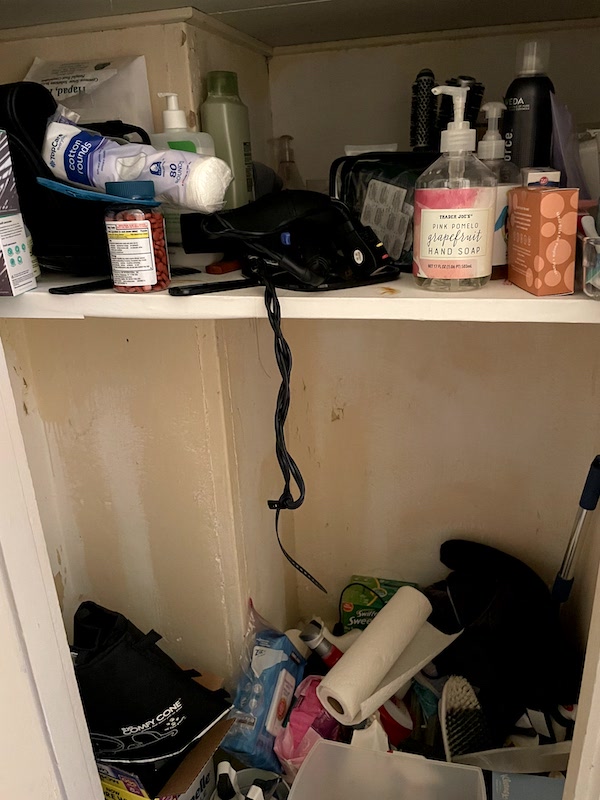
To this:
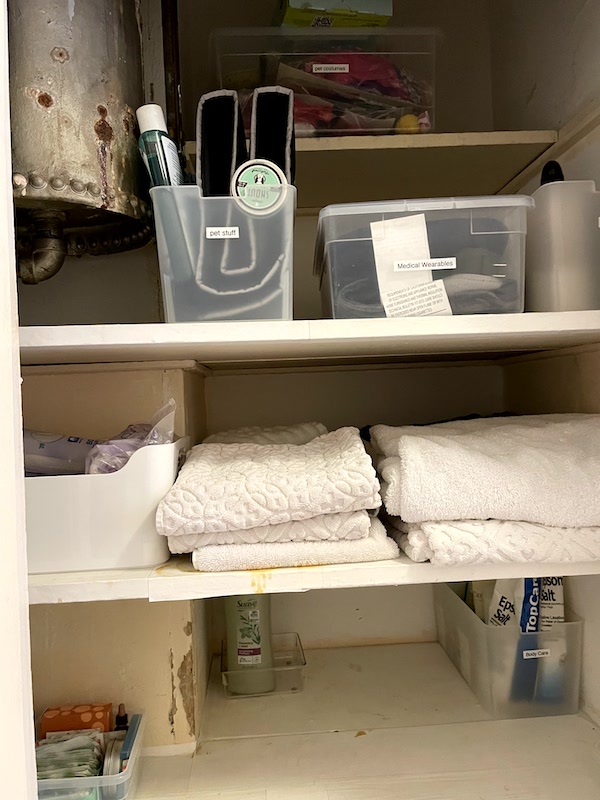
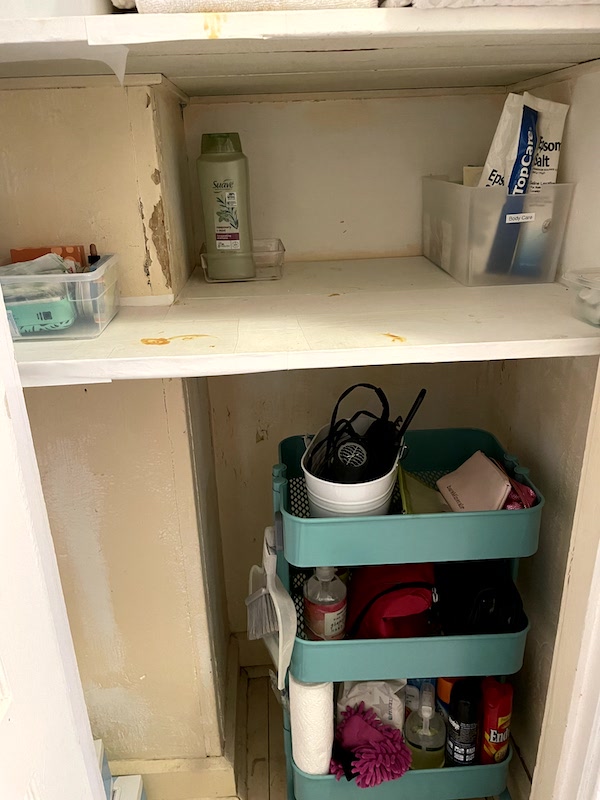
We emptied the contents of the closet, shelf by shelf, onto a folding table right outside the bathroom. I looked at each item, got rid of those that had aged out, sorted like things together and then put it all back together again. Lydia suggested that a three-tiered rolling cart would work well on the floor of the closet (genius!), so I repurposed the one I’d been using next to my washing machine. (In its place, I put a nightstand I’m no longer using, which stores my laundry supplies very nicely.) The cart is perfect for my purposes in the bathroom.
Moving items to the rolling cart not only made much better use of the floor space, it created space on the shelves. (That was helped a lot by my letting go of so much.) Lydia suggested we move the towels from the top shelf down a shelf (since we now had room) where they’re now within reach. We folded guest sets together and put them in the back of the shelf and the towels I use in the front. For 22 years, I have been storing towels on the top shelf, where it’s difficult for me to put them away and get them out. I struggled for 22 years. Why didn’t I consider moving them to a more accessible shelf?
I love it when I have organizers help me because it makes me really appreciate the value of working with an organizing professional. You set aside time to focus on the process. You make a financial commitment. And you get a fresh set of (expert) eyes on your situation. The five hours I spent with Lydia on Friday made a huge difference. I’m been smiling every time I use the refreshed spaces.
If you have spaces in your home that are getting on your nerves, I urge you to set aside some time to focus on decluttering and organizing them. If you have inclination and budget, you can supercharge the effort by hiring a professional to help! If you’re in St. Louis, shoot me an email. Or go to NAPO’s website to find an organizing professional near you!
Jane Goodall's part in my becoming a professional organizer

Jane Goodall, the famed primatologist, died this week. I felt a special connection to her because, believe it or not, she was the catalyst to my becoming a professional organizer. I was a freelance writer from 1995 until I started my business in 2005 and I worked with her on my last book. To put it mildly, it was not a good experience (that was the fault of the publisher and her staff, not Jane herself). After it was over, I knew a radical change was is order and I started Peace of Mind Organizing. I just reread this post, originally written in 2013, about why I became an organizer and why I continue being one. More than a decade later, all the reasons in this post are still valid and I’ll add another: It feels so great to have helped so many organizers get their start in their own businesses by working on my teams. (I now have employees, as well as independent contractors, and I’m thrilled they enjoy their jobs so much.) Peace of Mind Organizing® has helped hundreds of clients over the years and helped many organizers along the way. I feel so good about that. If you’ve ever wondered what a PO gets out of her work—which to some people looks decidedly unglamorous—read on.
Often when I meet folks who learn what I do for a living, they’re keen on learning how I became a professional organizer. I explain the training I took and how I went about starting my business. (That’s all detailed in my blog post, Are you interested in becoming a professional organizer?)
But seldom am I asked why I became a PO, rather than how. I thought I’d spend a little time exploring that question.
In my observation, there are two sorts of folks who become professional organizers:
- Those who do it because organizing comes so naturally to them. Being organized is like breathing. It’s their passion. So why not make a living doing it?
- Those who enter the field because of their own struggles in getting and staying organized. They’ve spent a lifetime seeking solutions for themselves and want to share those solutions with others.
I fall into that second camp. As I’ve mentioned over and over, I’m a naturally messy person. I’m pretty organized in my space and I’m definitely organized inside my head, but I’m a bit messy and unruly. I sought solutions for my time management and clutter issues throughout my life and I learned a lot. I felt it was time to start sharing.
When I first contemplated starting my business, I was a freelance writer. I’d been writing about pets for ten years and had written hundreds of articles on various aspects of pet care. I’d had seven books published (most of which are no longer available) and contributed to several others. I was working on my last book, an ill-fated venture called Jane Goodall’s Return to Gombe co-written with the famed primatologist. The book was never published (though a cover, pictured above, was produced). The process of writing that book excruciating and I knew that in order to get through writing that manuscript I had to know it was going to be my last book. So I started looking for other things to do.
As I considered becoming a PO, I thought of several very important things that being a professional organizer would offer that being a freelance writer was not delivering:
- The ability to help people directly and tangibly
- Respect for my expertise (I was being very disrespected during the whole Goodall book experience)
- Payment at the time of service
Those things were very appealing and a big part of why I became a PO. But why do I keep doing it, after twenty years? The truth is that my employees do most of the actual organizing. But I still thoroughly enjoy running the business, communicating with the clients and seeing the huge difference my organizers make in their lives.
Those initial three reasons did prove to be really compelling. In addition, here are some other things I’ve found to be very rewarding (as do my employees):
- We get to help people transform their lives.
- We help people feel better about themselves as we normalize (and sometimes empathize with) their messy behaviors.
- We can help our clients go from striving (and failing) to be perfectly organized to reveling in being organized enough.
- We get to effect vast, fast change by working in teams, rather than one on one.
Being a professional organizer has been life-changing work for me. And its results can be life changing for our clients. It is easily the most rewarding work I’ve done in a career that’s spanned four decades. And as long as it continues to be this rewarding, I’ll keep doing it. I’m so grateful to have the help of my wonderful employees!.
5 Lies About Keeping a Clean Home (That We All Need to Stop Believing)
My employee, Lydia Boda, who herself has ADHD and is an expert on helping neurodivergent clients, shared this video with me. The creator, Jessica McCabe, is a superstar in the world of ADHD and I can see why. I love her charming, relatable style. And I found her video, 5 Lies About Keeping A Clean/Decluttered House to be spot on. I don’t have ADHD myself, but I could relate to everything she said and I think many of my readers will too.
You can see more of Jessica’s videos on the How to ADHD YouTube channel. Or check out her New York Times bestselling book, How to ADHD: An Insider’s Guide to Working with Your Brain!
I’d love to know which of her five lies resonated most with you!
20th anniversary reflection: Working with an organizing team
This 2012 post captures one of the most pivotal moments in Peace of Mind Organizing’s evolution—when I realized that teams could create magic that solo work simply couldn’t match. Thirteen years later, our team-based approach remains our signature service. Here’s how it all began…
When I started my organizing business in 2005, I exclusively worked one-on-one with clients. It’s intimate, fulfilling, valuable work. But it can be really slow. And that means progress is harder to see and it can become discouraging for the client.
Around 2008, I started to be approached by clients who had very large, whole-house decluttering jobs. I realized that bringing in more help was in order. And so every now and then I would put together an organizing team to effect quick change on giant projects.
In the last year or so I realized that it wasn’t just huge or overwhelming projects that could benefit from a team approach. As the long as the client can handle the hubbub and the faster pace of a team, there are many benefits, not the least of which is the visible results we see after a single session.
I don’t have employees. When I put together an organizing team, I use independent contractors, members of the St. Louis chapter of the National Association of Professional Organizers. I call on organizers I know personally, thanks to NAPO St. Louis. I’m always on site supervising them and coordinating the efforts. I’m also typically the one working with the clients to guide decisions. [ETA in 2025: I started hiring employees in 2018 but do still occasionally use contractors for larger teams. They are supervised by my employees.]
Here are some of the advantages I have found to team organizing:
- We get a whole lot done. If I’m working one-on-one with a client, I not only guide the decisions, but implement them. When I’m working with a team, there’s someone to do the leg work and everything happens a whole lot faster. Also, the team members pre-sort items for the client before the keep/donate/toss decisions are made (in a decluttering situation), which makes the decision-making much easier. As a result, the client sees visible progress, which isn’t always the case after a one-on-one session.
- It’s economical. I charge less for the time of organizing team members than I charge for my own time. So bringing in a team is not only faster than working with me one-on-one, it’s less expensive.
- More minds are better than one. I populate my teams with smart and talented organizers. I’d be crazy not to tap into their considerable skills and knowledge on the job. While I’m working with the client, I frequently consult team members on the best way to approach or organize a space. So the client benefits from the cumulative knowledge of the group.
- It’s fun! All the organizers I use love working on teams. Doing work we love (sorting and organizing) alongside our colleagues practically makes us giddy. And that’s contagious. While it’s tiring for the client to make a lot of decisions in a short period of time, most confess to having fun while doing it during our team jobs. Time flies.
Here’s a before and after combo from a team job at the end of 2010. Two of the organizing team members worked in this kitchen while the client worked with me and other team members in another part of the house. The client gave basic parameters and was brought in to answer questions periodically. She was thrilled at the end of the day.
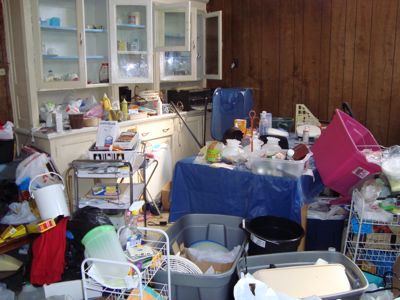
A cluttered kitchen before a team arrived to help.
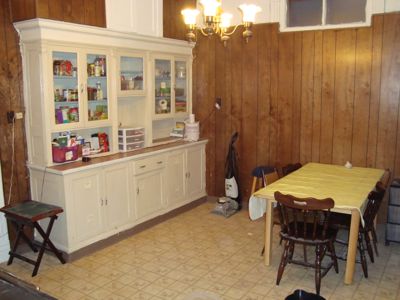
Two organizers created this transformation as part of a team project.
This year, my goal is to help more clients this way. I’m hooked on the fun of the team approach and the quick results. If you have a big project that seems overwhelming, maybe I could bring in an organizing team to help you. Take a look at my Operation: Peace of Mind page to read a few more details. Then feel free to shoot me an email to discuss how a team might help you!
The power of words
Back in 2021 on our podcast, Getting to Good Enough, my co-host Shannon Wilkinson and I discussed the power of language. (It’s Episode 165 and you can listen to it on our website, or wherever you get your podcasts.) We discussed subtle shifts we can make in our language that change how we feel about something, like a task. Words really do matter.
Here’s a great case in point: Asking yourself “What do I choose to do?” rather than “What should I do?” or “What do I need to do?” or “What do I have to do?” can calm you and actually make your more willing to do the task at hand.
I created a hand-lettered little reminder sign for myself. I printed it out small (less than 3” × 3”) and mounted it on black paper so it stands out on my bulletin board. Here’s that sign. Feel free to print it out as a reminder yourself.
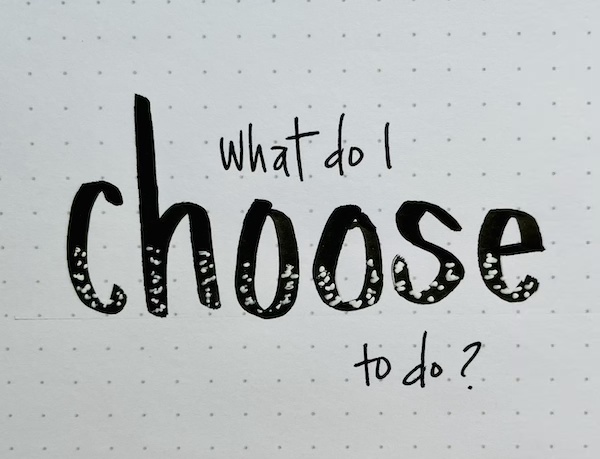
If you’re intrigued by this, I encourage you to listen to the episode!
Speaking of the podcast, this week we start airing new original episodes after a two-year hiatus. It’ll appear on our website (and podcasting platforms) on Thursday but in the meantime, you can go there to listen to any of the 258 prior episodes!
Worth repeating (once again): Why decluttering is so important
Nearly a decade ago, I wrote about why decluttering is so important—and honestly, this message is as relevant than ever. Many of our clients feel overwhelmed by their belongings and paralyzed by the thought of what to let go. But decluttering before organizing is so important and is absolutely worth the effort. This is a gentle reminder that letting go of excess is the key to an organized space.

I met with a client recently who explained all the storage solutions she and her husband had attempted in an effort to create order. They have three kids and a small house and it felt to them like their home was bursting at the seams. Yet their storage solutions hadn’t solved the problem.
My comment to her was that one way to get things to fit better into their home was to have fewer belongings.
Decluttering is an important first step in the organizing process.
Decluttering should be embraced, not skipped, because when you let go of those items that don’t serve you, it is so much easier to organize what remains.
I was reading some old blog posts this morning and came across one from 2008 in which I detailed some organizing projects in my own home. My 2016 self started twitching when I read this sentence, “Last weekend, I started doing some shifting of closet contents in order to help alleviate some clothes storage problems.” No, I thought! Don’t shift things around. Get rid of things! I know that in 2008 I had a lot more clothes than I have now. And I know I still have more than I need.
When we own fewer items we have less to manage. When we distill our items down to those things that we use and love, then we can easily find what we need and put it away. I’ve said it before and I’ll say it again:
Life is easier when you have less stuff.
Next time you have the itch to organize, see how much you can let go of before you start the actual organizing. Don’t move things around, move things out. Resist the temptation to buy organizing supplies or storage solutions before you declutter.
If you declutter prior to organizing, you set yourself up for success. When you have fewer items to organize (and manage), everything becomes easier.
Search
Recent Posts
- Worth repeating: Figuring out what to watch on TV
- The power of incremental progress
- Podcast guest spot on the role of organization for folks with chronic illness
- No excuses series (part 3): "It was a present"
- No excuses series (part 2): "I paid a lot for that item"
- No excuses series (part 1): "But I might need it!"
- Retiring the New Organizer Guides
Tags
About Janine
Hello! I’m Janine Adams — a certified professional organizer based in St. Louis, and the creator of Peace of Mind Organizing®.
I love order, harmony + beauty, but I believe that the way that you feel about yourself and your home is what truly matters.
If you’re ready to declutter with a purpose and add more ease to your life, you’ve found the right blog — and you’ve found the right company.
read more »Links
- National Association of Productivity and Organizing Professionals
- Getting to Good Enough podcast
- NAPO St. Louis
- Are you interested in becoming a professional organizer?
- Institute for Challenging Disorganization
- Peace of Mind Spending
- Organize Your Family History
- Shannon Wilkinson, life coach
- Ravelry