Happy birthday to Bix!
I’m going to indulge myself today and write a post about my standard poodle puppy, Bix, who turned one yesterday. Just two weeks after he joined our family, when he was a rambunctious 10-week-old puppy, he totally disrupted my life, as is to be expected. At that time, I wrote a blog post about the lessons this tiny puppy had already taught me. He’s come a long way since then.
So now that he’s one, I’ve been thinking of the many things that make Bix special. He can be naughty—he’s probably the naughtiest of the five spoodles we’ve had—but the naughty behavior is ramping down. He used to like to steal stuff and chew it but now he’s so good he has free reign of the house, even when we’re not home. He also likes to jump on people he likes. And he’s the only one of our poodles to steal stuff off the counter. He’s probably 8 percent naughty. But he’s 92 percent delightful.
Here are some of the things he’s especially good at:
- Making dog friends. He’s great with new dogs, somehow sensing the best way to play with each.
- Making human friends. He’s getting over a tendency to bark at people on the other side of the street who don’t have dogs. And he’s very passionate about certain friends, especially ones he met as a tiny puppy.
- Standing on his hind legs. Bix can stand unsupported on his hind legs—or even walk on them—with no effort. He loves standing on his hind legs. He especially loves putting is paws on the counter and greeting the receptionists at the vet and groomer.
- Walking on leash. He rarely pulls. He’s growing out of chasing squirrels and bunnies. He sits automatically at the corner. He is a joy to take for a walk.
- Not eliminating in the house. Except for a couple of recent exceptions, his house training is rock solid.
- Taking food gently. He takes anything offered to him by mouth very gently. My fingers are never in danger.
- Begging. Yes, he begs at the table (because we feed him from the table, so it’s on us). But he’s very polite about it. He just sits, a polite distance away, and stares. It’s very effective.
- Playing with his toys. This puppy plays more than our others ever did. He plays with us, whenever possible, but if we’re busy he plays by himself. He probably takes eight toys out of his toy basket every day. (I really need to teach him how to put them away.) He enjoys removing the stuffing and squeakers from toys and then playing with the carcasses. He never consumes them.
Now that I’ve bored you with a list of his attributes I’ll post some pictures of Bix over the past ten months. He’s a very cute, very enjoyable dog. For the first time since 1992, we were without a dog after our poodle, Kirby died, in March 2015. For nine months we managed to live dog-less. I’m so glad Bix joined our family and filled that void. And I’d like to thank Dianne Janczewski of Clifton Standard Poodles in Virginia for entrusting Bix to us.
I hope you enjoy these photos as much as I do.
Here’s Bix on Day Two in our home (that was our holiday card picture). What a confident little guy:

Here he is in January and in April. He grew so fast!

He still loves that spot on the couch (September):

Demonstrating his prowess on his hind legs:

And here he is just a couple of weeks ago, victorious in his removal of the squeaker from a toy:

If you have a dog, please give him or her a treat in honor of Bix’s birthday!
Confessions of an email hoarder
I openly admit that I have been an email hoarder. I abandoned my emails on my old Windows computer when I switched to the Mac in 2008. And since then I had a tendency to hang on to all emails that might possibly come in handy some day.
I keep a clear email inbox but I do so by moving emails to an archive folder, rather than deleting them. That seemed to work well for me because I could simply search for emails I might need. But I was completely indiscriminate in terms of what I decided to archive. It was easier to archive than to make a decision to delete.
Despite a “less is more” attitude and my rejection of the “But I might need it some day” reason to keep physical stuff, I saw no disconnect with hanging on to digital items forever and ever. In my mind, space was plentiful, and using the Search function on my Mac I could find anything, so it wasn’t a problem.
And I was right: it wasn’t a problem. Until it was.
Last week my computer told me that 99 percent of my hard drive was full. My 500 GB hard drive had only 5 GB available. What? I took the computer’s suggestion to optimize my hard drive, which gained me another 25 GB, and I reached out to my Mac consultant, the wizard Gabriel Steinbach of The Mac Guys and we did a virtual consultation. We discovered that something was messed up in hard drive, probably as the result of my simply transferring everything (without decluttering) every time I bought a new computer. This is my third MacBook since 2008. I was hoping to get another year out of it.
The solution, we hope, is what Gabe calls a “clean reinstall” of the operating system. So he’s going to wipe the computer clean, reinstall the operating system and put the essentials back on the computer, along with my data.
That led to a discussion of what exactly is essential for my computer. And then we talked about my emails. Most modern computer users use IMAP email protocol which stores the emails on the server. I’ve used POP3 for decades and was more comfortable with storing them on my own hard drive. They feel more safe and secure there to me. But my using a POP3 server makes the process of transferring my email back onto my computer a huge hassle, rather than the breeze it would be if I used IMAP.
So I resolved to let go of unnecessary emails. And that was an interesting experience—it put me smack in my clients’ shoes. I heard myself saying things to Gabe that my clients with hoarding tendencies say to me about physical items. It was a bit of an existential crisis, since I am so committed to the benefits of living with less stuff.
I gave some really serious thought to why I like keeping all that email. I had almost 30,000 emails in my Archive folder alone and tens of thousands in other folders. I came to realize that the voluminous email archive allowed me to:
- Not have to make notes elsewhere
- Be the hero who can get my hands on information
- Recall any fact that came to me via email
- Keep track of purchases for tax purposes
- Keep track of client communication (Gabe suggested I shift to a CRM.)
- Let go of worry about forgetting things
So I shifted my perspective and thought about the worse that could happen if I couldn’t get my hands on a particular email. I realized that in most cases, it wouldn’t result in a problem. Temporary discomfort, perhaps. But not a long-lasting problem.
So here’s what I did:
- I searched my archive for correspondence from certain friends and family members and moved them into appropriately named folders.
- I kept all client correspondence
- I kept 2016 archived emails and receipts and trashed the rest.
- I deleted eight years’ worth of accumulated emails from various professional email lists I was on, since I realized I never looked back at them.
As the emails were deleted, I felt a little anxiety. And then a whole lot of relief.
I feel like I’ve pared the emails down to the bone. But in fact I still have just under 25,000 emails spilt among 65 folders. I’m sure I could let go of more, but that’s a reduction of at least 2/3—I bet I had more than 75,000 emails.
I’m hopeful this will be enough to make putting the emails back on my computer relatively easy. And then I’m hoping to let those reside there and shift to an IMAP system to avoid any future problems.
ScholarShop closing in 2017 but St. Louis has an alternative

If you live in St. Louis, you’re probably familiar with the venerable ScholarShop. It’s a resale store that sells clothing and accessories (and a few housewares), run by the Scholarship Foundation of St. Louis. The 57-year-old shop, with two locations, is a great place to donate clothing because it offers an itemized, valuated receipt at year’s end. It’s also a great place to shop. I’ve bought many, many items there over the years.
I was shocked to learn a couple of weeks ago that the Scholarship Foundation will be closing the ScholarShop in 2017. Apparently it has not been generating enough income to make it worthwhile for the Foundation to operate it. According to this article on the St. Louis Post-Dispatch’s website, they will accept donations through the end of 2016 and will probably remain open for shopping through mid-2017.
But I wanted to make sure my St. Louis readers are aware that there is an another worthy resale shop in St. Louis that also provides a valuated receipt. It’s The ReSale Shop, run by the National Council of Jewish Women-St. Louis Section. I also donate to, and shop at, this terrific shop. It’s located at 295 N. Lindbergh Blvd., between Highway 40/64 and Olive.
Like the Scholarship Foundation, the NCJW does good work that benefits the community with the money generated by the shop. They make it easy to donate and get a tax deduction. And the shopping experience is terrific. I encourage you to donate and shop there!
Time for a new Project 333 collection!
September 30 was the end my first Project 333 season. From July 3 to yesterday October 2, I chose from only 33 wardrobe items when getting dressed each day. In a nutshell, the 33-item collection included clothing, shoes, jewelry and accessories. It did not include underwear, sleepwear, loungewear, or exercise clothes. It also did not include dog-walking clothes. Please read my August 1 explanation of Project 333 for complete details.
Yesterday was the big day that I’d been looking forward to for a couple of weeks: I changed out my 33 items for another 33-item seasonal collection that will last me until the end of year.
I’ll tell you about that in a second, but first I have a surprise to report: I did not wear all 33 items! That’s right. At the end of the three months there were eight items I never wore (a dress, two jackets, three shirts, a belt and a down vest). And there were four more that I didn’t wear until September 30 (a poncho, a shirt, a pair of shoes and pants). So basically I dressed from 21 items the whole quarter.
A giant caveat is that when I lead team organizing jobs, I wear exercise clothes, which were not included in the 33 items. Clothes worn on one-on-one organizing appointments, or appointments to give estimates, were included.
The experience has been really positive. Project 333 makes getting dressed so fast. It makes laundry easy. It also makes packing easy. I love being able to find anything in my closet or drawers very easily. And I absolutely love having fewer options because it makes my life easier.
So yesterday, I changed out my clothes to the new collection. All the clothes I selected came from the “Favorites” bin I’d created when I was binning up the clothes in July. That tells me that there are two more bins of clothes I could probably donate without suffering!
It took a little effort to whittle it down to 33—at the first pass I had about 40 items. But I managed to do it. Here’s what’s in the collection:
- 5 pairs of pants (including two pairs of jeans and one pair of leggings)
- 2 turtleneck sweaters
- 4 other sweaters
- 2 ponchos
- 1 shawl
- 3 jackets/cardigans
- 1 dress
- 2 long-sleeved tops
- 2 short-sleeved tops
- 1 shell
- 1 pair of long boots
- 1 pair of ankle boots
- 1 pair of dress shoes
- 1 necklace
- 3 pairs of earrings
- 1 down vest
- 2 coats
Here’s a photo of the bulk of it:
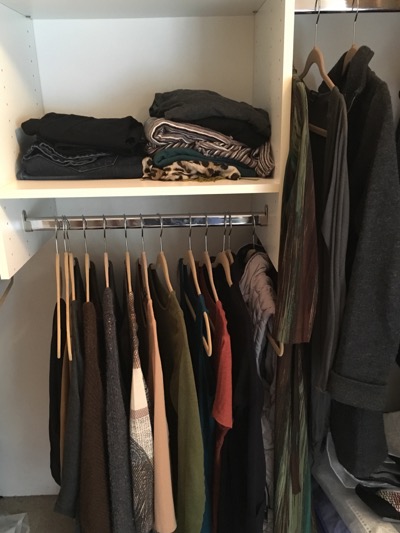
It’s worth noting that there was some overlap between the two seasonal collections: A down vest, two ponchos and a shawl, one pair of jeans, and three shirts appear in both collections, along with one pair of earrings, a necklace, and a scarf. That’s 11 items. A third of the collection.
I hate winter, but I prefer winter clothes to summer. So it was fun for me to pick out old friends to dress in. I foresee needing to purchase some very comfortable but nice flat shoes and perhaps a skirt. If I do that, I’ll try to take items out to compensate, so the collection doesn’t swell.
As much as I’m looking forward to getting into my leggings, I know that I will miss my white jeans. They were the foundation of my wardrobe this summer!
All in all, Project 333 has a been a real success for me. I’m interested in hearing from you if you’ve tried it!
Great sale on shelving AND Elfa at the Container Store
If you’re in the market for shelving or Elfa, now’s the time to buy! At the beginning of every year the Container Store has a sale on Elfa, its fabulous shelving and drawer system. And then in the fall they have a shelving sale. If I’m remembering correctly, the only Elfa that was included in that sale was shelving.
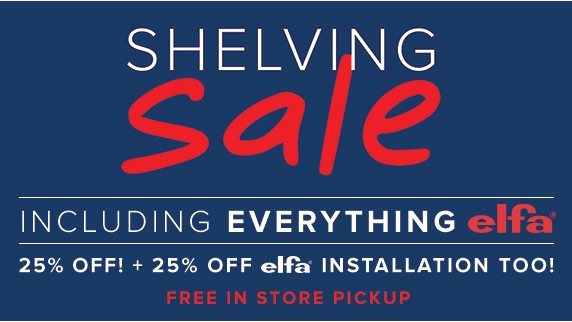
But this year is different. The shelving sale going on right now gets you 25% off all shelving, plus all Elfa, including drawers and other components, as well as Elfa installation. It makes me wish I had the need to buy some!
I use Elfa in my own home to store my yarn stash (as I mentioned in a post earlier this week). And I have a small Elfa system in a reach-in closet in my office. I also have three Elfa file carts in use. I’ve used Elfa drawers (similar to the ones I use for yarn) in several clients’ homes to house kids’ toys. And I have a couple of clients with small children who have really enjoyed the Elfa Kids’ Coloring Table
Tempted? The sale ends October 16.
Worth repeating: The joy of an organized yarn stash

Eight years ago, I organized my yarn into a bank of Elfa drawers. (Incidentally, Elfa is on sale right now for 25 percent off!) Four years ago, I blogged about how wonderful it is to have an organized stash. Today, I am repeating that post because is as true now as it was then. And, of course, it’s also true for fabric, beads or any other kind of craft supplies you might have.
I’m a knitter, and like most knitters, I have quite a bit of yarn. I don’t go out and buy yarn for the sake of buying it. Typically, I purchase yarn for specific projects. But sometimes those projects don’t pan out and I unravel them. And lots of times, I have yarn left over after finishing a project. Multi-color projects, in particular, can lend themselves to a lot of leftover yarn.
But the good news (for me) is that my yarn stash is well organized. As I have mentioned here, back in 2008 I purchased a bank of Elfa drawers to organize my yarn and knitting supplies. Four years later, I’m still thrilled with the system.
Case in point: A friend had a baby recently and I decided to knit the baby a teddy bear. I’ve knitted several teddy bears, out of a plush yarn called Oh My! My friend Lisa knit a different bear recently and I wanted to try out that free pattern. Alas, the yarn called for in the pattern is now discontinued and I wasn’t willing to go to a lot of work to try to track it down.
So yesterday, I wondered whether I had any Oh My! yarn left over from past bears. That teddy bear has a little sweater, so I thought maybe there would be some leftover pink yarn out of which I could knit a tiny scarf for the new bear.
I knew exactly where to look: the drawer marked “novelty yarn.” To my delight, I found 1.5 skeins of teddy-bear brown Oh My! And I also found some colored yarn for the scarf. No trip to the yarn store necessary for me. No money needed to spent. I can start on this pattern as soon as I get home. [2016 addition: That’s a picture of the completed bear at the top of this post.]
My organized yarn stash saved me time and money yesterday. It allowed me easy access to my yarn without any frantic searching. It also helps my stash stay neat and tidy. I love my Elfa drawers!
Old jeans take on a new life in St. Louis
I wrote a blog post a few years back about Charity Sharity, an organization in St. Louis that collects fabric to distribute to groups for charity sewing projects.
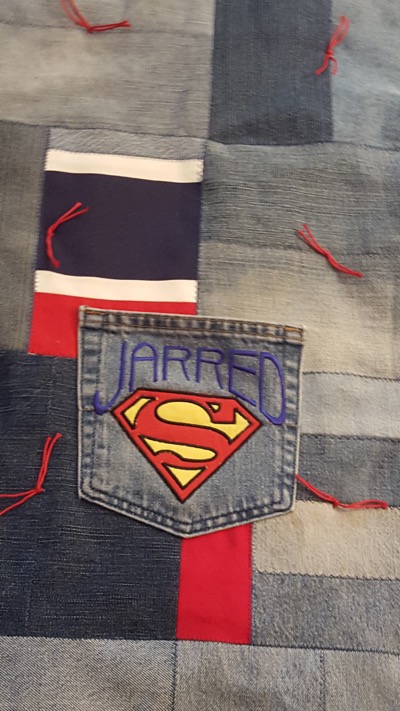
Just last week I received an email from Sally Safranski of DenimQuilts, a group allied with Charity Sharity. These talented quilters take donated blue jeans and use them to create personalized quilts. Last month they created their 1,000th quilt! Most of the quilts go to kids in foster care and others go to children and families currently grieving for someone close to them who has died or is in hospice. Some are donated to charity fundraisers.
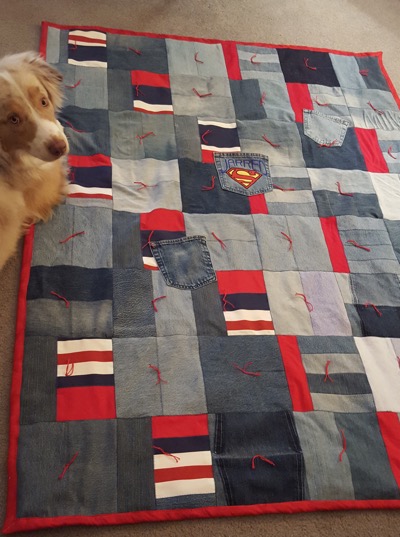
DenimQuilts volunteers use pockets from the jeans to machine personalize the quilt with an embroidered, name, image or message. Here are a couple of photos of a quilt made by DenimQuilts volunteers:
Sally wrote me, “We accept all types and conditions of jeans from non-smoking homes. Those that are teen/young adult friendly might be sent to Epworth in Webster for their kids on campus or at a homeless youth program in No.Co. We prefer 100% cotton jeans – any color and most any condition. They can be delivered to my home any time – 261 Horseshoe Drive, 63122 (west of Kirkwood Park). I have a covered courtyard entrance – so drop-off without an appointment is easy.”
ETA: If you live outside St. Louis and would like to mail jeans to DenimQuilts, they’ll happily accept your donation. Just mail it to Sally Safranski at the above address. (And remember, the jeans must come from non-smoking homes.)
You can also find DenimQuilts on Facebook. And you can read a feature story about them in a recent edition of the Webster-Kirkwood Times.
I can only imagine how comforting these cozy denim quilts must be to these kids in need. What a wonderful way to make your worn jeans live on.
Search
Recent Posts
- Worth repeating: Figuring out what to watch on TV
- The power of incremental progress
- Podcast guest spot on the role of organization for folks with chronic illness
- No excuses series (part 3): "It was a present"
- No excuses series (part 2): "I paid a lot for that item"
- No excuses series (part 1): "But I might need it!"
- Retiring the New Organizer Guides
Tags
About Janine

Hello! I’m Janine Adams — a certified professional organizer based in St. Louis, and the creator of Peace of Mind Organizing®.
I love order, harmony + beauty, but I believe that the way that you feel about yourself and your home is what truly matters.
If you’re ready to declutter with a purpose and add more ease to your life, you’ve found the right blog — and you’ve found the right company.
read more »Links
- Shannon Wilkinson, life coach
- Ravelry
- Getting to Good Enough podcast
- Organize Your Family History
- Are you interested in becoming a professional organizer?
- Institute for Challenging Disorganization
- National Association of Productivity and Organizing Professionals
- Peace of Mind Spending
- NAPO St. Louis