Worth repeating: When worlds collide (in a good way)
I originally posted this blog post on September 8, 2011. Incidentally, the client gave me that slip of paper and it’s been pinned to my office bulletin board ever since. It never fails to make me smile.
I was helping a client clear off the top of the desk in her home office. It was one of those desks where stuff gets added over the years but very little gets subtracted. I love those jobs because it’s kind of a time capsule. And, often, we find fun stuff.
As I was going through the bits of paper and notes, I came across this note, which made me smile:
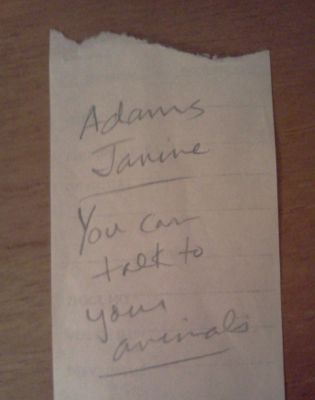
I’m used to seeing notes with my name on them in my clients’ stuff, because, typically, they’ve written down my name and business name and phone number as they think about hiring a professional organizer.
But this note had my name and the title of my first book! It came out in 2000 and has been out of print for years. My client confessed that she never bought the book, but read a review and thought she might. That just tickled me.
It reminds me of another time when I was helping a client clean out her files and we came across the adoption packet she got when she adopted a dog years before from a rescue group. Nestled among the papers given her by the group was an article I’d written for Family Circle about vaccinations for pets. That made me very happy, particularly since the article advocated less frequent vaccinations, which is one of my passions.
I love my work!
Decluttering is like exercising
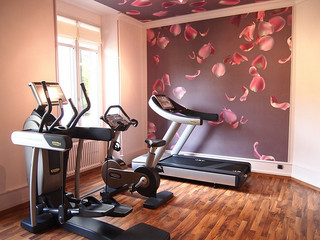
I’ve had my struggles with getting myself to exercise over the years and I’ve detailed some of them on this blog. The bottom line for me is that I’m pretty fit and pretty slender without going to the gym, so getting myself to go has been challenging, since I don’t enjoy it that much.
But now that I’m past 50, it feels like more of an imperative. I know that regular exercise will help me age more gracefully and healthily. I know that it will help stave off osteoporosis, which runs in my family. I know that it might help with the fact that my stomach is no longer perfectly flat. (Certainly, not exercising isn’t going to help with that!)
So I’m trying to make exercise a priority. But it’s not easy because I’m very busy with work. And did I mention I don’t enjoy it that much? (Thankfully, Shannon Wilkinson’s Change Artistry: Get Active group coaching class is already helping me shift my perceptions and welcome exercise into my life.)
Back in October 2013 I joined a gym, the tiny exercise studio called Take Action just a couple of blocks from my home. The membership and some personal training sessions with Take Action owner Jeanna Jackson were a (requested) 50th birthday gift from my husband. At that time, I discovered the similarities between personal trainers and professional organizers.
So the other day, as I was going through my exercise routine—created for me by Jeanna—I got to thinking once again about how exercising for people like me is like decluttering for folks struggling with clutter. I’ve already mused here about the how both decluttering and exercising get easier with practice. But more recently, I’ve been thinking about these similarities:
- You might not feel like doing it, but afterward you’re glad you did
- It can be hard to find the time
- Both decluttering and exercising can be easier to do when you have company (and/or guidance)
- You may not see instant results, but little by little you see progress
- Any effort at all is worthwhile
- You’re frequently struck by inspiration while exercising and while decluttering/organizing
- Both can become habits
When I look around my house and see the progress I’ve made over the years in keeping order despite being a naturally messy person, I know I can make progress in with exercise. I’m working on focusing on the benefits and making it a priority. I hope one day soon to make exercising a natural part of my day just as certain habits for keeping order (like clearing off my desk every day) have become habits.
Photo by Hotel de la Paix Geneve via Flickr.
Let it be easy
I have a little mantra I’ve mentioned here before.
I think it speaks for itself.
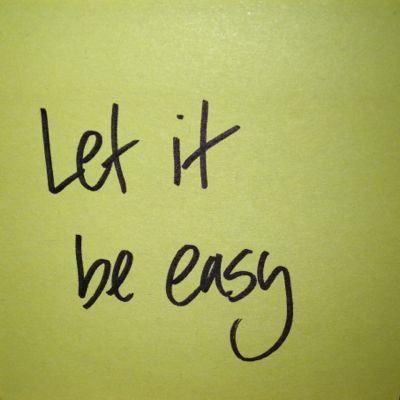
Next time you get twisted in knots over the details of a project or you’re grappling with some sort of conundrum, maybe you can keep it in mind.
I find it helps!
10 things you can throw away this weekend
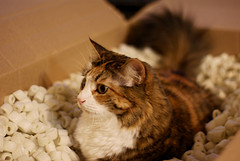
It’s basement season for my business. I’ve been in a lot of basements recently and my teams have helped make them much more enjoyable and functional spaces. I keep seeing the same sorts of items, so I decided to a create a quick list of items that I frequently see people unnecessarily hanging onto in basements (and other parts of the house).
Are any of these items cluttering up your home?
- Empty boxes for items you’ve had over three months (possible exception: the box your giant TV came in)
- Packing peanuts and air pillows if you haven’t used any in six months or more
- Paid bills (non-tax-related) that are more than a year or two old (if that)
- Supporting paperwork for taxes filed more than seven years ago
- Clothing that doesn’t fit you or you don’t feel fabulous in
- Supplies for pets you no longer own
- Outgrown games and toys
- Supplies for hobbies or crafts you no longer do (or never actually did)
- Expired over-the-counter medications or beauty/personal hygiene products
- Leftover holiday cards from years gone by—especially dated ones
Do a quick sweep of your house this weekend. If you spot any of the above items, consider letting them go!
Here are some ideas for disposing of these items:
- Take the old paperwork to a commercial shredding service (the big-box office supplies stores offer this service as well)
- Donate clothing, toys and craft supplies. Consider using the app iDonatedIt to keep track of donations for tax purposes.
- Give your unneeded pet supplies to a local animal shelter
- Take the unwanted packing material to a UPS Store (or similar establishment) for reuse
The longer I do this work, the more I believe that less stuff = more happiness. A good place to start is with these no-brainers!
Photo by alan.stoddard via flickr.
Creating a functional (and beautiful) bulletin board
Long before Pinterest, pinup boards have been used in houses everywhere to keep important information close at hand and top of mind. These bulletin boards can be really useful for information and for inspiration, but it’s really easy for them to get messy and full of outdated items. When that happens, they lose their utility (and beauty).
Last month, I was a guest on the Springpad Show and at the top of the interview, Katin Miller, who was interviewing me via Google Hangouts, commented on the fabric-covered bulletin board in my office (which was behind me in the shot) and the fact that it’s neat and attractive. In order to have a successful bulletin board, I think you need three things:
- The items should all be visible
- Outdated items should be removed regularly
- The arrangement of the items should be pleasing to the eye
In the May 2014 issue of Martha Stewart Living (on newsstands now through May 16) is an article on pinup boards, called Show and Tell. It features several different types of pinup boards—used for information or inspiration—and, true to Martha Stewart form, they’re beautiful.
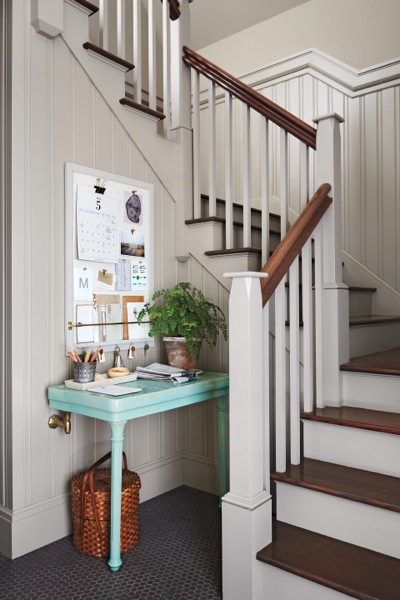
I was particularly struck by this little front hall board, which they call a “get-out-the-door organizer.” What I love about it is they’ve used a little nook, paired it with a shallow wall-mounted table (how cool is that?) and it used it for a calendar, pretty photo, and information and mail that’s going out the door (tucked behind a rod mounted to the frame of the board). There are also cup hooks for keys. This is a terrific landing/launch pad for the home.
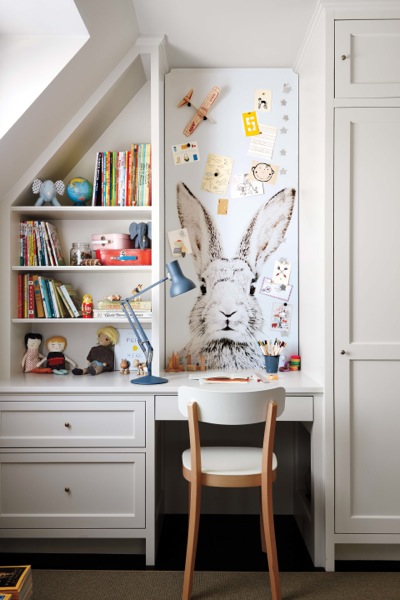
Here’s another that blew me away, because I had no idea that magnetic wallpaper existed. What will they think of next? I love the bold graphic on this wallpaper, which really transforms the space. And magnets will stick to it!
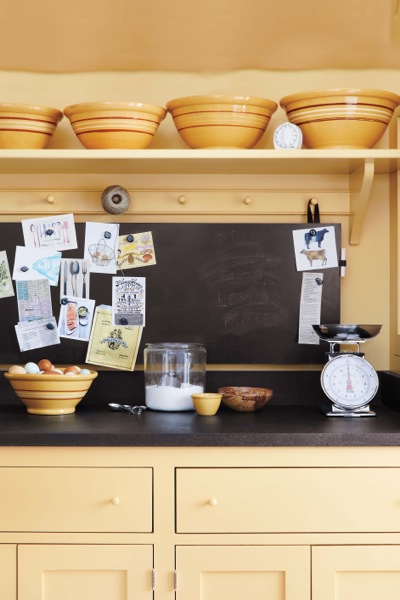
And there’s this magnetic chalkboard, perfect for a kitchen. It’s a DIY project—they even offer a free tutorial so you can learn how to create your own magnetic chalkboard.
There are more boards, and more details, in the May issue of the magazine. Martha Stewart Living tends to do everything a bit more beautiful than I do (I’m a function-over-form kind of gal), but this article really inspired me.
Photos by Lucas Allen. Courtesy of Martha Stewart Living. Copyright © 2014. Used with permission, of course.
Worth repeating: Don't give your mom clutter
Mother’s Day is in a week (and my mother’s birthday is today!), so I’ve been thinking about gift giving again. If you give your mom an experience, service or something consumable, you don’t have to worry about cluttering up her home. Here’s a post from a couple of years ago that I think is worth repeating. (I’ve updated it a little.)
Mother’s Day is just around the corner. Since moms tend to want to hang on to gifts their children give them, I urge you to consider giving her something that won’t become clutter.
Way back in 2007, in the very first edition of my monthly newsletter, I wrote about clutter-free gifts. I think the info bears repeating!
Clutter-Free Gift Giving
So many of my clients develop attachments to inanimate objects. Those attachments make it really hard for the client to part with the objects. And what happens? Clutter happens. I’ve found that clients who tend to get sentimental about stuff find it particularly difficult to part with gifts that have been given them.
This has certainly changed the way I think about gift giving. I personally believe that once I’ve given a gift, the recipient is free to do whatever he or she wants with it. My feelings won’t be hurt if the gift is given away or even thrown away. But I don’t want to clutter up anybody’s life. So I try to give gifts that won’t add to clutter. And I encourage you to think in the same way about gift giving, particularly if anyone on your gift list has a problem with clutter.
Here are some of my favorite ideas for clutter-free giving:
Fresh flowers. A beautiful arrangement of cut flowers livens up any room. After the flowers have died, they can be tossed guilt-free. I try to avoid including a vase with the gift—I’ve seen many a home cluttered by florists’ vases! An easy website for ordering flowers is 1-800-flowers. I’ve also used Proflowers with success. Sometimes I’ll call a local florist in the recipient’s town, if I know of a good one.
Pampering. If you have a friend who would enjoy a little pampering, consider a gift certificate for spa services. Many cities and even towns have day spas. A massage or facial (even for men!) might be something your gift recipient wouldn’t do for him or herself. To find a spa in your gift recipient’s community, try Spafinder.
Services. Give someone the gift of time by offering to perform some needed services for him or her. You could offer a few hours of babysitting, offer to shovel snow, rake leaves, walk dogs or even clean house. If you’re a gardener, offer to do some landscaping. If you’re good with computers, offer to set up a wireless network or make their computer more secure. These gifts are clutter-free and really very special. You can also give a gift certificate for organizing services if you’re sure that the recipient would love to work with a professional organizer.
Clutter-free subscriptions. Giving a magazine subscription is a nice year-long gift, but many people let magazines pile up. Instead, consider giving a subscription to a services like Netflix or Blockbuster Total Access, which sends rental DVDs right to your recipient’s home. If your mom is at all tech-savvy, she can stream movies and TV from Netflix or Amazon Prime Instant Video
If your gift recipient likes to listen to the spoken word, a subscription to Audible might be just right.
Edibles. Give something perishable to eat and you know it won’t linger in your gift recipient’s home. You can make homemade goodies, or send a gift package from a place like Wolferman’s, which sells English muffins and specialty breads, or Harry & David for fruit or other editbles. In 2006 Food and Wine published a terrific article on giving edible gifts.
A side benefit to giving an intangible gift is that you don’t have to go out shopping! Let your fingers do the shopping online. And give yourself (and your gift recipient) the peace of mind of not adding clutter to a cluttered world.
Do you need some help getting active?

We all know, intellectually, how important it is to be active, rather than sedentary. I did a quick Google search and found my way to the Johns Hopkins website, where I found these risk factors for cardiovascular disease and other conditions associated with inactivity:
- greater risk of developing high blood pressure
- greater likelihood of developing coronary heart disease
- anxiety and depression.
- possible increased risk of certain cancers.
Why, then, is so it so hard for us (and by us, I mean me) to take the time to exercise?
I’ve been very busy with clients and so going to the gym has fallen by the wayside in the last month or so. While my work at least usually has a physical component to it, it’s not enough. I bought a Fitbit Flex recently to monitor my steps, hoping I’d learn that I actually do get a lot of exercise without going to the gym. I was hoping for 10,000 steps a day and learned that I actually get between 6000 and 7000 on an average day. Not bad, but not a substitute for the gym!
But I have new hope!! I was absolutely thrilled when my friend and life coach, Shannon Wilkinson announced her new Change Artistry: Get Active program. It’s a group coaching program “for people who want to get more active (and have fun while doing it).”
This isn’t some sort of bootcamp. And it isn’t (just) about accountability. This is about shifting the way you feel about exercising. Shannon is amazingly skilled at helping you make unconscious shifts. I know this because she’s been helping me do that for years. From her website:
Being active and feeling fit comes from clearing out the unhelpful stuff inside, so you can do what works for you, your body, your lifestyle.
That sounds so perfect for me. I’m really excited.
The program consists of four weekly group coaching calls, starting May 15. There will be opportunities for individual coaching on your individual challenges during the calls.
If you’re like me and have trouble prioritizing exercise over other commitments even though you know it’s important to do so, this program could be a game changer.
The cost is $200 through Thursday. On Friday, May 2, it goes up to $250. (Still a bargain, in my opinion.)
Won’t you join me? Sign up here.
Search
Recent Posts
- Worth repeating: Figuring out what to watch on TV
- The power of incremental progress
- Podcast guest spot on the role of organization for folks with chronic illness
- No excuses series (part 3): "It was a present"
- No excuses series (part 2): "I paid a lot for that item"
- No excuses series (part 1): "But I might need it!"
- Retiring the New Organizer Guides
Tags
About Janine

Hello! I’m Janine Adams — a certified professional organizer based in St. Louis, and the creator of Peace of Mind Organizing®.
I love order, harmony + beauty, but I believe that the way that you feel about yourself and your home is what truly matters.
If you’re ready to declutter with a purpose and add more ease to your life, you’ve found the right blog — and you’ve found the right company.
read more »Links
- Shannon Wilkinson, life coach
- Getting to Good Enough podcast
- Organize Your Family History
- NAPO St. Louis
- Ravelry
- Peace of Mind Spending
- National Association of Productivity and Organizing Professionals
- Institute for Challenging Disorganization
- Are you interested in becoming a professional organizer?