Take enjoyment from your surroundings
A couple of weeks ago, I was walking my dog, Kirby, on a beautiful spring morning. He stopped to sniff some flowers and I glanced down. This is what I saw in my neighbor’s yard.
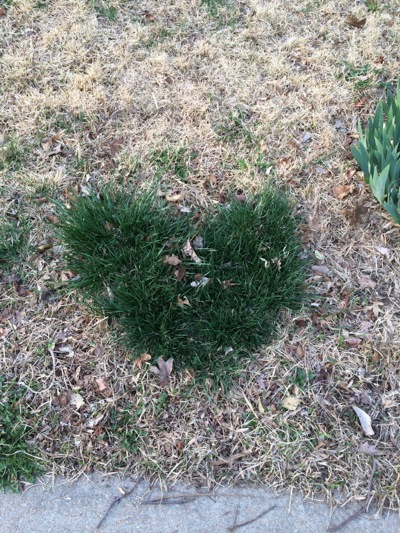
A patch of grass in the shape of a heart. I felt like I’d been sent a little message of love from Mother Nature.
It got me thinking about how easy it would have been to have missed that little day brightener. And how many great things in my surroundings I’m probably not noticing by staying in my head all the time, or simply being non-observant.
I also started thinking about how I can bring little, inexpensive things into my home to enjoy. Cut flowers in a vase. A pretty souvenir of a fun time. A lovely picture on a bulletin board.
I’m not talking about cluttering up my home. Just bringing in small delights. I’m not a gardener, but this holds true for my outdoor environment as well.
Thank you, Mother Nature, for that message of love. And for opening my eyes to helping me notice and enjoy my surroundings more.
National Drug Take-Back Day is this Saturday
Almost everybody has old prescription drugs cluttering up their bathrooms and other spaces. The trouble is, it’s hard to dispose of them responsibly.
On Saturday, though, it’s easy. A couple of times a year, the Drug Enforcement Administration, in conjunction with the Department of Justice, sponsors the National Prescription Drug Take-Back Day, where consumers can drop off their old medications for proper disposal.
That day is Saturday!

Click here to find a collection site near you.
The first Drug Take-Back Day took place in 2011. According to the event’s website, in that time 1700 tons of unneeded or expired medications have been collected and properly disposed of through this program. That’s amazing. Can you contribute to that number this weekend?
My advice to bloggers
Yesterday at our monthly NAPO-St. Louis meeting, I was on a panel called Blogging for Your Organizing Business. The other panelists were blogger extraordinaire, Aby Garvey of simplify 101 and online marketing expert Ken Tucker of Changescape Web.
The format was Q&A from the audience and there were loads of great questions. Before going in, I pondered some of the points I hoped to make. So here’s my advice to organizers who blog or want to blog:
- Stick to your commitment. An infrequently or sporadically updated blog may not reflect well on you. I think we look more organized and reliable if we set a regular schedule and stick to it.
- Keep your eyes open for blog posts. There’s blog fodder everywhere. (I turned a visit to my dentist into a blog post a couple of weeks ago.) You just have to learn to recognize it.
- Take notes. Keep a list of blog post ideas so that you never have to stare down a blank screen thinking, “What am I going to blog about today.” (I keep a list in Springpad, so it’s with me wherever I go.
- Make it personal, but keep it professional. I want people to get to know me through my blog and to regard me as an organizing expert. So I write in the first person and am not afraid to reveal my own organizing challenges. However, I keep politics and religion out of my blog and I never trash talk anyone.
- Let it be easy. I’m lucky because I’m a writer. (I made my living as a freelance writer for ten years before starting Peace of Mind Organizing.) But I still sometimes make blog writing more difficult than it needs to be. If you write from your heart about things you care about, it shouldn’t have to be hard.
Aby and Ken added other excellent points, like be clear on why you’re blogging, know the purpose of each individual post, and make sure you’re using words in your posts that you want search engines to pay attention to.
I know that this blog has helped me grow my business. It’s allowed clients and prospective clients to get to know me, it’s helped me stay at the top of google searches, and it’s led to great opportunities, like being a member of the Rubbermaid Professional Organizer Squad . If you’re looking to blog, I say go for it. But if you make the commitment, please try to keep it.
Storing the food-storage containers
Yesterday I had the opportunity to help a client declutter her somewhat vast and varied supply of food-storage containers. Different shapes, different sizes, different brands. We emptied all the containers and lids out of the cupboards and drawers and put them on the dining-room table. I set about sorting them so I could match up tops and bottoms so she could see what she had. There ended up being some tops without bottoms (and vice versa) and the client ended up letting go of a lot of containers, which was great.
While I was doing sorting the containers, I kept thinking how glad I am that my friend and colleague Aby Garvey convinced me to store my food-storage containers with the lid on. Because I match the lid and the bottom as soon as I take them out of the dishwasher (and there rarely more than three at a time in the dishwasher, so it’s easy), I never have to search for one or the other and I never have extra lids or extra containers.
Here’s a picture of my containers after Aby helped me with them:
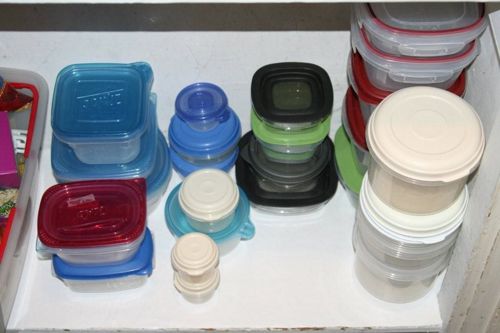
This makes me happy.
Aby was part of my team yesterday, and after the session, she and I, being the organizing nerds that we are, talked for quite awhile about how people typically object to storing food containers with the lids on. The objection is that storing them that way will take up too much space. (That’s what I said when she suggested it to me. in fact.) But when you store them with the lids on, it makes them so much easier to use. I think it’s worth any sacrifice of space you have to make.
As Aby pointed out people have a tendency to prioritize maximizing space over accessibility, when it comes food-storage containers. But that can be a mistake. If you can’t easily match lids and bottoms, you might be tempted to go out and buy more containers. The collection expands. Loose lids can slip out of sight and become annoying. Accessibility vanishes.
If you’re frustrated by the way you store your food-storage containers, I urge you to pull them all out, put the lids on, and see if you can put them all back with the lids on. If you can’t, consider paring them down to a number you can store that way. (Aby wisely says that, unless you’re someone who freezes food, if you have a really large number of these containers, something might be going bad in the back of your fridge.)
If your situation is such that you need to nest your containers, I urge you to have a set of containers from the same maker, so that you can more easily match lids and bottoms. Personally, I love the Rubbermaid’s Easy Find Lids collection.
The power of planning
I’m leaving today for Independence, Missouri, to do research at the Midwest Genealogy Center, part of the Mid-Continent Public Library. I’ve been doing almost all of my genealogy research at home on my computer and I’ve decided it’s time to branch out and look for documents not available on the internet.
Here’s a photo of the building. It looks nice!

I blogged on Organize Your Family History about how I planned to prepare for this trip to make the best of my time there.
Sometimes, despite my best intentions, I don’t actually do much advance planning for a trip, but this time I did it right. I took the time to figure out what it is I hoped to find at the library so I wouldn’t waste time on site trying to figure that out.
That pre-planning has created so much peace of mind! There are still some questions about how exactly I’ll go about finding what I want, but coming in armed with questions I want answered makes me feel so good.
If I hadn’t done this planning, I know I’d spend the 3.5-hour drive worrying about how things were going to go, afraid that I wouldn’t make good use of my time. Instead, I get to enjoy the anticipation of hitting the ground running when I get there late this afternoon.
Of course, my planning has extended to finding a hotel in close proximity to the library, where I’ll be comfortable, and researching nearby restaurants.
In many aspects of life, a few hours spent planning can reap so many dividends in terms of time—and anxiety—saved. Sometimes I feel like I’m moving too fast to do proper preparations, but when I do take the time to plan, I’m always glad I did.
Tracing my roots: Why I love genealogy research
Like millions of others around the world, I love doing family history research. Sometimes friends will ask what is it about genealogy that turns me on so much. I think it boils down to this:
- It gives me a personal connection to history
- I get to play detective
- It presents an organizing challenge (and I love an organizing challenge!)
- It connects me with other people
- It gives me a new way to help others
I’ve always been fascinated by history and enjoy reading non-fiction history books. I also adore historical fiction. When I’m doing genealogy research and can put one of my ancestors into an historical context it makes it all the more thrilling. Discovering that one of my ancestors (Benjamin Franklin Igleheart) was paid to fight in the Civil War as a substitute for a person of means who was drafted—and learning that fact from digital images of the handwritten Civil Records—prompted me to learn more about how people in that war were able to buy their way out of service. Fascinating. And, thanks to my genealogy research, personal.
I love being an internet sleuth. Searching for specific bits of information is so much fun. Finding it is even more fun. I love the small victories I get doing genealogy research. And, of course, with that comes the disappointments and frustrations of not finding the information I’m searching for. They go hand in hand. But hope springs eternal.
It’s so easy to get overwhelmed by genealogy information, particularly when it’s flowing freely. And that’s where being organized comes in. I need to have organized and accessible paper and electronic files. And I’ve found that having a research plan, so I know what to look for, and having a research log, so that I don’t duplicate effort, is really helpful. I use Evernote to help me keep track of the research I’ve done, as well as next steps.
I love the organizing aspects of genealogy so much that I started a blog, Organize Your Family History to keep me focused and to help other people tackle their genealogy-related organizing challenges. It’s been rewarding—genealogist enthusiasts are such a generous group of people.
A side benefit of my blog is that it has made it very easy for me to connect with relatives I did not previously know. I was absolutely thrilled in 2012 to be contacted by my mother’s first cousin, Jerry Brown, because he found my blog when he was searching for information on a common ancestor. Jerry then introduced me, via email, to a number of cousins and I had the pleasure last year of meeting some cousins (and my grandfather’s 99-year-old sister). I wrote about that little journey in a blog post called Genealogy = connections. This year I’ll attend a family reunion—something I’ve never experienced in my family.
Here’s another side benefit: Because of the connections I’ve made, I’m able to share stories and updates with my octogenarian parents. It’s fun to be able to tell them about some of the documents I’ve uncovered and that I’ve connected with people they remember from their childhood. It’s given us lots of topics of conversation.
I’ve found that my passion for genealogy has found its way into my business as well. Many of my clients have an interest in genealogy and appreciate that I am enthusiastic about some of their inherited items and photos and that I understand their connection to them.
I’ve started offering the service of helping clients go through their inherited items (my Heirloom Explorer package) and I have also started offering genealogy organizing services through Organize Your Family History.
Genealogy is a fantastic pastime and I’m so glad I have the time these days to actually spend time with it. If you’ve ever been tempted to give it a try, I urge you to go for it! (You can read this blog post, which I wrote for my friend Geralin Thomas’s blog, to figure out how to get started.)
When is an organizer like a dentist?

I had my teeth cleaned today, something I don’t really enjoy. But I do it faithfully every six months. And that’s because I know the pain and fright of slacking off on going to the dentist and then having to go because something’s gone awry in my mouth. For a number of years, when I was younger, I let my fear of the dentist get in the way of my getting regular checkups. Then a tooth broke and I had to face the music. After a root canal and a nasty surgical procedure called “crown lengthening” (I don’t wish that on anyone), all was well again. And, believe me, I haven’t missed an appointment since.
As I was sitting in the dental chair today, I thought about how putting off going to the dentist is a bit like putting off decluttering or organizing your home. If you’re dealing with an overabundance of items, clutter just builds up until it becomes overwhelming. Calling in an organizer for help can be scary and embarrassing (though I try hard to put to rest any fear or embarrassment my clients might feel). I know from experience that letting plaque build up on your teeth can make the prospect of going to the dentist scary and embarrassing too.
But once you declutter and find a place for everything, all you have to do is maintain. Just like brushing and flossing daily, if you put things away every day, then all you need is a bit of a spruce up every six months or so.
Because I brush and floss daily, my semi-annual dental visits are merely mildly unpleasant (because I don’t like having my teeth scraped). But they’re nothing to be afraid of. As a reformed dental phobic, I find this to be revelatory.
So if you’re looking for a reason to get started organizing your home, perhaps you can think of it in terms of preventive maintenance, like going to the dentist every six months. Don’t wait until your tooth breaks (or your house starts falling apart) to reach out for help!
Photo by Steve Snodgrass via Flickr
Search
Recent Posts
- Worth repeating: Figuring out what to watch on TV
- The power of incremental progress
- Podcast guest spot on the role of organization for folks with chronic illness
- No excuses series (part 3): "It was a present"
- No excuses series (part 2): "I paid a lot for that item"
- No excuses series (part 1): "But I might need it!"
- Retiring the New Organizer Guides
Tags
About Janine
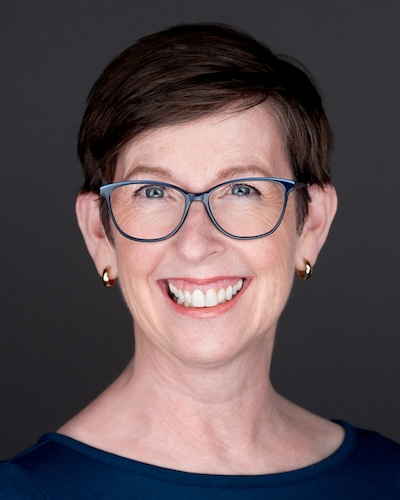
Hello! I’m Janine Adams — a certified professional organizer based in St. Louis, and the creator of Peace of Mind Organizing®.
I love order, harmony + beauty, but I believe that the way that you feel about yourself and your home is what truly matters.
If you’re ready to declutter with a purpose and add more ease to your life, you’ve found the right blog — and you’ve found the right company.
read more »Links
- Are you interested in becoming a professional organizer?
- National Association of Productivity and Organizing Professionals
- Ravelry
- NAPO St. Louis
- Getting to Good Enough podcast
- Peace of Mind Spending
- Organize Your Family History
- Shannon Wilkinson, life coach
- Institute for Challenging Disorganization