There's no such thing as a free book
I make no secret of the fact that I love my Kindle Paperwhite. It makes books so portable that I’m reading more than ever. I love my cover too—I have the persimmon-colored cover pictured below.

One of the things that made me hesitate to buy a Kindle was that I was afraid I’d spend a lot of money on books. Since I was a heavy user of our library system, I was not accustomed to paying for fiction.
Turns out I needn’t have worried. Some Kindle books are available via my library’s system—and I don’t have to leave the house to check them out. But thanks to Bookbub, I’m downloading free books practically daily. And there’s the rub.
Bookbub (which I enthused about in a blog post last summer) sends me an email every day with a selection of free and discounted Kindle books available that day in the genres I selected. I limit myself to the free ones. And there’s usually at least one each day that appeals to me.
So what’s the problem? I have so many books on my Kindle I can’t separate the wheat from the chaff. When I finish the library book I’m reading now, how will I know which one to select?
I tried creating a spreadsheet that ranked the books I had so I could simply start reading the next one on the list. But it’s not realistic to keep that up on a daily basis, especially since I can’t rank books against one another if I can’t tell from the title what a book is about.
I’m pretty sure that if a client were having this problem (be it with electronic books or paper books or other items) and asked me for advice, I’d tell her to stop buying books. I’d talk with her about how there’s a cost to acquiring and keeping even free things.
Perhaps that’s what I need to do. Stop downloading free books. I’m sure there will be free books available after I’ve read the approximately 100 books on my Kindle that I haven’t yet read. At some point, I could revisit my spreadsheet and keep using it until I’ve read all the books I want.
The overabundance of books on my Kindle was starting to stress me out a little. Now that I’ve resolved to stop downloading new books until I’ve read the majority of books on the device, I can breathe easier.
Sometimes the simplest solutions are the best
I had one of those “Why didn’t I think of that before?” strokes of brilliance that illustrates how sometimes we overlook the most simple solutions.
I had white towels in my bathroom, including the hand towels. I use mineral makeup, which I love, but I do hate the powdery mess it makes. After applying makeup, I would wash my hands and dry them on the towel. Perhaps because I’m always in a hurry, sometimes makeup residue would remain on my hands and get transferred to the hand towel.
I put up with this for literally years, lamenting the demise of the towels. (Even bleach didn’t seem to help.)
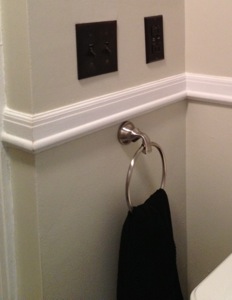
Then I redid my bathroom, which gave me the opportunity to re-think my towels. The new bathroom is beige with white trim, with silver and black accents. That’s when it hit me: I should buy black hand towels! They not only look good, they’re functional. Now if there’s makeup residue on my hands, it doesn’t show on the towels.
What could be more simple? Sometimes the simplest solutions really are the best!
One of the joys of being organized
I sold my car a couple of weeks ago. It was easy to do—the receptionist at my mechanic shop bought it. Even the paperwork wasn’t too bad, and I’ll tell you why: Because I’m organized.
When it came time to put together the forms, I was able to go to my auto file and see how the paperwork was filled out when I bought the car (I bought it used off Craigslist). And here’s the best part. As I knew it would, the car’s title sat in the file right where it was supposed to be. No searching. No worrying. All I had to do was sign it over.
I’m a proponent of keeping all service records for a car in the event you sell it. It’s a great way to help the buyer realize the car was well maintained. I just keep one file per car (including the title) and hand over the whole thing when I sell the car.
Being able to find important documents when I need them is a huge benefit to being an organized person. If you’re not there yet, trust me, you can be!
Worth repeating: Inbox Zero - how I do it
I’ll be celebrating three years of routinely clearing out my email inbox come January. I wrote this nuts-and-bolts post about how I do it in January 2012, after I’d been practicing this habit for a year. Now, more than a year and a half later, nothing’s changed. I use the same procedures and I’m still in love with this habit, which make my life unequivocally better.
It’s been over a year since I started my Inbox Zero habit. On January 2, 2011 I cleared out my email inbox. And, for the most part, it’s been empty at the end of each workday since.
In May of last year, I blogged about why I love clearing out my inbox every day. You can read more detail in the post, but the bottom line is that clearing out my email inbox every day is easier than not clearing it out. Each day my inbox has only new messages in it. Nothing lingering. No time bombs. It’s fantastic.
Moreover, having an Inbox Zero habit prompts me to respond to messages that, in the past, I would have let linger in my inbox. It forces me to make decisions today, not tomorrow or next week. That not only enhances my productivity; it frees up my brain!
Today I thought I’d share the nuts and bolts of how I do it, since it seems to be the kind of thing that many consider difficult. In reality, I find it very easy.
Here’s an important note: When I talk about Inbox Zero, I’m not talking about deleting all my emails. I keep thousands of emails. But they’re filed away from my inbox, waiting for me to refer to them. They’re not mixed in with new emails.
I use my MacBook’s Mail program as an email client. All my emails are downloaded to my computer, which is how I like it. I see no reason, though, that these principles wouldn’t apply to cloud-based systems, like gmail.
- I have many, many email folders. The one I use the most is called *Archive. (More on that below. The * ensures that the *Archive folder is at the top of my list of folders.) I also have folders for various volunteer activities, one called Clients, another for Prospective Clients, and folders for each email list I’m on.
- I use rules to divert listserv emails to designated folders, so they never hit my inbox. Google groups, yahoo groups, any other group emails automatically go into their respective folders and I read them at my leisure. Same goes for messages from Twitter telling me I have new followers.
- For those emails that do land in my inbox, I read and respond as necessary. Ideally, I respond immediately and then move that message out of my inbox. If the incoming message doesn’t apply to a volunteer activity or isn’t from a client or prospective client, I move it into the *Archive folder. If I don’t need to keep it, I delete it. If it doesn’t require a response, but I want to keep it, I just file it.
- By far, most of my emails end up in the *Archive folder. Thanks to the robust search capabilities of my Mac, I can always find an old message; I don’t have to be more detailed in the filing.
- If a message requires action after the response, I flag it, add it to my task list, then file it. In Mail, when I click on the word Flagged in the sidebar, all flagged messages are displayed. No need to move it into an action folder (which I always found scary to look in) and then refile it when the action is done.
- At the end of each day, I go through any emails left in my inbox, respond as necessary, file and delete. It’s that simple.
The number of emails that land in my inbox each day isn’t huge—usually less than 100—and this system works very well for me. It’s very easy to maintain. I typically take a break on the weekends, which means that I have a backlog to deal with Monday morning. (That’s not ideal, but the break feels important.) During the week, I strive for—and unless I’m traveling, almost always achieve—inbox zero.
I have an iPad and I read my email on my iPad (using the Mail app) when I’m out in the world. I automatically blind copy myself on outgoing messages on my iPad, so those messages end up in my inbox on my computer. I just file them along with the rest, thus maintaining a correspondence record in my Mail program. But I don’t worry about Inbox Zero on my iPad. I left the device delete all messages at certain thresholds.
I have a secret weapon in my email success: an accountability buddy. At the end of every weekday my friend and colleague Aby Garvey and I send one another an email about the status of our inboxes. It’s highly motivating and, in the beginning, also helped me remember to clear out my inbox.
Inbox Zero may or may not be attractive for you. It’s certainly been helpful for me and if you’re tempted, I hope you find this post helpful!
Change can be good
Last week, Apple issued a new operating system for its mobile devices, iOS 7. I saw online that it was a huge redesign. At first I balked at updating. (I tend to be slow to do that anyway; I like to wait for the bugs to get worked out.) I wondered why they’d make such a drastic change. The old design—unchanged since the original iPhone—was clearly a winner. I was used to it. It worked well. I had no complaints.
I resisted making the change; I wasn’t interested in going through a learning curve that might make it temporarily more difficult to use my iPhone.
Then I started hearing good things. And I had a chance to get a taste of the new iOS on my friend’s iPhone. So I went ahead an updated.
It might sound strange, but (so far, anyway), the iOS 7 makes me really happy. It’s actually brought joy into my life. I love the lighter look. I love the improved functionality. (So much more weather info available at a glance, for example!) I love the anticipation of noticing new and wonderful things.

The weather app in the old iOS.

The new weather screen is lighter and more informative.
Thinking about the experience of upgrading my iPhone’s operating system makes me realize how limiting it is when I’m reluctant to make changes. Things are going great with my business (and my life, really), so my tendency is to leave things alone. If it ain’t broke, why fix it?
But maybe I should take (yet another) clue from Apple and consider beneficial changes that could help things go from great to amazing. If Apple is willing to change up something wildly successful, and in the process improve it, why shouldn’t I?
Slow down
Today I had occasion to choose a card at random from a deck of Pause cards. Created by a Inspired Mastery, a coaching company, each Pause Card in the deck has a potent message for the mindful leader.
This was my card.
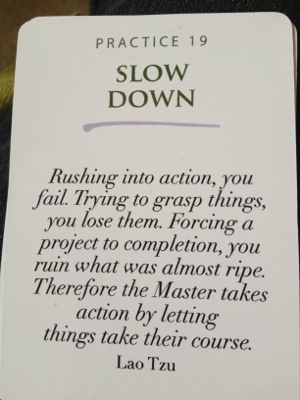
I love this message. Five years ago, I wrote a blog post called S-L-O-W down about the importance of mindful living.
I love the message of this card. To me, it’s about looking before you leap and carefully considering before acting.
Have you ever rushed into something and wished that you’d slowed down?
Worth repeating: Life without cable TV
Almost two years ago, I wrote this post about giving up cable TV. I’ve since written two updates: Update on the cable-free life and A year without cable TV, but I think this post was the most informative of them. I’m an avid TV watcher and don’t miss cable a bit. Between the shows I can watch on my Roku, the Tivo I ended up buying which records broadcast shows for me, and shows I can catch online, I have more than enough to watch. And I’m so delighted not to pay for cable TV!
I’m a huge fan of quality television. I watch a lot of TV and always have. I think it’s one reason I love knitting so much. I can knit while watching TV and feel productive. (And I find the combo really relaxing and fun.)
About two months ago, we canceled our cable TV. I never would have guessed that I would do that. We’ve always subscribed to all the premium channels and it’s hard for me to imagine I’d do without. But here I am, cable-free. Why did my husband and I cut the cord?
- Charter jacked up our bill (again) and they were going to have us pay $135 a month for television alone (we’re satisfied getting our landlines and DSL through AT&T).
- It’s no longer necessary to have cable or a satellite dish to have ample access to quality television.
I’m watching as much TV as ever. But now the internet is my TV provider. We replaced the cable box with a little Roku box, which allows us to easily access streaming video from Hulu Plus and Netflix, as well as Amazon Instant Video. We paid $99 for the Roku box and we pay $7.99 a month each for the Hulu Plus and Netflix Watch Instantly (we were already paying $7.99 a month for Netflix before we cut out cable) and we pay $79.00 a year for Amazon Prime, which, among other benefits, allows us to stream certain content free of charge.
We can watch web-only content (like CBS shows) by hooking up a laptop to the TV. We spent $30 on an HDMI adapter to allow us to do that.
We can also watch live programming on the five major broadcast networks (ABC, CBS, NBC, Fox and PBS) over the air, free of charge. (We bought an indoor antenna to make that happen.)
So let’s add it up:
$7.99 a month for Hulu Plus
$7.99 a month for Netflix (which we were paying anyway)
$6.58 a month for Amazon Prime (and we also get free second-day shipping and Kindle book sharing)
That’s a total of $22.56 a month. Plus there were the one-time charges:
$99 for the Roku box
$30 for the laptop adapter
$50 for the indoor antenna
That’s $179 in up-front, one-time costs.
In the first year, counting those one-time expenses, we will have spent just under $450 on television viewing. If we’d stuck with Charter, that same year would have cost us $1,715 (counting the Netflix we were already paying for). A savings of 75 percent! Not counting the one-time charges, the savings is 85 percent.
That’s huge. And I’m never short of things to watch, because I’m the kind of gal who loves to watch multiple episodes of a TV series in a row. So right now I’m alternating between Parenthood and Sports Night. (Love that Peter Krause!)
I’ll occasionally pay for episodes of certain shows, via Amazon or iTunes, I expect. But that’s okay when I compare it with the money we’re saving.
The one thing I miss is a DVR for the live programming. If I had it to do over again, I might consider spending $99 on a Tivo, rather than Roku, which I now know offers the same streaming services, plus it’s a DVR. But I’d have to pay $20 a month for the DVR service. I’m looking into ways to make the laptop we have connected to the TV serve as a DVR.
Going without cable has been surprisingly pain-free. And I know we’re going to enjoy the savings!
Search
Recent Posts
- Worth repeating: Figuring out what to watch on TV
- The power of incremental progress
- Podcast guest spot on the role of organization for folks with chronic illness
- No excuses series (part 3): "It was a present"
- No excuses series (part 2): "I paid a lot for that item"
- No excuses series (part 1): "But I might need it!"
- Retiring the New Organizer Guides
Tags
About Janine

Hello! I’m Janine Adams — a certified professional organizer based in St. Louis, and the creator of Peace of Mind Organizing®.
I love order, harmony + beauty, but I believe that the way that you feel about yourself and your home is what truly matters.
If you’re ready to declutter with a purpose and add more ease to your life, you’ve found the right blog — and you’ve found the right company.
read more »Links
- NAPO St. Louis
- Are you interested in becoming a professional organizer?
- Getting to Good Enough podcast
- Organize Your Family History
- Institute for Challenging Disorganization
- Ravelry
- Shannon Wilkinson, life coach
- National Association of Productivity and Organizing Professionals
- Peace of Mind Spending