Create a checklist of travel cords
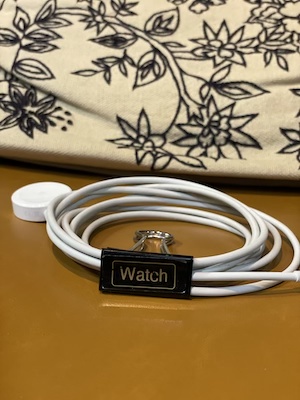
Keeping your devices fully charged while traveling can be a challenge. I’m on a trip to visit family in Walla Walla, Washington, and I find that I did not pack all the right charging cables. I’ve had a good system for some years, involving a packing cube that I keep stocked with my travel cords, which are separated using labeled binder clips. That’s worked well because I can easily see that I have everything when I’m packing for a trip. It also allows me to see if any cables are missing when I pack up my hotel room to come home.
But here’s where things failed: I didn’t update my system when I got an iPhone 12 with MagSafe charger that has a USB-C charging cable. I also have a backup battery to charge my phone that charges with a USB-C cable. That means I need to bring extra cables and at least one USB-C brick. On this trip, I ended up having to play musical chairs with cables.
While it’s fresh in my mind, I created a checklist of cables, in Evernote, that I will need for future travel. I also created a task on my Trello task board to add a couple of labeled binder clips to the packing cube when I get home to my label maker. They will serve as a reminder, if I need it, to check my new Evernote checklist and make sure I have everything. I hope that I will be able to store all the cables in my packing cube, if I have enough cables for everyday use available to me.
I’ve managed to keep everything charged on this trip but it’s been a bit more challenging than necessary. I’m glad I thought to create the checklist, so I don’t have to rely on my memory. I look forward to updating the system when I get home to make future travel easier!
Worth repeating (again): Feeling busy? Take 5 minutes to create a little order
I wrote this post five years ago, amidst the upheaval of a kitchen renovation. Taking just a few minutes to create a little pocket of order was so helpful. I can’t tell you how many times I’ve implemented this since then. Five minutes on a timer and enough order can be created to restore sanity. I encourage you to give it a try!
When I get busy my natural messiness kicks in. Our kitchen is being renovated so disorder reigns in our house and has for the last six weeks. But even in small spaces that have nothing to do with the kitchen, like my desk, everything felt out of control this morning. I’m feeling pulled in a bunch of directions and just wasn’t taking the time to put away the stuff I could. And the clutter started getting tome.
So this morning I set my timer for five minutes and I cleared off my desktop. I recycled papers I didn’t need. Took coffee mugs away to the (temporary) kitchen and put things in their homes.
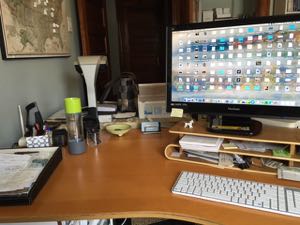
After five minutes my desk wasn’t perfect (see the photo above). But I wish I’d taken a before picture, because the improvement with just a little effort was vast. I felt so much better when I was finished. And I was able to get productive quickly—I’m always amazed how a cluttered desktop hampers my productivity. (It’s clear I need to spend some time decluttering my computer desktop…please don’t judge!)
Sometimes when you’re really busy and things are messy you think you just don’t have the time to tidy up. But I think that’s when you should take a little time—even if it’s just five minutes—to create a little order and give yourself some peace of mind.
Decluttering, tidying and cleaning are not an all-or-nothing propositions. You don’t have to wait until you have enough time to do everything. You can do just a little and enjoy some big dividends.
Buying and selling a car in this crazy car market
As you probably know, there is a shortage of cars in the U.S., thanks, apparently, to a shortage of computer chips. That means that you can sell your current car for more money than you might expect. But it also means that it’s hard to find a car to replace it at a reasonable price.
I wanted to take advantage of the demand for used cars to sell my 2014 Ford Transit Connect van. I bought it to use in my business and it was great for carrying around lots of bins and organizing supplies. But now that I have employees I don’t need to carry around so much stuff. And I wasn’t a big fan of driving that van.
To sell it, I got bids from Carmax, Carvana and WeBuyAnyCar.com. Carvana offered me $16,129 for the van, which was $1929 more than Carmax’s offer (and $4269 more than WeBuyAnyCar’s initial offer). After accepting the offer, all I had to do was upload some documents to prove ownership and the odometer reading and arrange for it to be picked up from my home. It couldn’t have been easier. Two days after it was picked up, the money landed in my bank account.
But I needed a car to replace the van. I set my sights on a new Nissan Leaf all-electric car. (My friend Shannon Wilkinson has one and loves it and that was enough for me.) I almost never get new cars, but in this case, I wanted the most advanced technology and the opportunity to take advantage of the federal tax credit for buying a new electric car. Plus Nissan lowered the price of the 2022 models as compared to 2021.
Trouble was, there were no 2022 Nissan Leafs in all of St. Louis, according to the NissanUSA website. I was told they might be in stock in late October. I didn’t want to wait that long. So here’s what I did.
Every day, I checked inventory within 250 miles of me on the NissanUSA website. I knew I wanted the larger battery (the Plus), so I could get more miles on a charge (215 miles for the Plus vs 150 miles for the S version). And I was pretty sure I wanted leather seats. So that meant I was searching for a 2022 Nissan Leaf SL Plus. As soon as one showed up, I would contact the dealer. And I would be told the car was already sold. That was frustrating, so I started contacting dealers who had cars marked “In Transit” rather than waiting for the car to arrive before contacting them. I kept a spreadsheet of all the individual cars I had inquired about so that didn’t lose track of the nearly identical cars sold by a bunch of different dealers. I went to a local dealer and test drove a 2020 that I wasn’t interested in buying (with full disclosure to the salesman). That test drive cemented my decision that this is the car I wanted to buy.
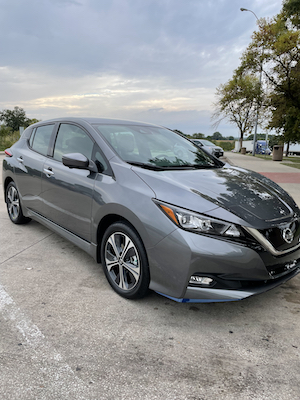
The day after the test drive, September 30, I heard from one of the dealerships I’d been in touch with, Dream Nissan in Kansas City, Kansas. A 2022 Nissan Leaf SL Plus had just arrived on the lot. It was grey (Gun Metallic), my second-favorite of all the colors (though any color would have been fine). And they were offering to make it mine.
Dream Nissan, unlike other dealers I’ve heard about, did not try to charge me above the sticker price, despite the high demand for the car. And there was a Nissan rebate that brought the price down below MSRP. The car had all the bells and whistles I sought. (It’s easily the nicest car I’ve ever owned.) I decided to lease, rather than purchase, this car because with technology advancing I didn’t think I’d want to drive it for a long time. (I had to forfeit the federal tax credit to do that.) I was able to do all the paperwork for the lease over the phone and internet on September 30 and made arrangements to pick up the car on Saturday, October 2.
Bright and early Saturday morning, I took Amtrak to Kansas City’s Union Station, where a Dream Nissan employee picked me up and took me to the dealership across the state line. I got a quick tour of the car and off I went. The trickiest part was that the 262-mile trip was longer than the driving range of the car. So I had to find a fast-charging station to juice up my car. And I wasn’t driving through very populated areas.
I used PlugShare to locate a charger in Boonville, Missouri. Unfortunately, when I got there the charger was out of order. (Best laid plans.) I ended up deciding to spend the night in Columbia (where I could find no fast chargers) and drive to a fast charger in Kingdom City the next morning. (I had a contingency plan if that one was out of order). I got there with 20 miles to spare on my battery. The Kingdom City charger was in great working order and was on my way home in an hour. This was a great crash-course in charging my car!
Dream Nissan was a dream to work with, if you’ll forgive a pun. The Remote Sales salesman I worked with, Chris Herring, was responsive and helpful, as was everyone else I spoke with. There was no hard sell and no attempt to upsell me. And here’s the best part: They are reimbursing me for my travel expenses, even the hotel room.
Once I got to the dealership, a salesman named John Hart gave me a tour and test drive of the vehicle and he was diligent in making sure that the very helpful Nissan Connect EV&Services app was working for me. That actually took more than a week, but John spoke directly to Nissan and made it happen and I’m so grateful. (I was getting a confusing error message about the fact that my cell phone provider was AT&T.)
I love my car. I love that I didn’t have to compromise. I love that I figured out how to find a car without too much difficulty and without much waiting, despite the strange car-buying times we are in.
Setting a vision for your organizing business

When I started Peace of Mind Organizing in 2005, I sat down and tried to picture what my business might look like down the road. I took out pen and paper and had brainstorming sessions with myself. I tried to envision myself in various client situations and what that might feel like. I thought about how it would feel to help someone get organized and build a bank account doing so.
Did my vision come true? To be honest, I don’t know, because I didn’t hang on to those early sheets. But I do know this: Having a vision for what success looked like was a compass that helped me navigate the decisions I made about marketing my business, setting policies and boundaries and so much more.
If you’re considering starting an organizing business (or perhaps you’ve started one in the past couple of years), I urge you to sit down during a quiet moment and think about what you would like your business to look like.
You might ask yourself questions like these:
- What kind of people would I like to work with?
- What kind of organizing projects seem especially appealing?
- Am I ready, willing and able to put in the effort to build my business, which may mean working a lot of hours for no pay, especially at the beginning? (If this one seems very unappealing, you might consider becoming an employee, rather than a business owner.)
- What do I love most about organizing?
Once you’ve written those thoughts down, the next step would be to think about how you will find the people you’d like to work with (and how they’ll find you) and how you might market those appealing projects. You might brainstorm the systems you could establish to make your business run smoothly or think about where you can learn about that stuff. (My advice is to join the National Association of Productivity and Organizing Professionals and your local chapter so you can learn from fellow organizers.)
You might take another step back and think about how things will look one year from now and then five years from now. This might help you steer your business. I encourage you to file away those sheets (or take a picture of them) so that you can look back ten years from now and see how your vision panned out!
I know that I didn’t expect to do team organizing when I started out. I never dreamed I’d have employees. I also expected to get more clients from word of mouth than from my website (the opposite has proven to be true). Having a vision for my business while keeping an open mind to other possibilities has been successful for me. I urge you to try it too.
I’m just about to start a new mailing list for new and prospective organizers. Keep your eye out on the blog and website for a sign up. Or, if you’d like, feel free to email me at janine@peaceofmindorganizing.com and I’ll personally add you to the list once the sign up is live.
Photo by Virgil Cayasa on Unsplash
Worth repeating: Reflections after a year in our new kitchen
We renovated our kitchen five years ago, in 2016. A year later I posted some reflections. The new kitchen has been life enhancing and we still absolutely love it. We’ve done a little bit of rearranging but the organizational infrastructure I set up five years ago remains solid. My only regret is that we took 24 years to renovate our old red kitchen!
A year ago today, our kitchen renovation was complete and I finished unpacking our stuff into the new kitchen. A month or two later, I wrote a blog series about the renovation. I just re-read the series and relived the joy of that project. Honestly, it was a bit of a pain while we were going through it, but the results were absolutely worth the hassle and the money.
A year later, we’re still loving the kitchen. My favorite storage features are still favorites. I hadn’t mentioned how much I like the trash/recycling pull-out cabinet in the island. It’s so much better than having two trash cans on the floor, which is what we had before. The other thing I love is how easy it is for me to empty the dishwasher each morning because almost everything is stored right near the dishwasher (a huge departure from our old kitchen). I love that we have ample space to store everything. It’s amazing what a difference in quality of life it make when you create a highly functioning kitchen.
Unlike our old kitchen, the countertops in the new kitchen stay quite uncluttered. I think that’s because there’s a place for everything and it’s easy to put stuff away. And when countertops stay clear, they don’t attract random stuff. The exception to that is the counter that runs along the wall from the kitchen to the radiator. (We call that the bar area.) It has started to attract some clutter—things that didn’t really have a home, like a single copy of a Sunday New York Times purchased for its puzzles, the recipe cards that came with our trials of Hello Fresh and Blue Apron and the full-color book/program you get when you go to Opera Theater St. Louis. But it took me less than ten minutes this morning to clear off a six-month accumulation. So that’s not bad!
One improvement we added was a bar for our dishtowels, which we put on the far end of the island. We used an appliance pull that matches our cabinet and drawer pulls. That’s worked out great. Here’s a photo taken after I decluttered the bar counter (with special guest appearance by Bix):
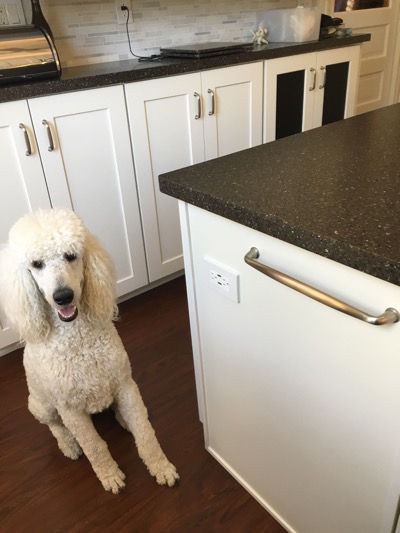
There are only a few things I think we’d do differently if we had it to do all over again.
- We might have selected a different countertop because the solid-surface LG-Hi-MACS scratches easily and is heat-sensitive. I’m not sure what we should have chosen instead; we haven’t discussed that.
- I’m not crazy about the Allure vinyl plank flooring we chose. I think it looks fake. If I had it to do over again, I might have chosen vinyl tile or vinyl wood plank that doesn’t look distressed. I don’t mind that it’s vinyl; I’m just not crazy about how the one we chose looks. But I really do love that it’s waterproof.
- I kind of wish we’d designed a place for Bix’s food and water bowls because that water bowl has been kicked more than once. But I haven’t spent much time trying to figure out what we might have done. We’ve ended up placing them at the near end of the island, where we store his food. That’s working out pretty well.
Because everyone likes to look at before-and-after photos, I’ll run again the pix from the first post in the series last year. We don’t miss the red countertops. And we certainly like having upper cabinets!
From the entrance to the kitchen from the living space:
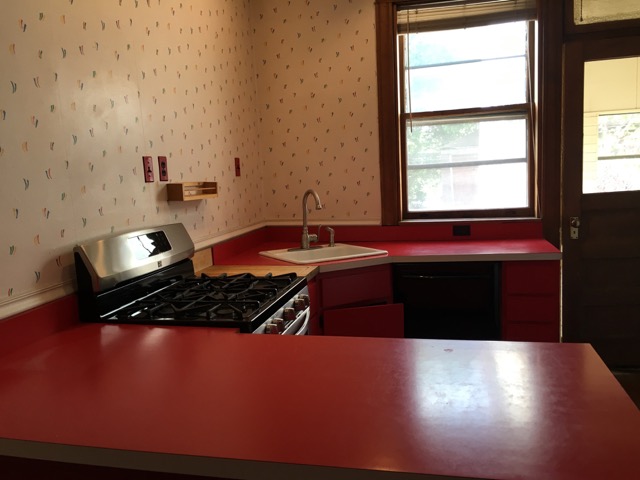
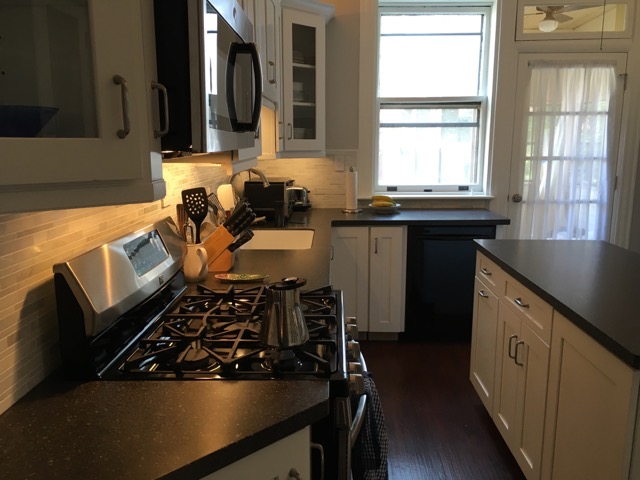
From the sink:
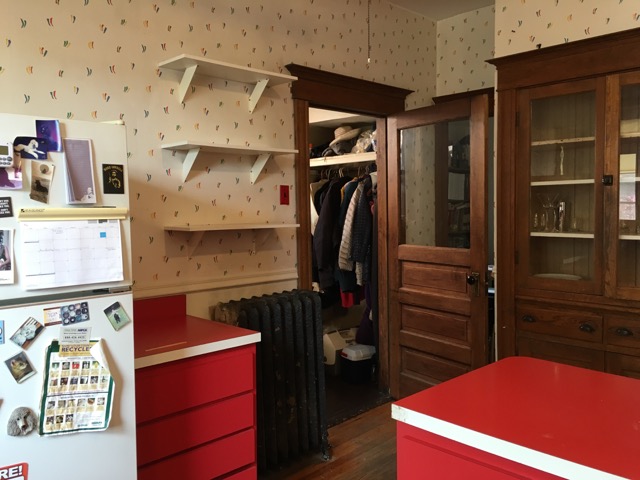
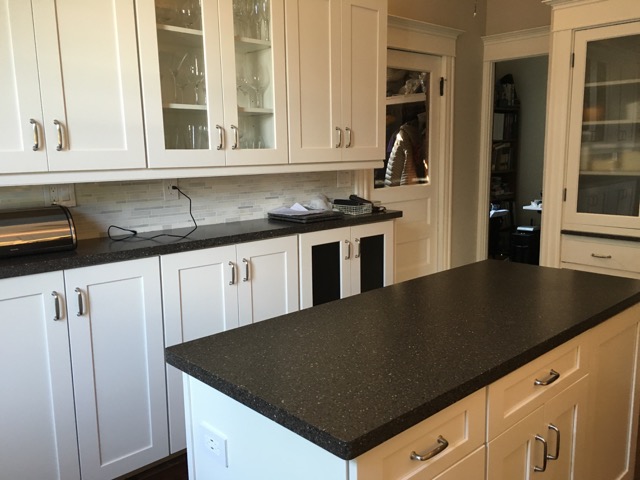
From the back door:
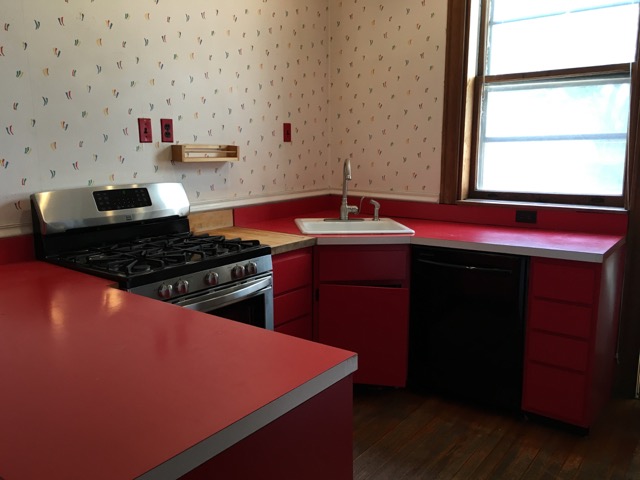
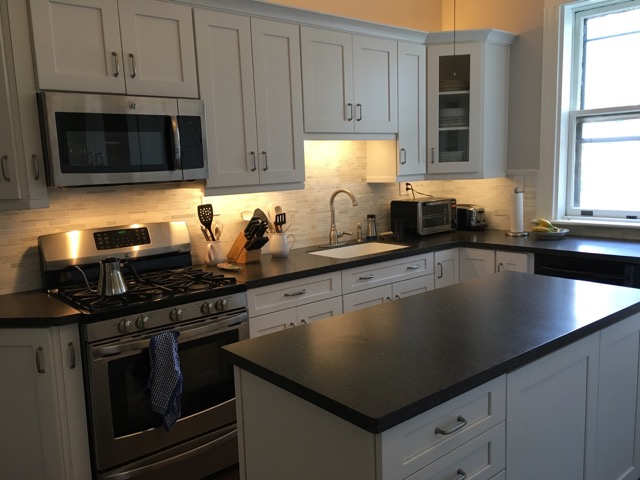
View of the built-in cabinet:
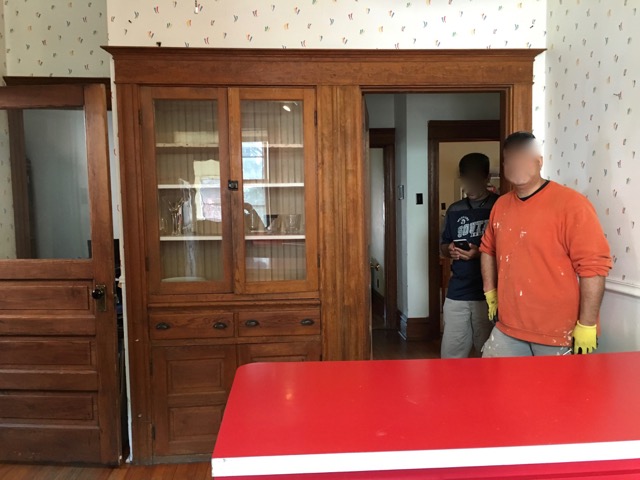
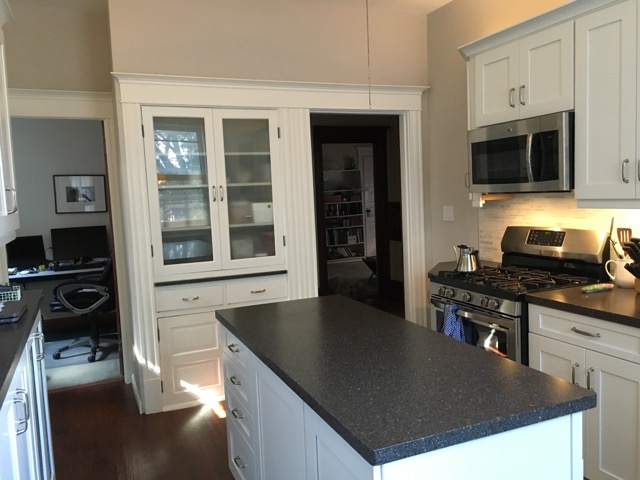
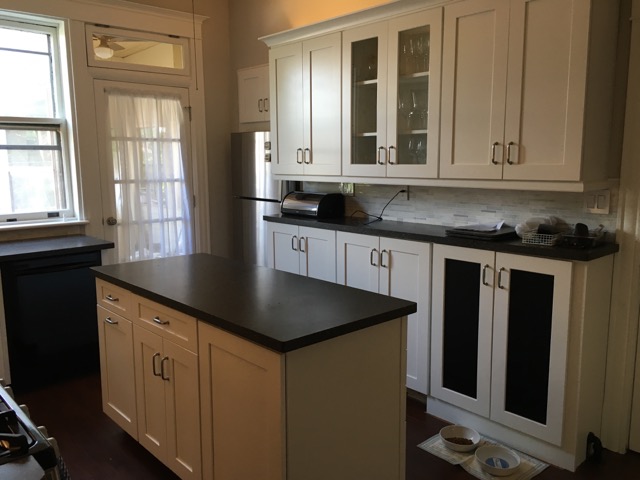
This last “after” shot shows that we sacrificed our pantry so that we could get the refrigerator out of the way. That was a stroke of genius on the part of the designer.
Meet my employees!
For ten years, I led organizing teams comprised of wonderful independent contractors who have their own businesses. In 2018, I hired my first employee, Amy. I made a shift toward employees so that I could create processes and policies that by law I’m not allowed to impose on contractors. (I can’t tell contractors how to organize, but I can train my employees.)
A few months after hiring Amy, I added a second employee, Geraldine. Both of them were fantastic organizers. Unfortunately, they both had to resign in November 2019, due to circumstances beyond their control. Luckily for me, right at that time I was approached by a wonderful prospective organizer, Beth Hunyar, who was not interested in starting her own business. I hired Beth in December 2019 and we got right to work. And then, of course, the pandemic hit just three months later.

Beth Hunyar
Since we went back to work last year Beth has been an instrumental part of Peace of Mind Organizing®. I have stepped back from client work somewhat due to my husband’s health and concerns about COVID. Beth has filled the void, working with most of my clients, alongside independent contractors. She has moved into the lead organizer role and is doing a wonderful job. She is great at organizing and is simultaneously calm and enthusiastic. Her client skills are excellent.
Last month, I hired a second employee, Adrienne Pittson. She’s still in training, but she’s had her first client session, alongside Beth and me. (Spoiler alert: She did a great job.) Adrienne absolutely loves organizing and I’m very excited about her enthusiasm and readiness to learn, coupled with her natural organizing skills.
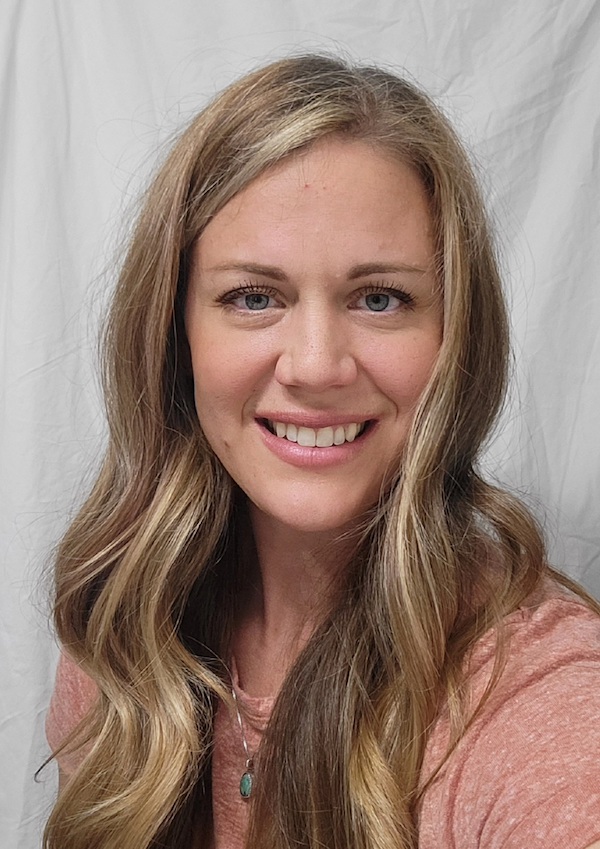
Adrienne Pittson
Both Beth and Adrienne are moms with young kids ranging from kindergarten to high school. (Beth has three, Adrienne has four.) They both juggle busy lives but as moms of young kids have amazing time-management skills. And they have the ability to really focus on the clients during sessions. Since they don’t have to run the business, all their work time is about the clients.
Beth and Adrienne make an amazing team. They both get such pleasure from organizing and from helping clients. I’m thrilled that they can benefit from my experience, because I can provide detailed training and instruction when they need it. We’ll be adding independent contractors to the team for larger jobs, as usual. We are more prepared than ever to help our clients!
Dealing with task-management overwhelm
I have a terrific Trello daily task management board that I’ve been using for 15 months with great success. It’s especially good at helping me complete important daily tasks. I’ve been supplementing it with a hand-written/hand-lettered task list most days that helps me practice my hand lettering and keep my tasks top of mind (plus it’s pretty to look at, which is nice.) My co-host, Shannon Wilkinson, and I talked about my hand-lettered task list a little in this week’s episode of our podcast Getting to Good Enough.
I don’t usually have a problem staying on top of my tasks and prioritizing them. Ordinarily I plow through a lot of tasks in a day and I’m generally pleased with my productivity. But right now, at this moment, I’m overwhelmed by projects and keeping track of all the tasks they entail. I feel out of control and that feeling alone is distracting. My productivity and peace of mind are suffering!
On top of my normal activities of client consults and administration, blogging and podcasting, I have these things going on:
- I hired a new employee, Adrienne Pittson (I’ll introduce her to you next week!);
- I have a leadership role in a community service project;
- I’m researching a new car to buy (I’m thinking of going electric!);
- I’m working with Molly Winters, a wonderful marketing consultant and copywriter, on a campaign targeted at new and aspiring organizers (if that piques your curiosity, shoot me an email and I’ll add you to the mailing list I’ll be building);
- I’m planning a trip to Walla Walla next month.
So today I created a new board in Trello called Projects – Fall 2021. Here’s what I did:
- I created a list for each project as well as a list called Empty the Brain.
- In the Empty the Brain list, I added a card for each task I could think of, regardless of what project it was associated with.
- I created a colored label for each project and marked each card with the appropriate label.
- I moved each labeled card to the appropriate list. (I used the Bulk Actions Power-Up to make labeling and moving the cards easy.)
- I created a list called DONE!, which I placed in the left-most position, and when I complete a task I will move the card into that list. That gets the completed task out of the list of things to be done and allows me to see at a glance which projects I’m making progress on.
Here’s a picture of that board as it stands now. (I haven’t started attacking the tasks yet.)
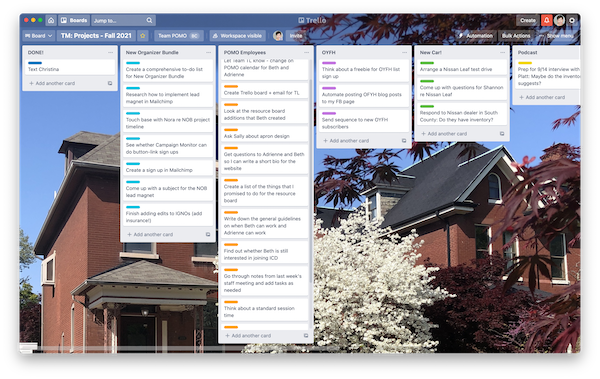
Even though I’ve literally completed only one task, I am feeling so much better. Just having one place to put all these tasks is very helpful—they were just too much for my already-crowded daily task management board. My brain is no longer swirling with tasks and I have the comfort of knowing where to put tasks as they come to mind.
I’m looking forward to completing some of these projects and being able to go back to using my Daily Task Management board alone. But for now, I’ll use two boards (one for the projects, one for the daily tasks and those not related to these projects). I already feel an uptick in my productivity!
Search
Recent Posts
- Worth repeating: Figuring out what to watch on TV
- The power of incremental progress
- Podcast guest spot on the role of organization for folks with chronic illness
- No excuses series (part 3): "It was a present"
- No excuses series (part 2): "I paid a lot for that item"
- No excuses series (part 1): "But I might need it!"
- Retiring the New Organizer Guides
Tags
About Janine

Hello! I’m Janine Adams — a certified professional organizer based in St. Louis, and the creator of Peace of Mind Organizing®.
I love order, harmony + beauty, but I believe that the way that you feel about yourself and your home is what truly matters.
If you’re ready to declutter with a purpose and add more ease to your life, you’ve found the right blog — and you’ve found the right company.
read more »Links
- National Association of Productivity and Organizing Professionals
- Organize Your Family History
- Institute for Challenging Disorganization
- Ravelry
- Getting to Good Enough podcast
- NAPO St. Louis
- Are you interested in becoming a professional organizer?
- Peace of Mind Spending
- Shannon Wilkinson, life coach