Tiny projects challenge: Day 4
I focused my attention on my printer stand/snack bar today. In about 20 minutes, I decluttered and tidied this little space and it felt great!
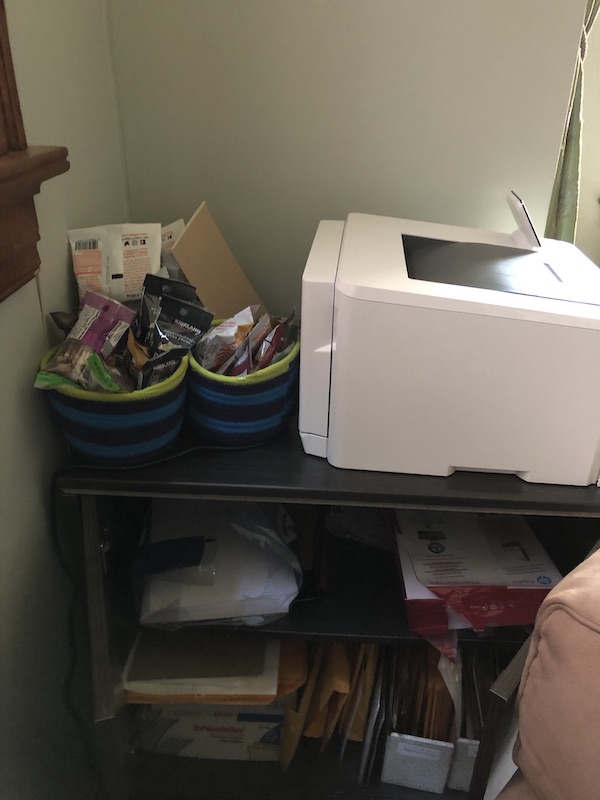
Let me explain the snack bar: I buy snacks like packets of nuts and snack bars that I take with me to client appointments so I can nosh when I’m hungry without interrupting my work. I typically buy the snacks at Costco and I store them on top of my printer stand, next to my printer.
In the printer stand I store paper (both printer paper and premium paper that I use for hand lettering), along with mailing envelopes, file folders and cardboard to make envelopes stiff. It’d been awhile since I spent any time with the contents of the printer stand and things had devolved a bit.
Here’s a picture of the printer stand before I got started. Not pictured was a partially full Costco box of snack bars on the windowsill.
And here’s how it looked twenty minutes later.
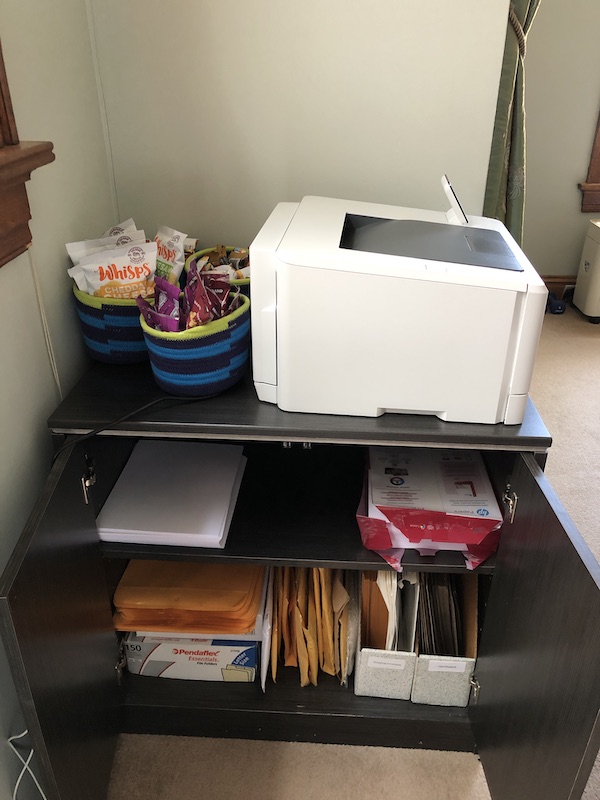
It took me ten minutes to tackle the snack bar. I went through the snacks and discarded the expired ones. (Quite a few had expired!) With the space I gained, I was able to integrate the bars from the windowsill into the containers on the printer stand and get that unsightly box off the windowsill.
Inside the printer stand, I put like things together, took my regular printer paper out of its packaging for easier access and recategorized what went into the magazine holders. And I took a moment to create a new label so the magazine holder labels reflect reality.
I took note that I need to buy some more printer paper and also some more of the tea I buy in bulk and usually store between the two types of paper. I also moved Bix’s armchair so that I could open the printer-stand doors more fully.
I have to say, this was a satisfying tiny project. The little bit of work I did today will make accessing snacks, paper and envelopes easier. It felt great. The photos don’t do it justice!
Tiny projects challenge: Day 3
Today, I focused on my desktop (the top of my actual desk, not my computer desktop). I forgot to set my timer and I was watching Anderson Cooper on Stephen Colbert’s show at the same time, so I don’t know how long it took. But I’m confident it would have taken less than 15 minutes if I’d been focused on the task at hand.
Here’s the before shot. If I don’t clean up my desk at the end of the work day, this is how it usually looks when I arrive at my desk in the morning.
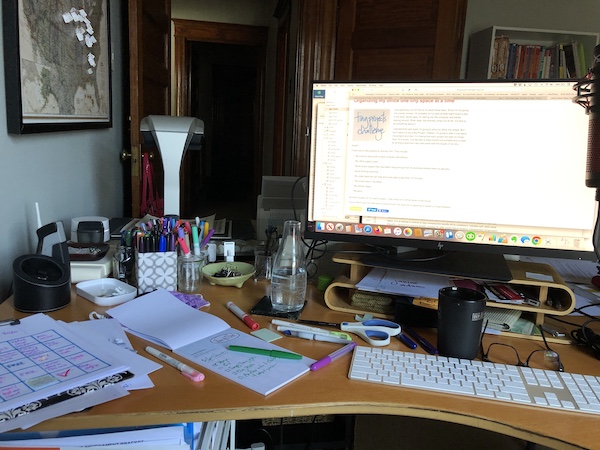
And here’s the after shot.
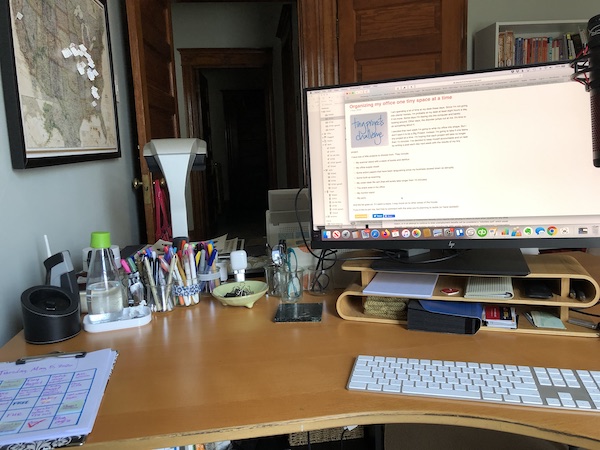
I actually did do a little more than tidy up. I went through the square pen cup that’s been on my desk. I realized that I use about two of those pens on a regular basis (usually I use my lettering markers, in the glass jars). So I tested all the pens in the pen cup and discarded the half dozen that didn’t work. The rest were Sharpies and highlighters. I put them away in the Sharpie area of my office-supply closet. (I may have a Sharpie problem.) I was left with a few fine-point pens, which I put in a Oui yogurt jar for easy grabbing.
I also went through the papers in the small pile on the edge of the desk and created a couple of files I put in the file box behind me on the radiator.
I’m so glad that I committed to these five days of tiny projects. They’ve each had a great payoff for a small time investment!
Tiny projects challenge: Day 2
Today I tackled two desktop file bins of paper that at one time were Action papers but that had languished due to inattention. It wasn’t a whole lot of paper, but these two bins were cluttering up my office—and my psyche. (To be honest, these bins were much fuller about six weeks ago, but they were among the first things I dealt with at the beginning of the stay-at-home order, so today’s project focused on those items I hadn’t dealt with over the last six weeks, as well as some papers added during that time.)
The larger bin had been hanging out on top of the shredder (making the shredder less accessible) and the other was on the radiator directly behind my desk. I put the two together for this picture.
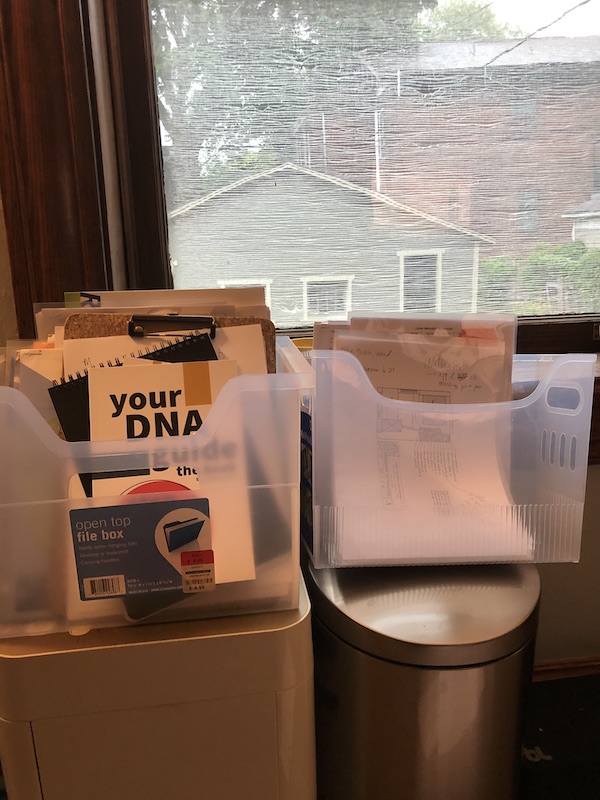
It took me twenty minutes this time, but when I finished, I whittled the papers down to one smaller bin. (It’s small Multi-Purpose bin from The Container Store.)
Here’s a picture of what’s left:
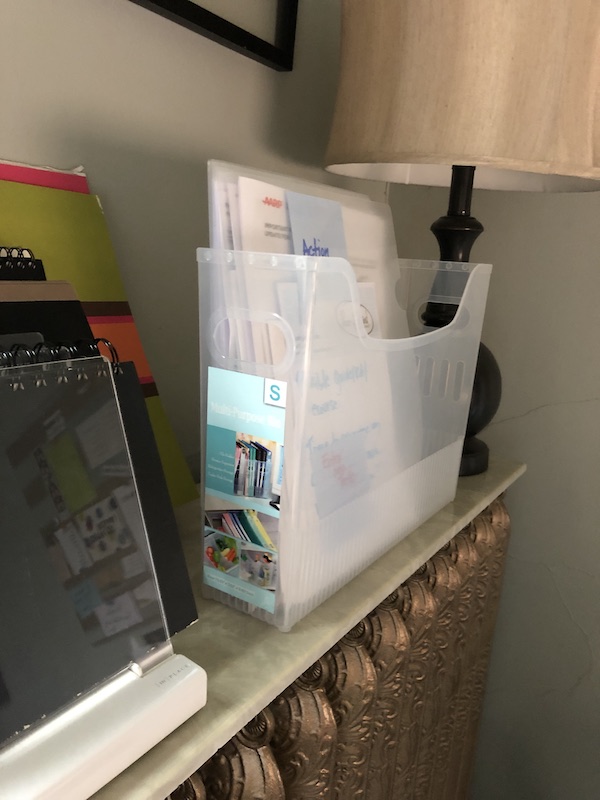
In those twenty minutes of focused attention, I discarded some papers after deciding I didn’t want to deal with a project anymore. I put some papers together and moved them to a closet. I filed a few. I shredded a bunch. I moved the book to a bookshelf. What’s left is a fairly small Action file with clearly defined actions, as well as a few current files I wanted to keep close at hand. (I like to group papers into clear plastic file jackets and use a sticky note to label them.)
Look for another post tomorrow with another tiny project!
Tiny projects challenge: Day 1
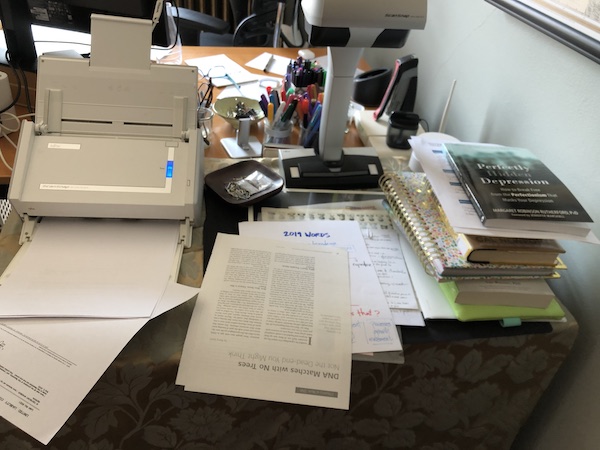
I decided to kick off my five tiny-project challenges this week with my scanner stand. It’s a repurposed printer stand (it’s got to be 20 years old) that I use for my ScanSnap S1500M sheetfed scanner and my ScanSnap SV600 contactless scanner. It had become a bit of a dumping ground.
Here’s the before shot:
Fifteen minutes later (woot!) here’s the after shot:
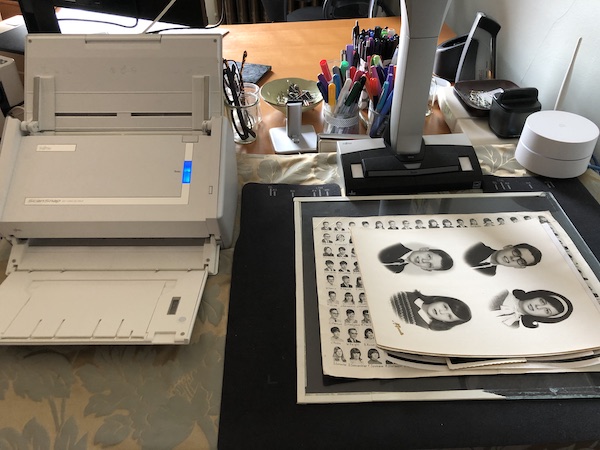
All this took was a little focused attention. In those 15 minutes, I:
- scanned, then discarded, three documents
- filed two documents
- moved books to a bookshelf
- moved the 23andme DNA test to my desk to consider actually doing
- put the old photos my husband asked me to scan front and center so I’ll actually scan them
- put my little dish of push pins where it belongs
That was 15 minutes well spent. I had completely forgotten about those photos and now will be able to scan soon. The scanner stand is the first thing I see when I walk in my office and I also see it when I’m sitting at my desk. So it feels great to have some visual peace!
Organizing my office one tiny space at a time
I am spending a lot of time at my desk these days. Since I’m not going into clients’ homes, I’m probably at my desk at least eight hours a day, if not more. Some days I’m staring into the computer and barely looking around. Other days, the disorder jumps out at me. It’s time to do something about it.
I decided that next week I’m going to whip my office into shape. But I don’t want it to be a Big Project. Instead, I’m going to take it one teeny tiny project at a time. I’m hoping that each project will take no longer than 15 minutes. I’ve decided to keep myself accountable and on task by writing a post each day next week with the results of my tiny project.
I have lots of little projects to choose from. They include:
- My scanner stand with a stack of books and detritus
- My office supply closet
- Some action papers that have been languishing since my business slowed down so abruptly
- Some built-up scanning
- My under-desk file cart (that will surely take longer than 15 minutes)
- The snack area in my office
- My monitor stand
- My pens
And the list goes on. If I catch a wave, I may move on to other areas of the house.
If you’d like to join me, feel free to comment with the area you’re planning to tackle (or have tackled)!
YNAB to the rescue

You Need a Budget is a website/app that has revolutionized the way I think about money. I am surprised that I haven’t blogged about it before (besides a brief mention in January). I did write a bit about it in the January issue of my newsletter .
Today I was reflecting on my gratitude for YNAB, as it’s called, during this current economic crisis. Because I’ve been using YNAB in combination with Profit First for Peace of Mind Organizing since November 2018, I now feel in control of my finances. One of the principles of YNAB is to give each dollar that comes in a job, which allows you to put away a little every month for an annual bill, for example. When you spend money, you tell YNAB which category it comes out of. And if you have unexpected expenses, you can move money from a category you’ve funded and make up for it later. (One its principles is that you should roll with the punches. I love a flexible system.)
The upshot of this is that I’ve had the delightful experience of having the money at the ready when big bills, like my liability insurance, come due. Because I took the time to write down and budget for these annual expenses (which YNAB calls True Expenses), I am aware of how much money it costs to keep my business going. Thanks to Profit First, I’m allocating all my income among the following categories: Profit, Taxes, Owner’s Pay and Operating Expenses. So not only am I paying my business’s bills, I’m paying myself, putting away money for taxes, and I’ve even amassed some reserves, thanks to the profit category.
Using YNAB has cut way down on financial surprises, which was a most welcome change. But then the biggest surprise of all came along: COVID-19. Because I work in people’s homes, my income slowed to a trickle after the stay-at-home order was imposed. Thanks to YNAB, I didn’t freak out about that. I had a very good first quarter. I actually have money in my bank account. And I know how much I need every month to fund my business’s monthly and annual expenses. That is such a huge gift for my peace of mind.
If you’re intrigued by YNAB, here’s what I suggest you do:
- Sign up for a free 34-day trial of YNAB. (If you use that link, we each get a free month after your trial is over. YNAB costs $12 a month or $84 a year, if paid annually.)
- Read articles and watch videos at YNAB’s help center
- Check out YNAB YouTube videos (I particularly like the ones by Nick True.)
- Consider joining the YNAB Fans Facebook group and, if you’re a small-business owner like me check out the Fans of YNAB for Small Business Facebook group
- Figure out your monthly expenses and your true expenses and give YNAB a whirl!
My friend, Shannon Wilkinson, has been using YNAB for years. She’s been raving about it to me all that time and it took me forever to give it a try. I really had to change the way I thought about money, so it took a little while for me to really see its benefits. But I’m in it for the long haul now.
Shannon and I talked about YNAB in Episode 87 of our podcast, Getting to Good Enough. That episode is called Financial Peace. You might enjoy listening to that episode if you’re considering YNAB.
I should point out that while I use YNAB for my business (my husband handles our personal finances), it’s fantastic for personal budgets as well.
Worth repeating: The curse of the large house
I originally wrote this post in 2016. And it’s as true now as ever. Now’s a great time to do some decluttering!

My husband and I own a house that’s larger than we need. It was built in 1908 as a two-family house and when we bought it, we lived in the upstairs apartment and rented out the downstairs apartment. The upstairs apartment, which has two bedrooms and is 1600 square feet, was plenty big for the two of us. But we rather hated being landlords, despite the fact we had good renters. (Truth be told, we’re born renters.)
We moved to Brooklyn, New York, for four years and in that time rented out both units of the house, with the help of a property manager. Our rent in Brooklyn was twice the mortgage payment of our St. Louis house. So when we moved back to St. Louis, we decided to live in the whole house and avoid the stress of being a landlord.
So we literally have twice as much space as we need. (More than twice a much, actually.) Plus we have a full basement.
Recently I’ve been decluttering some deep storage in our home because we’ve waterproofed our basement and now have the ability to store stuff down there. I came across items that we put away in 2001 when we moved back to St. Louis. This is stuff we haven’t used in 15 years. Stuff we didn’t even miss. Or remember owning. (I’m talking about items like tablecloths, games, and a bag marked, in my handwriting, “Barry’s shirts.” What was I thinking?) Most of it has been donated.
The longer I’m a professional organizer the more fervently I believe that life is better when we have less stuff. I believe that owning fewer belongings leads to more freedom. And I see it in my clients as well.
I have two clients looking to put their houses on the market on February 15. Both clients own spacious homes. Consequently, both clients have lots of stuff. I am encouraging them to let go of as much as possible as we pack up items for storing for staging purposes. As my team members and I are handling these items, I just keep thinking about how much better off we all would be dragging around less stuff.
If you live in a small home that is bursting at the seams, you may think the answer to your clutter problem would be moving to a larger home. I’m here to tell you that it isn’t true. When we have large homes, we tend to acquire more. (Just like when we have higher incomes we tend to spend more.)
At some point before long, I suspect Barry and I will sell our house and move. Believe me, I will be advocating for a much smaller space! As challenging as the downsizing might be, I’m confident having fewer belongings will lead to happiness and peace of mind.
Search
Recent Posts
- Worth repeating: Figuring out what to watch on TV
- The power of incremental progress
- Podcast guest spot on the role of organization for folks with chronic illness
- No excuses series (part 3): "It was a present"
- No excuses series (part 2): "I paid a lot for that item"
- No excuses series (part 1): "But I might need it!"
- Retiring the New Organizer Guides
Tags
About Janine

Hello! I’m Janine Adams — a certified professional organizer based in St. Louis, and the creator of Peace of Mind Organizing®.
I love order, harmony + beauty, but I believe that the way that you feel about yourself and your home is what truly matters.
If you’re ready to declutter with a purpose and add more ease to your life, you’ve found the right blog — and you’ve found the right company.
read more »Links
- Peace of Mind Spending
- Ravelry
- Are you interested in becoming a professional organizer?
- NAPO St. Louis
- National Association of Productivity and Organizing Professionals
- Institute for Challenging Disorganization
- Organize Your Family History
- Getting to Good Enough podcast
- Shannon Wilkinson, life coach