Worth repeating: Creating a capsule wardrobe
I wrote this blog post in 2015, after a delightful visit from my friend Geralin Thomas. I’ve updated it a little, including adding that Geralin is now selling an inexpensive Wardrobe Wisdom Workbook. Geralin is my secret weapon when it comes to looking good. I’m so lucky (and grateful!)
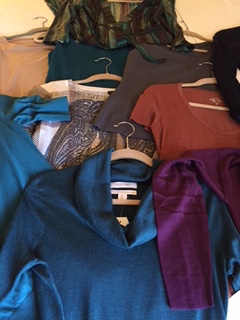
For the last eight years I’ve been fortunate enough to be friends with Geralin Thomas, a professional organizer and wardrobe consultant who has patiently been trying to educate me on what to wear and how to wear it. (I like looking nice, but I lack confidence in knowing what looks great on me and how to put together outfits.)
Geralin was visiting me recently and, like she did last year, went through my closet with me so that we could retire those garments that were either unworn or too worn. She took a look at what was left and created a mental shopping list to fill things out.
And then we had some very successful (and, I must say, enjoyable) shopping excursions. The icing on the cake was the time we spent yesterday putting together top-to-bottom outfits, so I can dress with confidence.
My goal is to have as few clothes as possible and still feel well-dressed. I’m easily overwhelmed by choices, so when choices are limited I am happier.
Geralin taught me that what we did was create capsule wardrobes for me. On page 85 of her book, Decluttering Your Home: Tips, Techniques and Trade Secrets Geralin describes a capsule wardrobe as one in which “individual pieces are combined into outfits that offer maximum use…it’s simply a collection of pieces that work together.” In my case, I now have a nice, simple color-coordinated collection. Everything goes together so I can’t really mess it up. (But to keep from messing up, I photographed the outfits that Geralin put together for me—including accessories.) This allows me to dress with confidence and it makes dressing so much easier.
Here’s a photo of happy me with part of our score from the designer section of the late great Scholarshop, a charity resale shop in St. Louis that closed in 2017. (My new go-to resale shop is the wonderful NCJW Resale Shop.)
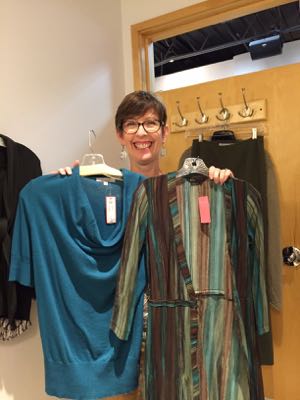
A year ago, we purchased clothes in three neutral colors: black, charcoal and camel. Most of those clothes are still in my closet, and this year we added some color. Primarily, we focused on peacock, teal, green, rust and plum.
My pants wardrobe has been pared down to three pairs of dress pants (black, charcoal, camel—they go with all my tops), along with some black leggings, some ponte knit fitted pants and some jeans. (I have some attractive work-out clothes that I wear when I’m leading organizing teams.) I don’t need any more options than that. And It feels so good.
We took photographs of the outfits, including accessories, and my next step will be to use Geralin’s Wardrobe Planner Worksheet (which you can download free from her website) to write down the individual components of the outfits. I did this last year and it was very helpful.
I have great news: If you’d like to tap into Geralin’s wardrobe wisdom, she’s now selling a workbook! The downloadable Wardrobe Wisdom Workbook is only $9.99.
Geralin is so patient with me and slowly, ever so slowly, I’m learning. Thanks to the great choices we made, I don’t think I’ll have to do any shopping for quite some time, but if I do venture out without Geralin, I think I’ve learned enough that I can make some successful choices!
Making the most of your time at home
I wrote this article yesterday for my monthly newsletter, and received such positive feedback I thought I’d run it here on the blog as well. I encourage you to subscribe, if you don’t already, if for no other reason than the newsletter-only special offers I sometimes run.
We are living in interesting times. As I write this on March 15, 2020, I ponder what the coming months are going to bring during the COVID-19 pandemic. It’s certainly hard to know, but one thing seems certain. We’re going to be spending a lot of time at home.
I’ve come up with some suggestions for making the most your spare time at home while you’re practicing social distancing to try to minimize the spread of the coronavirus. (If you’re now an at-home worker, my advice is to keep up your regular work schedule, then do the stuff below after work.)
- Do some decluttering and organizing. Take a tour of your house and look for small spots you can declutter and organize. Maybe it’s your underwear drawer. Or the mugs in your kitchen cabinet. Or the papers in your file cabinet By doing little projects, you’ll get to enjoy the benefits of multiple successes.
- Take some time to relax without feeling guilty. We all relax differently. I like to knit and watch TV. I also like yoga and finally I’ll have more time to do it. It’s okay to relax. In fact, it’s important to relax!
- Do some planning. Now is a great time to revisit (or re-evaluate) any goals you set for 2020. Not only do you have time for introspection, but the advent an unexpected crisis is always a good time for self reflection.
- Learn a thing or two. You don’t have to take a class in person to get educated. Read a book. Listen to podcasts (you can start with the podcast I co-host, Getting to Good Enough). Learn a foreign language via an app like Duolingo.
- Reach out to others. Call, text or email to see how your family members, colleagues and friends are doing. Just because we might not see each other in person doesn’t mean we can’t keep up.
- Research your family history. Online genealogy research is a great stay-at-home activity. Feel free to check out my blog Organize Your Family History for some ideas and inspiration.
- Take in nature. If you’re feeling healthy but prudently not spending time with others, taking solitary walks or hikes can be a great way to pass some time. Of course, keep your distance from people you might encounter and wash your hands when you get home.
- Help others. This article provides some practical ways you can help vulnerable people whose services are affected by the COVID-19 crisis. If you’re feeling well, you can also help more personally by picking up groceries or running errands for people who cannot leave the house.
- Avoid stressors. I’m finding myself spending a bit too much time reading about the pandemic than is good for me. I’m now trying instead to skim headlines to stay abreast of the news and make an effort spend less time on Facebook and Twitter. Now is a great time to cultivate a gratitude practice.
- Create healthy habits to stay healthy. I read this great article by Ariana Huffington about creating great habits to keep our immune systems strong. It boils down to 1) get plenty of sleep; 2) drink lots of water; 3) eat fresh food and 4) try not to stress.
These are interesting times and most of us are going through something we’ve never before experienced. I believe it’s up to us to help ourselves and others by being community minded and keeping a positive attitude. Let’s make the most of a strange situation!
Worth repeating (again): How not to label a photo
I originally wrote this post in 2013 and it’s just as relevant now in 2020 as it was then. Labels are so important in general, but on photos, they’re essential. Even if you’re working with digital, not printed, photos, creating good labels (in the metadata) is a good practice. If you take the time to label your photos well, they’ll be much more valuable for generations to come.
I blogged over at Organize Your Family History about the importance of labeling photos while the information is fresh in your mind. It’s also important to make the labels meaningful.
While I was going through a box of old (very old) family photos with my mother on my recent visit to Walla Walla, we came across this one, whose label made me laugh.
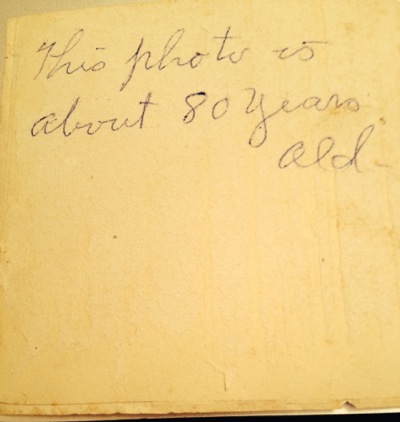
In the absence of a date, that’s a meaningless label. Well, virtually meaningless. At the very least, we know this photo is about 95 years old, since my mother inherited it after her mother died in 1999. And let’s not even talk about the fact that the label doesn’t mention who is in the photo!
Now that we’re printing out fewer and fewer photos, remember that you can label digital photos as well, using metadata. That’s a little easier said than done as this blog post from the Library of Congress discusses, but worth the effort.
When it comes to archiving your own photos, I urge you to think of the next generations who will be looking at them. That means consider getting rid of duplicates and bad shots and labeling those that you deem worth keeping and passing on! Great labels include the names of the people in the photos and where and when it was shot. If it’s a special occasion, that’s nice to mention too!
Many hands make light work
I love leading organizing teams. The amount of work we can get done in a short period of time amazes me. Back in 2012, I wrote a blog post called Working with an organizing team that outlined some of the advantages of hiring an organizing team, rather than a single organizer. Eight years later, all of that is still true!
I’ve been leading teams since 2008. What started as something I did only occasionally has turned into the mainstay of my business. I stopped taking new one-on-one clients some years back (though I do work with individually with some legacy clients) and my team members sometimes work one-on-one with clients who prefer that slower, more deliberate approach. But the vast majority of Peace of Mind Organizing’s work is team organizing.
Here are a couple of pictures of a case in point. We were able to give this food professional back her workspace in just two (long) days. In addition to this main area, there was a large back area filled with boxes and bins. Sixty-five human hours were spent creating a decluttered and organized workspace. Obviously, if only one organizer were working, it would have taken weeks, instead of just a couple of days.
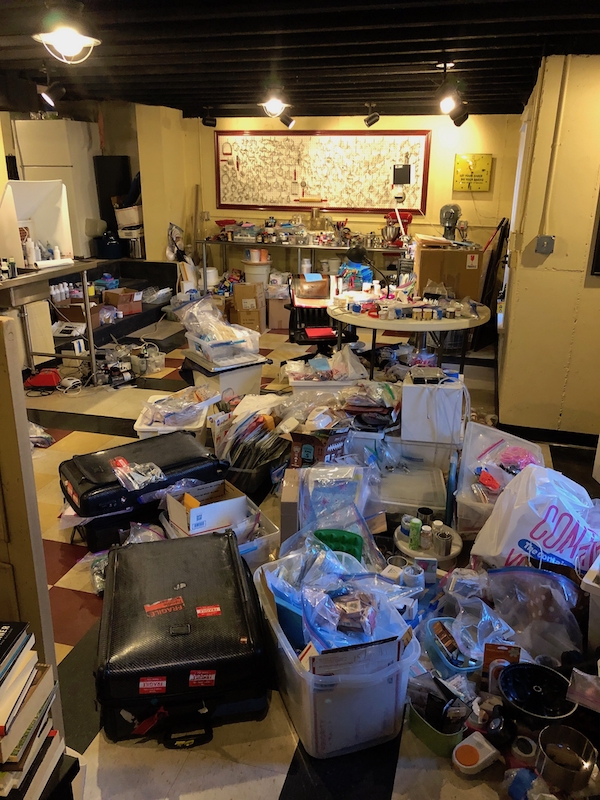
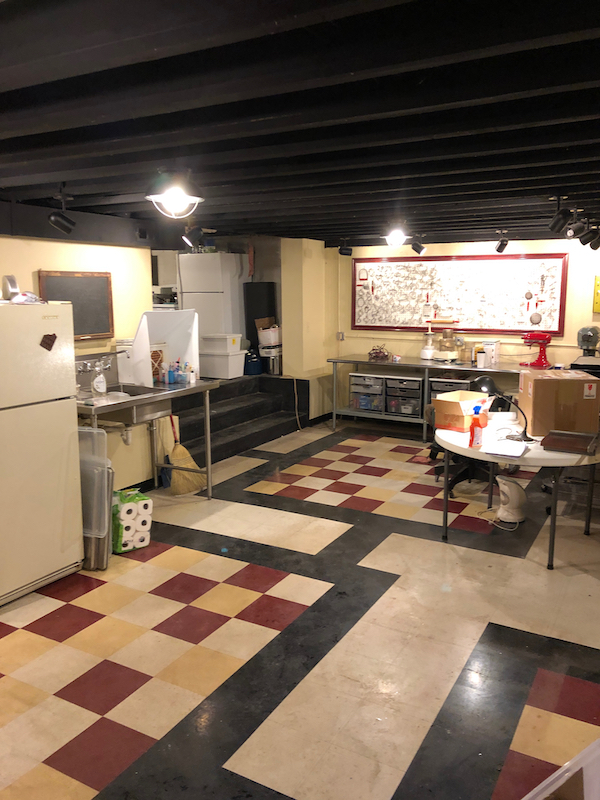
It is such rewarding work creating swift transformations for people who are able to let go of things quickly and whose budget allows for the up-front investment. My team members are talented and cheerful and full of compassion and good spirit. I feel so fortunate to be able to provide this service to my clients! You can learn more about the team organizing experience on the Operation: Peace of Mind page on this website.
Worth repeating (again): Decluttering old papers and memories
I spent the day yesterday working with a client on years of accumulated paper so this post, in which I discussed liberating myself of excess paper, resonated with me today. I wrote this post in October 2015 and have not missed a single piece of paper I let go of during that purge four and a half years ago!

Over the weekend, I faced down the challenging of decluttering a file cabinet full of old papers and memories. I love having these experiences that put me in my clients’ shoes and help me better understand what they’re going through.
A number of years ago, I moved my office four-drawer filing cabinet into the basement, replacing it in my office with an Elfa file cart. I didn’t bother decluttering the stuff that moved to the basement with the file cabinet. It was all papers related to achievements in my first two (and only) jobs, as well as administrative and project files from my decade as a dog writer, along with over 100 files of newspaper and magazine clippings of published articles I’d written.
They might have sat there until we moved, except that we’re doing a big repair and renovation in our basement, so the file cabinet has to be moved several times. It seems like a good time to (literally) lighten the load in that cabinet.
So I went to the basement and started going through the files. It was a fun and sometimes sad trip down memory lane. The tricky part was much of the material in that file cabinet pre-dated the worldwide web as we know it so isn’t available online (or at least not easily). I always caution people to give some thoughtful consideration to discarding irreplaceable items, but I also tell them that the more sentimental items they keep, the less value any of it has. So I was experiencing the push-me-pull-you of those two factors.
In the eighties, I worked for a non-profit on an international project that involved publishing magazine supplements in magazines around the world. I had a copy of each of those supplements. They really don’t have any value for me—in thirty years I’ve never once been asked about them. Yet they evoke some fond memories. (I traveled around the world and met those magazine editors.) And I don’t think they exist in digital form. What to do?
After a little thought, I decided to keep one of them and recycle the rest. That felt a little scary but also gave me that great feeling of lightening the load.
My next job was doing media relations for the Missouri Botanical Garden and I had kept some important clippings I’d placed. Back then I was able to garner some pretty significant attention for stories that felt like a very hard sell. Those clippings and the news releases I’d written to place them could be handy if I were every seeking a job in media relations. But the likelihood of that is close to nil. So I ended up keeping a little portfolio I’d created back then and recycling everything else.
Then I came to the more recent career—all the files from when I was a dog writer from 1995 to 2005, when I started Peace of Mind Organizing. I threw away all past project files, which was a pretty easy decision. Then I dealt with the clipping files. I wrote something like 150 articles and back in those pre-internet days one mailed photocopies of clippings with query letters to try to get magazine assignments. So I had made a bunch of copies of every article I published. Only laziness had stopped me from getting rid of the extras years ago. Yesterday, in the spirit of lightening the load, I kept one copy only of the more significant articles, like the ones that appeared in national magazines (I wrote quite a bit for Family Circle—that’s part of one of my favorite Family Circle articles in the photo above), the columns I wrote for a now-defunct magazine and a now-defunct website, and the articles for which I won awards. I went from hundreds of files to a single, fairly thick, file.
Going through this process was a great mental exercise. I got to revisit some achievements, which is always fun. I cried when I read the column I’d written after our dog, Scout, died in October 2001 and the one I wrote after our other dog, Kramer, died in December 2001. It made me appreciate, as I probably didn’t at the time, that those articles probably helped others who were grieving the loss of their pets. I’m glad I kept hard copies of those because they’d be tricky to find online.
Do you have ancient files or other memorabilia lurking somewhere in your house? I encourage you to bring them out into the light and go through them. You may jog some really fond memories. And you find it easier than you think to let go of this particular type of excess. Trust me, it can be liberating!
Screentime Genie can help you cut down on screen time

If you, like me, find yourself paying more attention to your computer and mobile devices than real life and non-digital activities, the geniuses at Stanford University, led by B.J. Fogg of Tiny Habits fame, have a free tool that can give you some tools to cut down on your screen time.
It’s called Screentime Genie. I’ve been following B.J. Fogg for years now so was delighted to receive an email about Screentime Genie. I’ve bought his new Tiny Habits book though I haven’t read it yet. I’ll be writing about it here after I do.
I tried out the Screentime Genie today, telling the tool that I wanted help in reducing time on Facebook. It asked me a couple of questions, then offered me about a half dozen potential tools to help me out. I selected three (setting an intentional background for my phone, downloading the HabitLab Chrome extension, and reducing notifications on my phone). The tool will check in with me in a week (via email) to see how it’s going. I love accountability, so that’s great.
If you’ve been looking for ways to cut down on your screen time, you might give it a try!
Worth repeating: Working during times of stress
I wrote this post 5.5 years ago when I was dealing with some health challenges for family members. It came to mind recently, because my oldest brother has taken ill and has been hospitalized in southeastern Washington state for the past three weeks. I was trying to maintain my work schedule in St. Louis while checking in on him but decided about two weeks into his illness that I needed to travel to Washington to be there for him and be his advocate. In rereading the post, I felt like it had a great message. Scott is recovering from his bouts with severe pneumonia and I know I’ll keep these strategies in mind as I go back home to St. Louis and try to support him from afar.
Since my schedule lightened up a couple of years ago, I’ve lived with relatively little stress. I work hard, which is occasionally stressful, but it’s good stress, since I love my clients and my work. Everything else has been on a pretty even keel. I know that I’m very fortunate.
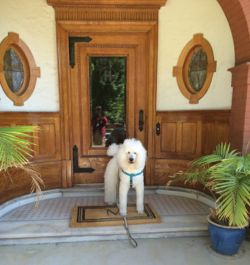
But this month I’m facing some pretty serious health concerns for loved ones. And this morning my beloved standard poodle, Kirby, woke up not feeling well. We have a vet appointment this afternoon. (That’s him in the photo, on our friend’s porch.)
The worry is driving me to distraction. I know I can’t spend my time worrying because (a) it does no good and (b) I have stuff that needs to get done.
So I got to thinking about what I can do for myself to help me be productive, rather than just miserable, during these times of stress. Here’s what I came up with—maybe it will help you when you’re feeling stressed.
- Stick with my habits and make sure the basics get done. Luckily, my habits are pretty ingrained, so they’re getting done. Ignoring the laundry will get me nowhere, so there are clothes in the wash as I type. Letting my blog go unwritten is also not helpful, so here I am blogging.
- Have a good task list. A solid, realistic daily task list gives structure to my day and helps me know what to do next. (These days, I’m using TeuxDeux to keep track of tasks.)
- Know what’s important. I’m focusing on putting items on my task list that are both urgent and important. Now is probably not the time for me to launch new initiatives.
- Write everything down. My memory isn’t great anyway, but when I’m stressed out it’s really bad. I don’t want to worry about forgetting something, so I’m writing things down, primarily in Evernote (except tasks, which are going in TeuxDeux).
- Distract myself with some fun stuff. I’m trying to keep my daily task list short, leaving me some time to immerse myself in enjoyable, productive endeavors, like knitting, reading or genealogy research.
- Avoid mindless internet or channel surfing. It’s so easy to get on Facebook and lose a half hour (or more) watching dumb videos. That can be mercifully mind-numbing, but also completely unproductive. I’m trying to avoid that by consulting my task list and staying away from Facebook. But I do allow myself the occasional Facebook break—which I keep in check with the help of a timer.
- Practice self care. I’m always urging my clients to take care of themselves and not put everyone else’s needs before their own. That’s something that’s important for me to remember right now.
If all goes well, the majority of the health concerns should be over in about six weeks (shorter for Kirby, I hope!), so this is short term. I can’t put my life and work on hold for six weeks but I can practice the above coping mechanisms.
Search
Recent Posts
- Worth repeating: Figuring out what to watch on TV
- The power of incremental progress
- Podcast guest spot on the role of organization for folks with chronic illness
- No excuses series (part 3): "It was a present"
- No excuses series (part 2): "I paid a lot for that item"
- No excuses series (part 1): "But I might need it!"
- Retiring the New Organizer Guides
Tags
About Janine

Hello! I’m Janine Adams — a certified professional organizer based in St. Louis, and the creator of Peace of Mind Organizing®.
I love order, harmony + beauty, but I believe that the way that you feel about yourself and your home is what truly matters.
If you’re ready to declutter with a purpose and add more ease to your life, you’ve found the right blog — and you’ve found the right company.
read more »Links
- Are you interested in becoming a professional organizer?
- Institute for Challenging Disorganization
- Organize Your Family History
- Getting to Good Enough podcast
- Shannon Wilkinson, life coach
- Peace of Mind Spending
- NAPO St. Louis
- Ravelry
- National Association of Productivity and Organizing Professionals