Using the Reminders feature of Evernote
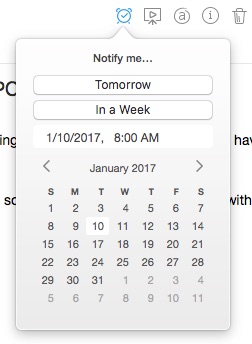
I’ve finally embraced Evernote and it’s become an indispensable part of my work and life. Every now and then I think about writing another blog post about how I use Evernote and I get overwhelmed at the thought of it. So my plan is to highlight one feature at a time, as the mood strikes me. Today I’m going to focus on the Reminders feature of Evernote, which I absolutely love.
With Reminders, you can ask Evernote to remind you of something on a specific day or time. I get an Evernote notification on the lock screen on my phone and in the notifications on my MacBook. I also get an email. I love having all those bases covered.
How is this different from using my iPhone’s reminders? The big difference is that I can attach Evernote notes to the reminder. I use reminders on my phone all the time, for things like taking the laundry out of the dryer or taking my vitamins. But Evernote reminders feel more robust and less ephemeral.
Here are a few examples of how I use it:
- When I receive an email that requires future action, I’ll forward the email to my Evernote account and then set a reminder to do the task. The email is then put in front of me on the appropriate day.
- When I sign up for a telesminar, I’ll forward the confirmation to Evernote and set a reminder. On the day of the teleseminar, I get a reminder that I can click to see the email with the call in instructions.
- If I need to follow up on an email (say, somebody promised me they’ll do something and I don’t want to forget), I’ll forward the email the promiser sent and set a reminder to follow up on it and the appropriate time. This has been a life saver.
- When I don’t want to forget to cancel a subscription, the Reminders feature saves my bacon. For example, just under a month ago I subscribed to Consumer Reports online so that I could check out ratings on tires. You pay $7 or so for a month and if you don’t cancel it automatically renews. I didn’t want to cancel as soon as I got my tire information, in case some other need came up in the month. So I created an Evernote reminder to remind me two days in advance that I needed to cancel. That reminder appeared this morning. I had no recollection of needing to cancel that subscription. It would have gone on until I noticed it on my credit card bill.
One downside to Evernote reminders is that you can’t set them as recurring. Here’s my workaround: For recurring tasks I embed the instruction to reset the reminder. For example, I have a task I do monthly for NAPO-St. Louis that I can’t seem to save in my brain. So I wrote an Evernote reminder and included in the reminder note, “Then reset this reminder for next month.”
I would never get Evernote just to use the reminders feature. But since I’m already using it, I find the Reminders to be a really wonderful benefit.
Conquering countertop clutter
This morning I braved a whole inch of snow to drive into downtown St. Louis and do a spot on Great Day St. Louis, the morning program of our local CBS affiliate.
I’ve been on this show a few times, but it’s been a couple of years. I was interviewed by the charming Matt Chambers, a genuinely nice guy.
My message was pretty simple. If you want clear countertops do the following things:
- Clear out your cabinets and drawers so that you actually have space to store stuff you use.
- Assign a place for everything so that you can put everything away.
- Create two habits: Run the dishwasher at night and empty it in the morning and clean up the counter after dinner or before bed every night.
- Keep paper off the counter.
- Find an out-of-the-way spot for your electronics charging and consider creating the habit of charging them while you sleep.
Here’s the video:
I had a great time!
My third Project 333 collection!
In July, I started what I think will be a year-long experiment with Project 333, the challenge created by Courtney Carver of the Be More with Less blog, in which participants dress from a 33-item wardrobe collection for 3 months at a time. I heard Courtney speak here in St. Louis in June and was intrigued.
I’ve blogged about it a couple of times. Here’s my first post when I selected my initial collection. I went into some details on the rules there. Three months later, I evaluated the first quarter and selected my second quarter’s clothing.
Before I knew it, it was December 31 and the second quarter was over. Never did I feel deprived of clothing in the second quarter.
Yesterday, I spent a little time picking out my clothing for the first quarter of 2017. Here’s the thing that struck me: The longer I do this, the easier it gets. The first two times, I narrowed options down to 40 or so and then had to whittle that away. Yesterday, there was no whittling. My first pass at a collection was less than 33, then I added a couple of things. The whole process took me fifteen minutes or less.
As a reminder, my collection includes clothes, shoes and accessories that I wear out of the house to client appointments (but not team organizing appointments, to which I wear work-out clothing) and social events and just going about life. It does not include dog-walking clothes, exercise clothes, pajamas or underwear.
There is a huge amount of overlap between the last quarter and this one. We had a late winter, so I didn’t end up wearing a lot of my winter stuff until December. So most of it stayed in the collection, though I did switch out a few items.
The first quarter 2017 collection is comprised of:
- 4 pairs of pants (including a pair of jeans and a pair of leggings)
- 2 turtleneck sweaters
- 3 other sweaters
- 2 ponchos
- 1 shawl
- 1 scarf
- 4 jackets/cardigans
- 1 dress
- 2 long-sleeved tops
- 2 short-sleeved tops
- 1 shell
- 1 pair of black flats
- 1 pair of long boots
- 1 pair of ankle boots
- 1 pair of dress shoes
- 1 necklace
- 3 pairs of earrings
- 2 coats
Here’s a photo of items that live in the closet:
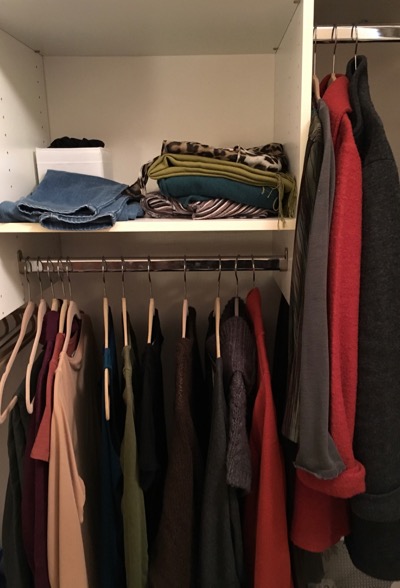
I still love dressing from this limited selection of clothing. I spend much less time and brain power figuring out what I’m going to wear, not to mention time I used to spend shopping, looking for just the right thing! I could even see creating a smaller collection, though I think I did wear virtually everything in the 2nd quarter collection at least once.
This experiment definitely strengthens my belief in the adage that less is more. I’m so glad I decided to give it a go!
My favorite things of 2016
I’m channeling my inner Oprah by creating this post about eight of my favorite things of the past year.
Container Store clear plastic shoe boxes
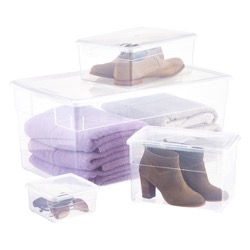
Container Store shoe boxes
These clear plastic boxes are my go-to organizing supply. I use them more than other in my organizing sessions. (An employee of the local Container Store recently told me she thinks I buy more of them than any other customer.) In my business, I primarily lead teams of organizers to effect swift change. I always (always!) bring along a selection of plastic shoe and sweater boxes from The Container Store. The sizes I keep in stock are Accessory, Ladies’, Tall Ladies’ Men’s, Sweater and Deep Sweater. I almost never use them for shoes or sweaters, mind you. Instead, my team members and I use them to sort items into categories. And because they come with lids and stack together nicely, we often use them for storing categories of items on a shelf. We even use them for dividers in deep drawers from time to time. I’m not sure what I’d do without them!
Two-tier cutlery tray
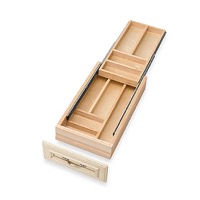
Two-tier cutlery tray
This was one of my favorite things in our newly renovated kitchen. (I detailed my favorite storage features of my new kitchen earlier this year.) With this cutlery insert, you can double the amount of items you store in your cutlery drawer. It’s genius! We took the contents of two drawers in our old kitchen and fit it all into one smaller drawer. (We did have to relocate a few taller items.) Our cutlery tray came with the new kitchen cabinets, but I see you can buy one at Bed Bath and Beyond and install it in your existing cabinet.
Favorite apps
There are three apps that I use each and every day. They make my life better. They are:
- Evernote. I’m sure you’ve heard of this desktop and mobile app that does an amazing job of helping you keep track of things. I use it for many aspects of my life, from shopping lists to recipes to keeping track of invoices to keeping track of my genealogy research. I have lists of books I want to read (and books I’ve read), along lists of movies and tv shows. I have account numbers I want easy access to. And I use it to remind me of date-dependent tasks. I blogged about how I use it last year, but I’m due for an update since how I use it constantly evolving. It took me a few years of trying to go all in on Evernote but now I’m a big fan.
- NPR One. This free app gives you complete control over listening to NPR content. I blogged in detail about why I love it, but in a nutshell, you tell the app what you like and don’t like among the offerings it puts in front of you and it learns what to offer you. And you can pause and restart shows. So it’s like listening to NPR on your car radio only a thousand times better.
- Elevate. I’m in my mid fifties and my brain doesn’t feel as sharp as it did in my youth. I figure it can’t hurt to play brain games on a regular basis. I’ve tried a few and Elevate is my favorite. I play three games a day, faithfully believing they’ll keep me from becoming less sharp. The games are mostly verbal and math, they take just a few minutes to complete, and I think they’re fun. They usually make me feel smart and occasionally make me feel dumb. The app is free, though you can pay for the premium edition, with more games. (I went ahead and ponied up $45 a year for that.)
Profit First, by Mike Michalowicz
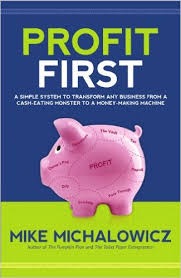
Profit First book
This business book revolutionized the way I think about my business; I heartily recommend it to other owners of small businesses. I first heard about Profit First from Cathy Sexton of The Productivity Experts, who gave a presentation about the Profit First concept to the St. Louis chapter of the National Association of Professional Organizers. It took me a couple of months to implement it, but I haven’t looked back. The basic premise of the system is to pay yourself first and also put away money for taxes and profit, before paying operating expenses. (Rather than paying operating expenses and running out of money for taxes or for paying yourself.) If you can’t afford to pay your operating expenses after taking out salary, taxes and profit, then it’s time to cut your operating expenses. Simple, but revolutionary. It takes a little effort to open the various bank accounts the system calls for, but the effort has definitely been worth it for me. Great stuff.
BarkBox

Bix with his BarkBox mustache ball
Our standard poodle, Bix, joined our family as a little puppy just over a year ago. I immediately signed him up for BarkBox, which I had heard about on Facebook. Every month, Bix receives a themed box of toys and healthy treats from BarkBox. It’s always the highlight of the month. The toys are durable and clever—and unique to BarkBox. Bix is a huge player and he enjoys his vast and growing collection of toys. I try to embrace minimalism in my life but this is one area where I am not remotely minimalist. But the joy that BarkBox brings to the human and canine family members cannot be overstated. if you buy a Barkbox subscription through this link, you’ll get an extra month added to your subscription (and so will Bix).
Hamilton, the musical

Can't wait to hold this Playbill in my hand!
Hamilton has been rocking my world since I saw the PBS documentary about it in October. Since then, I’ve listened to the soundtrack daily and when I’m not listening to it, it’s running through my head. I wrote a blog post about it on Halloween, complete with links of various videos to watch, so I won’t go into much detail here. But suffice it to say that seeing the show tops my goals list for 2017. I so admire the genius of Hamilton creator Lin-Manuel Miranda to tell the story of our very interesting founding father in such an accessible and enjoyable format. Honestly, I think the lyrics and music of Hamilton are works of art. I can’t wait to see the choreography and acting first hand. In a difficult year, Hamilton will always be a highlight for me.
Starting the new year with a clear desk
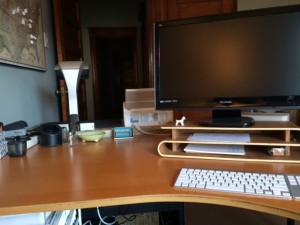
If you’re like me, the week between Christmas and New Year’s is one of planning and creating order. Last Friday I did a personal planning retreat and set some goals for 2017. That felt great. This week, I’m cleaning up some clutter spots in my office and trying to finish up some projects.
I wrote a post for my genealogy blog, Organize Your Family History with step-by-step instructions for clearing off a genealogy research desk. I’ve adapted it here, because it really applies to desks of any sort!
If you can’t remember the last time you saw the surface of your desk, perhaps it’s time to experience the joy of a clean desk. I know that time is limited and cleaning up your desk may not rank high on the list of ways you’d like to spend your time. but it’s worth it. When you sit down at a clear desk, your mind is more clear and you can be more focused on your research.
Here’s some good news: It doesn’t have to be hard or time consuming. Just follow this step-by-step method for creating some order on your desk, swiftly.
- Set your timer for 25 minutes.*
- Clear everything off your desk (and I mean everything except, perhaps, your computer). Put like things together into rough categories as you go. (For example, put papers together in a pile on the floor near your desk; put office supplies together, etc.) It might be helpful to have some bankers’ boxes or plastic totes handy to hold the categories, but the floor will do too.
- Put away the items that already have homes. For example, put binders and books where they belong. If something belongs in another room, put it in a box or bin that you’ve marked “Relocate to Another Room” so you don’t wander away from the room you’re working on. At the end of the session, you can put all that stuff away.
- Go through the non-paper items and put back on the desk only those things that deserve to take up such prime real estate. Only items used daily should merit being placed within arms’ reach when you’re sitting at your desk (with the possible exception of items that give you great pleasure to look at). Relocate or discard the other non-paper items that were on the desk.
- Take all those papers and put them in a box of some sort. Mark that box “Backlog.” (I use a box similar to this one from IKEA for that purpose and I place that box on a shelf.)
- Every time you’re at your desk, set a timer for ten minutes and go through the papers in the backlog, discarding, scanning and/or filing as required. Do this ten minutes a day for as long as it takes to eliminate the backlog. (You might be surprised how few of these short sessions it takes.)
- Don’t add to the backlog box. Instead, at the end of each day take the time (probably less than five minutes) to clear off your desk and put everything away. That way, you’ll start each session fresh.
*When your timer goes off, stop what you’re doing and take a five-minute break. Then set it for another 25 minutes and get back to work, unless you’re done.
Use your empty boxes to ship stuff (free!) to Goodwill
I just learned on Facebook about Give Back Box, a program that makes it really easy for you to donate to Goodwill, while reusing empty boxes. I think it’s just plain brilliant. After you’ve received something in the mail, fill the empty shipping box with items you’d like to give to Goodwill, rather than taking it to the dumpster. Then go to Give Back Box website and print a free shipping label. It will be pre-addressed to the nearest participating Goodwill. Then all you have to do is tape the label to the box and take it to UPS or the Post Office. You can even request a pick up. It’s all free to you.
Here’s a video that explains it:
I love the idea of keeping a box handy to put donated items in the minute you decide to let something go. Once it’s full, tape it up and send it away!
Staying on top of your email inbox
I’m struck by how similar our email inboxes are to physical clutter. Many people deal with physical clutter, but I bet even those who manage to keep a tidy home have email inbox clutter.
Here are some of the similarities I see between a bulging email inbox and a cluttered home:
- Both clutter up your mind.
- Both make it harder to be efficient.
- The idea of tackling either can be overwhelming.
- Order can be maintained in both with daily action.
- Decluttering both can be achieved in small bits of time.
- Clutter in both is frequently the result of delayed decisions.
- Having an under-control inbox and a tidy home both feel great!
I try hard to empty my email inbox on a regular basis. (I wish I could say I do it daily but, these days, it’s more like weekly.) I went through my big email existential crisis in October and since then staying on top of email has become a lot easier.
Here are a few things I do to make sure the email doesn’t get out of control:
- I delete as much as possible and archive the rest. Now that I have an IMAP email server, archiving just takes a single click and the email is out of my inbox.
- I try to respond right away to any email that requires a response, ideally on the day it was received. Then I delete or archive the email.
- I forward emails that require later action to Evernote, then attach a reminder to them so the email is put in front of me, in the form of an email and an Evernote reminder, on a specified date and time. (If you use gmail, I think the Boomerang app does the same thing.)
- When the email inbox starts filling up (for me, that means more than 50 emails), I use a timer to get me on track. I typically set a goal number of emails (say, ten) and try to get my inbox down to that number by the time the timer goes off. Usually, I don’t set the timer for more then five or ten minutes at a time.
- I unsubscribe like crazy to newsletters and promotional emails. Unsubscribing is almost as easy as just deleting them. (For gmail users, the app unroll.me makes even easier.)
Like keeping a tidy home, the secret to keeping your email inbox lean is to not hang on to too much, to have a place to put emails away, and to spend a few minutes daily throwing and putting stuff away. When you do that, you can find what you need, when you need it, and not lose important emails or documents.
Isn’t that worth a little effort? It doesn’t have to be hard.
Search
Recent Posts
- Worth repeating: Figuring out what to watch on TV
- The power of incremental progress
- Podcast guest spot on the role of organization for folks with chronic illness
- No excuses series (part 3): "It was a present"
- No excuses series (part 2): "I paid a lot for that item"
- No excuses series (part 1): "But I might need it!"
- Retiring the New Organizer Guides
Tags
About Janine

Hello! I’m Janine Adams — a certified professional organizer based in St. Louis, and the creator of Peace of Mind Organizing®.
I love order, harmony + beauty, but I believe that the way that you feel about yourself and your home is what truly matters.
If you’re ready to declutter with a purpose and add more ease to your life, you’ve found the right blog — and you’ve found the right company.
read more »Links
- NAPO St. Louis
- Peace of Mind Spending
- National Association of Productivity and Organizing Professionals
- Ravelry
- Shannon Wilkinson, life coach
- Organize Your Family History
- Getting to Good Enough podcast
- Institute for Challenging Disorganization
- Are you interested in becoming a professional organizer?