Procrastinating again? Identify your barrier—and move forward
I first published this post in 2020, and I’m re-sharing it because procrastination is something most of us wrestle with at least occasionally (me included). In it, I point you to a quick quiz created by my friend and podcast cohost, Shannon Wilkinson, that helps you identify your procrastination barrier (confidence, reward, enjoyment, or focus). Once you know what’s really getting in your way, it’s much easier to get unstuck. If you want more practical strategies like these, come join us on our podcast Getting to Good Enough (link below).
I think most of us procrastinate at least sometimes. (If you never procrastinate, you can go ahead and put off reading this post until later.) I used to be a terrible procrastinator, back when I was a writer. Since becoming an organizer 15 years ago, I’m better about it. But there are still tasks I put off. They’re usually tasks I don’t think I’ll enjoy. If they don’t have a deadline I have really hard time getting started on them.
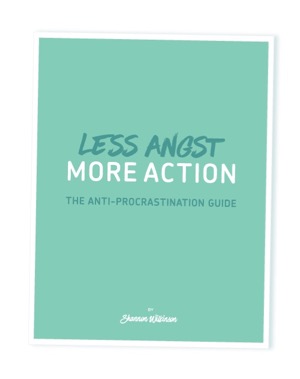
I learned that enjoyment was my barrier to getting started on a task when I took the quiz that my friend, life coach and podcast cohost, Shannon Wilkinson, created. Shannon is a wizard when it comes to helping people get over procrastination. She created the six-question quiz so you can identify the source of your procrastination. (The four barriers are confidence, reward, enjoyment and focus.) And she created a six-page guide and worksheet to overcome each type of procrastination. It’s yours free when you visit her website.
Just check out Shannon’s Less Angst More Action: The Anti-Procrastination Guide to get started.
Once the quiz helped me identify enjoyment as my barrier (I’m kind of shocked that’s not why everybody procrastinates), I’ve been able to use her worksheet to help me get in touch with the benefits of doing the dreaded task. And then the barriers just vanish. It’s a little like a miracle.
I haven’t read the other guides, but I’m sure they’re equally great and I encourage you to take the quiz and check out the guide that pertains to you. You may find yourself, like me, doing important things you’ve been putting off forever.
And if you come away from the whole thing with an appreciation for Shannon’s particular brand of genius, I encourage you to tune into our podcast, Getting to Good Enough where you can benefit from her wisdom every week!
Afraid to toss paper? Ask yourself these 5 questions first
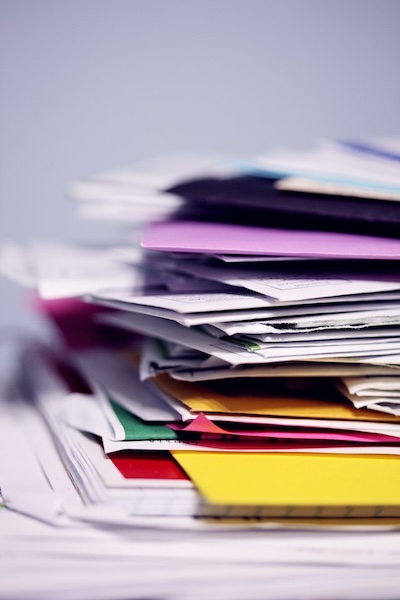
I wrote this post back in 2012, and I’m re-sharing it because paper is still one of the biggest sources of “just in case” clutter we see. When you’re worried you’ll need something later, it’s easy to keep everything—and then the piles create even more overwhelm. These five questions are a quick way to calm the fear and make confident decisions, one sheet at a time.
Sometimes when I work with clients, I realize that they’ve hung onto a lot of paper out of fear. They’re afraid that they’ll toss or shred a piece of paper and find out later that they need it.
When you’re afraid to let go of paper, before long you get overrun with it. Then you add a feeling of overwhelm to the fear and becomes really hard to go through the paper.
So to make things a little easier (and perhaps take away some of the fear), here are the five questions I suggest you ask yourself when you’re trying to make a decision about whether or not to keep a particular piece of paper (particularly paper related to finances):
- Can I get this information online?
- Can I replace this paper if necessary?
- Have I kept this type of information in the past and, if so, did I reference it?
- Can I scan this document and keep it electronically?
- What’s the worse that can happen if I get rid of this?
The fact of the matter is that very few papers are irreplaceable. So fear of getting rid of them is pretty unwarranted. You can always ask your tax advisor or your financial planner for advice. But hanging onto unneeded paper can weigh you down.
Why not take a few minutes now to go through your file cabinet and get rid of some outdated paper? (Don’t forget to shred anything with identifying information like social security numbers or account numbers.)
Photo by Alexander Grey on Unsplash
How decluttering is like exercising
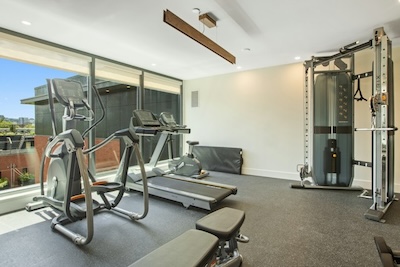
I first published this post on May 16, 2014, when I belonged to a gym. After leaving the gym a few years later, I had quite a few years without a solid exercise routine, primarily doing at-home yoga. But in January 2025 I started working out with a trainer weekly and that’s been the key to getting me to exercise. The benefits have been huge. A dozen years later, this post still resonates with me!
I’ve had my struggles with getting myself to exercise over the years and I’ve detailed some of them on this blog. The bottom line for me is that I’m pretty fit and pretty slender without going to the gym, so getting myself to go has been challenging, since I don’t enjoy it that much.
But now that I’m past 50, it feels like more of an imperative. I know that regular exercise will help me age more gracefully and healthily. I know that it will help stave off osteoporosis, which runs in my family. I know that it might help with the fact that my stomach is no longer perfectly flat. (Certainly, not exercising isn’t going to help with that!)
So I’m trying to make exercise a priority. But it’s not easy because I’m very busy with work. And did I mention I don’t enjoy it that much?
Back in October 2013 I joined a gym, the tiny exercise studio called Take Action just a couple of blocks from my home. The membership and some personal training sessions with Take Action owner Jeanna Jackson were a (requested) 50th birthday gift from my husband. At that time, I discovered the similarities between personal trainers and professional organizers.
So the other day, as I was going through my exercise routine—created for me by Jeanna—I got to thinking once again about how exercising for people like me is like decluttering for folks struggling with clutter. I’ve already mused here about the how both decluttering and exercising get easier with practice. But more recently, I’ve been thinking about these similarities:
- You might not feel like doing it, but afterward you’re glad you did
- It can be hard to find the time
- Both decluttering and exercising can be easier to do when you have company (and/or guidance)
- You may not see instant results, but little by little you see progress
- Any effort at all is worthwhile
- You’re frequently struck by inspiration while exercising and while decluttering/organizing
- Both can become habits
When I look around my house and see the progress I’ve made over the years in keeping order despite being a naturally messy person, I know I can make progress in with exercise. I’m working on focusing on the benefits and making it a priority. I hope one day soon to make exercising a natural part of my day just as certain habits for keeping order (like clearing off my desk every day) have become habits.
Photo by Andrew Kayani on Unsplash.
Re-running favorites through the end of the year
I’m going to try something a little different for the rest of 2026: I’m going to focus on re-sharing older posts from the archives.
I’ve been blogging for nearly 20 years (my blogiversary is in November!), and in that time I’ve published more than 1,700 posts. While I still love writing and connecting here, I’m also ready to build a bit more ease into my life. And I’ll be honest—after two decades of blogging, I’m finding it takes more effort than it used to to come up with fresh ideas.
So between now and December 31 (and perhaps beyond), you’ll see me re-running posts I still love—posts that feel evergreen, posts that readers have told me were helpful, and posts that I think are worth bringing back into the light.
A couple of notes about how this will look:
- I’ll add a short italicized intro at the top with a little context about why I’m sharing it again.
- I may give a re-run a new title (because sometimes a different title fits how I’d describe it today).
- If I’m inspired to write something brand new, I’ll absolutely do that too.
My hope is that this approach keeps the blog useful and fun—without me feeling like I have to reinvent the wheel every week.
Thanks for being here, for reading, and for letting this blog evolve over time. If there’s an older post you remember loving (or a topic you’d like me to revisit), I’d love to hear about it in the comments.
Worth repeating: Happy surprises might be hiding in your mail
Eleven months ago, I received a surprise check in the mail in the amount of $1,119.26. I wrote a blog post about it, encouraging readers to open their mail and they might have a happy surprise. Today, I opened an envelope from my health insurance company and it happened again! Today’s government-required rebate check was in the amount of $596.52. So I decided to rerun the post from last October as a timely reminder.

Over the years, I’ve encountered many clients who don’t open their postal mail. Some take it to extreme levels. I get it. Mail can be scary. I remember back when I was dealing with credit-card debt I would be afraid to open the mail and see my statements.
But I’ve learned that the truth is the truth whether or not you know about it. And ignoring your mail never helps.
Moreover, when you open your mail, you may find happy surprises. This happened to me recently when I received a letter from my health insurance company. (I get my health insurance on the marketplace.) I fully expected it to be a notice of a rate increase for 2026. But I cringed and went ahead and opened it.
It was a check in the amount of $1,119.26! I was incredulous so read everything in the accompanying letter. Come to find out, by law there is an audit every three years of companies who offer health insurance through the marketplace. If a company doesn’t spend at least 80 percent of its proceeds from premiums on health care, its members are due a rebate. (I’m paraphrasing from memory and probably grossly oversimplifying.) I’d never heard of this rebate, so wasn’t expecting it. And if I hadn’t opened my mail, I wouldn’t have known about it!
Three weeks later, I received an email from my health insurance company telling me I should have received a rebate, so I eventually would have opened the envelope if I hadn’t thrown it away.
Just like clearing off your desk, putting away your clothes or emptying your email inbox (and lots of other things), opening your mail is easier if you do it every day before it becomes overwhelming. And who knows? Maybe your effort will be rewarded by a surprise check in the mail! (Or something equally nice.)
Photo by Wolfgang Vrede on Unsplash.
Helping out my future self
I store all my food-storage bags in a drawer using some lovely bamboo food-storage bag organizers. I recently bought a large box of quart-size Ziploc bags…more than will fit in the container. Storage is at a premium in my apartment, so I put the overflow in the less-than-convenient cabinet over the microwave.
I was afraid I wouldn’t remember they were there and order more when the bamboo container was empty. So I helped my future self out by leaving a note stuck to the bottom of the quart-size container. It says, There are more Qt bags above the microwave.
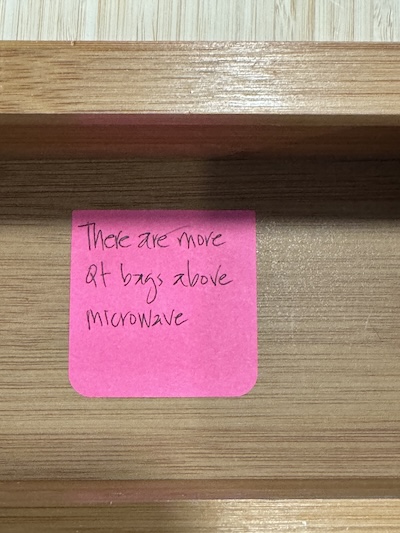
It makes me happy when I think to do stuff like that. (I’ve surprised myself in the past with notes about overflow items.) It’s not only helpful to my future self, but it removes some tension right now. Even if I’m not consciously aware of it, my brain gets concerned that when the time comes I’ll forget something like that. I don’t need that bouncing around in my head.
What can you do to help your future self today?
The five-pieces-at-a-time puzzle trick
I originally published this post back in September 2019. Due to space constraints, I haven’t done any jigsaw puzzles since we moved to an apartment two years ago. But when I came across this post while perusing my blog today, I was struck by how helpful the information is. And how it could apply to so many other things. (For example, I use a similar approach to writing my postcards to voters.) So I thought I’d repeat it today.
I enjoy doing jigsaw puzzles. One-thousand-word puzzles are just the right size and my favorite kind to do are collage puzzles. I think I like collages because of all the easy sorting that can be done.
Last month I completed a 1000-word collage puzzle five pieces at a time and mentioned it on Episode 68 of Getting to Good Enough, the podcast I host with Shannon Wilkinson. I’m just about to finish another puzzle using this method, which I devised for myself, and I find the method so successful (and relevant to other parts of my life) that I thought I’d share.
I do jigsaw puzzles at the end of our dining-room table. There’s room there, since there are only two us of eating (unless we have guests). But I don’t want a puzzle to languish there untended. I also don’t have hours a day to devote to doing puzzles. And I don’t want to wreck my productivity on a workday by getting sucked into a puzzle. So here’s what I do.
I start by connecting the edge pieces of the puzzle, which has always been my favorite part of the puzzle. (I can’t imagine working on the interior with the edges set up…I wonder what that says about me?)
Once I have the edge pieces connected, I tell myself that I will connect five puzzle pieces and then I’ll stop. That’s it. It’s that easy.
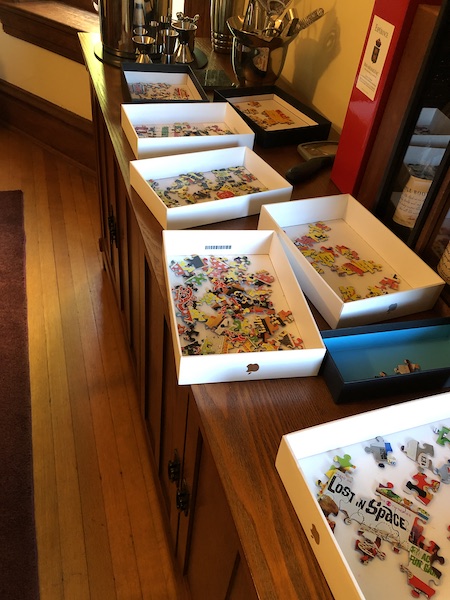
Much of the time in the early stages of completing a puzzle is spent sorting. With collage puzzles, I sort pieces into likely sets. I use empty boxes for the sorting. (At last! a use for those Apple boxes I can’t seem to throw away.) To achieve my pieces, I will connect pieces within those sets and/or I’ll connect pieces within the puzzle itself. If I connect a group of already-connected pieces into the puzzle, that counts as one piece.
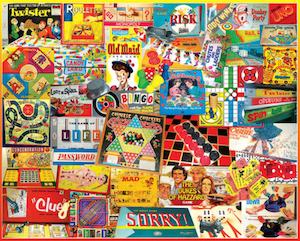
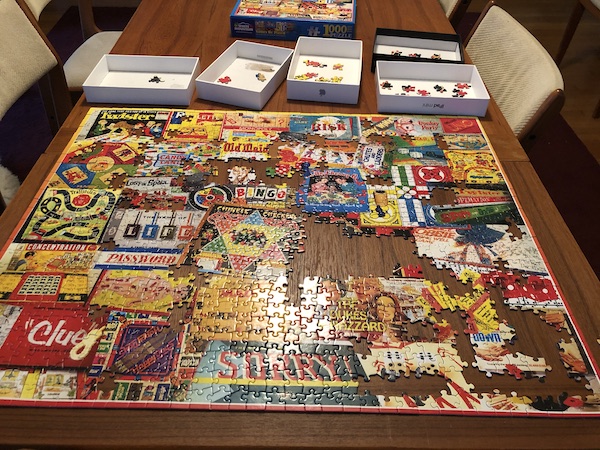
This is the puzzle I’m currently working on (The Games We Play from White Mountain Puzzles), taken a week ago.
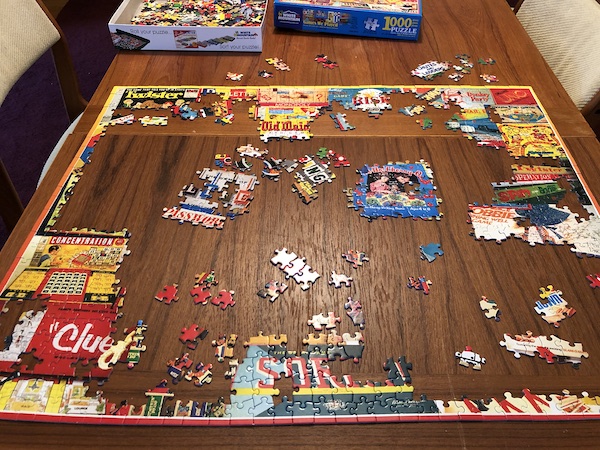
Here are some of the boxes of sets.
And here is the puzzle this morning. I’m almost finished! This puzzle has been particularly enjoyable.
As I see it, here are some of the benefits of my five-pieces-at-a-time method:
- It makes the puzzle feel very achievable
- The goal is so small I can easily grab a little pocket of time to do it, so the puzzle doesn’t languish
- I get to enjoy working on the puzzle many times a day
- I don’t get so caught up in the puzzle that I don’t go to bed or work (it’s kind of like setting a timer)
- I get the pleasure of watching the puzzle emerge slowly
- I get to enjoy little achievements over and over again while doing the puzzle
I think that last point might be most important and also really relevant to other (non-puzzle) tasks. By setting tiny goal after tiny goal, I get the thrill of achievement each step of the way. I am literally never frustrated by a puzzle because I can always find five pieces to put together. (That might be because I like collage puzzles…I think I’d find puzzles with vast swatches of monochromatic areas frustrating.)
Next time I get stalled or frustrated while working on a project, I’m going to think about how I might make it more like a jigsaw puzzle and just set my sights on connecting the next five pieces.
Search
Recent Posts
- Worth repeating (once again): Decluttering old papers and memories
- Leaving my comfort zone
- Worth repeating (again): Lessons learned from a painful thumb
- Our 300th episode!
- Worth repeating: Figuring out what to watch on TV
- The power of incremental progress
- Podcast guest spot on the role of organization for folks with chronic illness
Tags
About Janine

Hello! I’m Janine Adams — a certified professional organizer based in St. Louis, and the creator of Peace of Mind Organizing®.
I love order, harmony + beauty, but I believe that the way that you feel about yourself and your home is what truly matters.
If you’re ready to declutter with a purpose and add more ease to your life, you’ve found the right blog — and you’ve found the right company.
read more »Links
- Peace of Mind Spending
- Institute for Challenging Disorganization
- Getting to Good Enough podcast
- Are you interested in becoming a professional organizer?
- Organize Your Family History
- National Association of Productivity and Organizing Professionals
- NAPO St. Louis
- Ravelry
- Shannon Wilkinson, life coach