And the giveaway winner is...
On February 21, I posted a review of Clutterfree with Kids by Joshua Becker. Joshua had sent me an autographed copy of the book to give away to a lucky reader.
And that lucky reader is Thadeus! He posted the second comment on the review + giveaway blog post. I found his comment poignant:
My daughter and I need this book pretty bad. My wife may kick us out if we don’t learn to declutter soon! (We are both sentimentalists!)
The fact that I found his comment poignant had nothing to do with his winning, though. I assigned a number to each of the comments, as well as to each of the Twitter and Facebook mentions of the contest, then used the Random Number Generator to pick the number of the winning entry.
Thanks so much to those of you who entered. Even if you didn’t win, I urge you to read the book. It’s really thought provoking and, possibly, behavior altering. I hope it helps Thadeus!
Taking taxes one bit at a time

It’s that time of the year! I’ve had one client appointment where we pulled together tax information for the accountant, and I’ve started on my own taxes.
I do our taxes with Turbo Tax and have for six years now. Like many people, I don’t enjoy doing taxes. I think the fear of the unknown (Will I have all the information I need? Did I pay enough estimated taxes?) plays a part. Plus, it can be brain-bending work.
This year I have a few things going for me before starting the process of doing taxes:
- I had a designated spot for all my tax documents as they came in, so I didn’t have to search for anything
- I’m caught up in my business and personal bookkeeping (to give credit where it’s due, my husband keeps track of our personal finances in Quicken)
- I’d ordered Turbo Tax 2014 already and just needed to install it
So last weekend, I decided to start and I didn’t pressure myself to finish. I told myself that any effort was good effort and just getting over the barrier of starting would be a victory.
I didn’t start until late afternoon on Saturday, but I put in an hour or so. On Sunday, I was actually anxious to get going on it. (I think it’s the brain craves completion thing.) I also dangled a reward in front of myself. After working on my taxes for several hours, I went to the movie theater to see not one but two Best Picture nominees, followed by dinner out with my husband.
So now it’s February 28. I’ve made headway on my taxes, but am by no means finished—I’m still figuring out my business’s taxes and haven’t even started entering our personal financial info. I’m going to follow the same pattern this weekend; I’ll put in a little effort each day. If I don’t finish (which I don’t expect to), I’ll carve out some time during the week this week, so that I can finish by the end of next weekend. (We anticipate a refund, so it’s in our best interest to file as soon as possible.)
How about you? Have you started your taxes? If not, I urge you to start soon and avoid the stress of facing down the April 15 deadline.
Photo by PT Money via Flickr.
How I'm using Springpad
For the last three months, I’ve been using (and enjoying) Springpad, the personal-organizer app. I’ve accessed it daily, either from my desktop, iPad or iPhone (often all three in the course of day). I wanted to share here how I’m using it and why I like it so much.
Task management
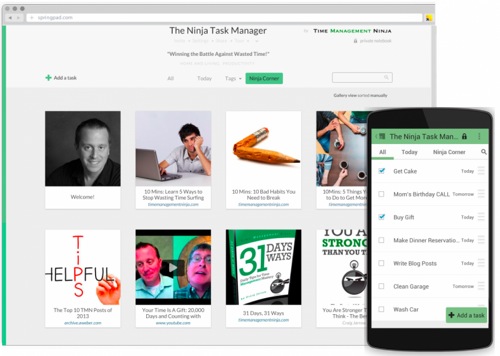
I’ve long wanted to use an electronic task-managment system, but was never able to stick with one—until Springpad. I started out using their built-in Tasks notebook, but switched over the the Ninja Task Manager notebook in January. (That’s it pictured above.) Ninja Task Manager is one of the custom notebooks that they launched in January, in partnership with a dozen or so organizing experts, including me.
What I love about the Ninja Task Manager is the ability to mark any task with a heart so that it appears on the Today tab. That means I can scan a master list and segregate those tasks I want to focus on today. Love it. (This custom notebook actually comes with a $1.99 price tag. It’s so worth it, in my opinion.)
Shopping lists
I have a Shopping Lists notebook that allows me to keep a running list of regularly purchased items, by store. I can enter the items as specific products, if I want, and see pictures of the items. (I can even scan the UPC code of an item in my pantry to make adding it to my list really easy.) If my husband were on board, we could share the notebook and add to it separately, so whoever’s at the store has an up-to-date list.
Keeping track of books
Last year I started keeping a list of the books I read. I read mostly fiction, and my Kindle has made it convenient for me to read a whole lot of books. With Springpad, I enter a book I want to read and it draws the description (including cover photo) from Amazon. I can mark it “Want” or “Read” and I can see all my books, just the ones I want, or just the ones I’ve read. I tag the read ones with the year, so I can easily keep track of how many books I’ve read in a year. (So far, I’ve read eight in 2014.) I can go right from a book entry in the My Books notebook on Springpad to Amazon to purchase it with just a touch (or click).
Keeping track of movies
When I hear about a movie I want to watch, I add it to my My Movies notebook. When the movie becomes available on DVD or at Netflix, I’m notified, within Springpad. How cool is that?
- Keeping track of all sorts of other stuff*
I have notebooks for individual clients so I can keep track of time and tasks, for blog posts ideas, for apps to check out, for recipes and for wines I like, among many others. The wine notebook is cool, because it shows the label of the wine (which is how I remember wine) and gives info about the wine.
Family history research
One of the two custom notebooks I created with Springpad is the Family History Organizer. Within that notebook is a simple Research Tracker that I have found immensely helpful. I also keep track of research tasks in that notebook.
Connecting with people
I have a few public notebooks that any Springpad user can see and follow that allow me to share information that I find valuable. Right now, those notebooks are on topics I get a lot of questions about, like professional organizer training and working with a professional organizer.
I always have my phone with me, so I always have Springpad with me. I am really benefitting from it and I suspect the benefits will grow as I get to know it better.
If you’re intrigued, I encourage you to check it out!
Less stuff, more living: A review of Clutterfree with Kids (+ giveaway!)
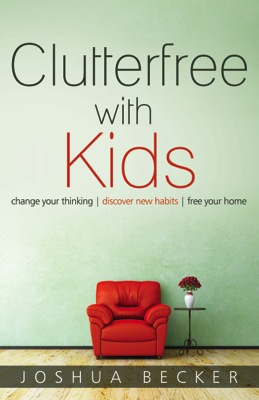
Joshua Becker, the founder and editor of the popular Becoming Minimalist website, sent me a copy of his new book, Clutterfree with Kids for a review and giveaway. Here’s the review. At the end you’ll see how to enter to win an autographed copy of the book.
I’ve long extolled the virtues of living with less. I tell my clients and various audiences that less is more. Owning less stuff makes life easier. I sincerely believe that.
Reading Clutterfree with Kids, though, has given me even more perspective on it. I define clutter has having more items than you can comfortably store. Until now, I’ve always thought about excess in terms of whether or not stuff can be stored.
But Joshua Becker has me thinking about minimalism. That is, living with a fundamental philosophy of not just avoiding having too much, but rather embracing having as little as possible. That’s actually a pretty big shift. And it was an wow moment for me.
While this is a book focused on children’s possessions, the first third of it is about the concept of minimalism. And even if you (like me) don’t have kids, you might find it really interesting and, possibly, mind blowing.
Before he even gets into talking about kids’ stuff, Becker outlines his four steps for living in a clutterfree home.
- Believe it is possible
- Remove the excess
- Implement habits to manage your clutter
- Slow the accumulation of possessions
If you have kids, and you find the notion of teaching your kids the value of living with less intriguing, this book will give you many reasons to do it and will give you a way to go about it. The discussion isn’t limited to toys. It also includes chapters on clothing, artwork, sentimental items, collections, tv and video games, photos, gifts, packing, schedules, and preparing for baby.
I was especially delighted to read the chapter, “Clutterfree with a reluctant partner.” Minimalism is a huge lifestyle changed for many. What if your partner is not on board? Becker is full of sound advice, like “Refuse to let stuff separate you.” And “Realize you can’t change someone else. You can only change yourself (and your attitude).” He recommends leading by example, purging your own items first then looking for common items you can together agree to part with. And he recommends patience. Sounds spot on to me.
This book is well written, with lots of gentle humor. And it has what I believe is a profound message. If you’re at all enticed by the subject, I encourage you to read it.
The giveaway
Here’s how you can get a free copy of Clutterfree with Kids, autographed by the author. Just leave a comment below and/or tweet about the giveaway and/or post on your Facebook timeline or page about the giveaway. You’ll get extra entries for doing tweets and Facebook posts in addition to the comment. (Be sure and put my twitter handle, @janinea, in the tweet or, when you’re posting on Facebook, tag my Facebook page Peace of Mind Organizing so I’ll count your extra entries.)
Last day to enter is Friday, February 28. I’ll select the winner at random and announce the winner on my blog on Monday, March 3. (And I’ll contact you directly if you’re the lucky person.)
Decluttering Step #5: Put everything away
Here is the fifth and final entry in my Declutter Your Home blog series. Each Monday since January 20, I’ve covered a different step of the decluttering process: Step #1, Create your vision, Step #2: Choose your space, Step #3: Gather your supplies and Step #4: Ask key questions. This ends the series, but keep an eye out for future series!
If you’ve been reading this series and followed the steps, you’ve created your vision for your space, chosen a small but mighty place to start, gathered up your supplies and started making decisions about what to keep and what to let go of. This last step is critical, because it’s what’s going to stop you from finishing with a worse mess than when you started.
When you have a decluttering session, it’s important to reserve time at the end of the session for this clean-up step.
Here’s all you have to do: Put everything away.
- Put the keep stuff back into the space you decluttered.
- Throw away the trash
- Take out the recycling
- Put the donations in your car or call a charity for a pick up
- Take the stuff that belongs in other rooms back to those rooms
- Return any items that belong to other people
- Clean up your supplies
Even if you haven’t finished decluttering your space, put everything away. Then you can go about your business until your next decluttering session. Otherwise, you’ll be tripping over stuff. And worse yet, the items you segregated for disposal will somehow work their way back into the general population, so you’ll have to decide about them all over again. Trust me, I’ve seen this happen.
That’s it. If you follow these five steps in as many sessions as it takes to get through the areas you want to declutter, you’ll have a decluttered home. The next step will be organizing it. Keep an eye on the blog for a new series on organizing your decluttered space!
Five ways to make packing easy
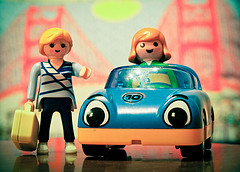
I travel every month or two and over the years I’ve managed to make packing fairly stress free. There are five practices that I’ve adopted that have helped make packing a piece of cake.
- I put together my outfits before I pack. I detailed my method in this blog post on avoiding overpacking but the basic point is that I plan my outfits before I pack and I don’t bring any more clothes than those that are needed for the outfits. It makes it easier to get dressed during the trip, too, since the decisions have already been made.
- I limit my shoes. I know, I know. That’s tough. But shoes are heavy and space-consuming. I try hard to bring no more than one or two pairs of shoes or boots beyond the pair I’m wearing while traveling.
- I keep a travel set of toiletries. I have travel-sized version of almost all my toiletries and they live in my toiletries kit. This way I save time packing and I don’t have to stress about forgetting something.
- I take only the makeup I need. It’s not practical for me to keep a travel set of makeup (it would go bad before I could use it up), but I just pack it into a makeup kit as I put it on the day of travel. Unless I’m going to a super-fancy event on my trip, I just take along this everyday makeup, not a whole bunch of different shadows or potions to choose from when I’m at my destination.
- I use a travel jewelry case. The Clos-ette Too Travel Jewelry Case makes it easy for me to take along what I need (and no more) and to see what I have brought. It also prevents my necklaces from getting tangled.
There are plenty of things to stress out about when traveling. Packing needn’t be one of them. By making decisions in advance and limiting my choices when I’m traveling, I make the process easier—and my bag lighter.
Photo by Susana Fernandez via Flickr
Decluttering Step #4: Ask key questions
This is the fourth in a blog series I’m writing on Mondays that will take you step by step through the decluttering process. Each Monday for the last few weeks, I’ve covered Step #1, Create your vision and Step #2: Choose your space and Step #3: Gather your supplies. Today we actually getting started decluttering.
If you’ve been reading this series and followed the steps, you’ve created your vision for your space, chosen a small but mighty place to start, and gathered up your supplies. Now it’s time to actually start decluttering.
If you have space, empty the area you want to declutter. (Remember, I suggest it be a small space like a drawer or a cupboard.) Sort the items so that like things are together. That way, you’ll discover your multiples. (When I decluttered my kitchen utensil drawer I was shocked to learn that I owned three pizza cutters!).
It should be relatively easy to part with all but one of the multiples. Pick the one you like best and put the rest in the donate box.
Then start going through each of the items and ask yourself the following three questions:
- Do I use it?
- Do I love it?
- Does keeping this item contribute to my vision for the space?
If you can honestly answer yes to any of the above questions, keep it. If you can’t, please consider letting it go. If it’s tough to let it go, try these two follow-up questions:
- If I let go of this item and I find I need it, will I be able to get another one?
- How likely is that to happen?
The three key questions should help guide you to letting go of the stuff you won’t miss. Don’t let these common objections derail you:
- I paid a lot for it. (The money is gone and keeping the item won’t bring it back.)
- It was a gift. (That doesn’t mean you have to keep it.)
- I might need it some day. (See the two follow-up questions, above.)
Place items in the appropriate boxes you’ve gathered (see Step #3), or the trash, until you’ve gone through them all.
Next week’s post, the final one in the series, will cover the next step.
Search
Recent Posts
- Worth repeating: Figuring out what to watch on TV
- The power of incremental progress
- Podcast guest spot on the role of organization for folks with chronic illness
- No excuses series (part 3): "It was a present"
- No excuses series (part 2): "I paid a lot for that item"
- No excuses series (part 1): "But I might need it!"
- Retiring the New Organizer Guides
Tags
About Janine

Hello! I’m Janine Adams — a certified professional organizer based in St. Louis, and the creator of Peace of Mind Organizing®.
I love order, harmony + beauty, but I believe that the way that you feel about yourself and your home is what truly matters.
If you’re ready to declutter with a purpose and add more ease to your life, you’ve found the right blog — and you’ve found the right company.
read more »Links
- NAPO St. Louis
- Ravelry
- Organize Your Family History
- Getting to Good Enough podcast
- Institute for Challenging Disorganization
- Peace of Mind Spending
- Are you interested in becoming a professional organizer?
- Shannon Wilkinson, life coach
- National Association of Productivity and Organizing Professionals