What is true independence?
Here in the United States, we’re celebrating Independence Day. That got me thinking about what independence means to me.
A few years ago I created a little graphic to declare what I think brings true freedom.

This month I celebrate 15 years of helping people gain that independence. The longer I do this work, the more sure I am that we’re all better off when we surround ourselves with less.
Photo by Paul Poli via Flickr.
ExactMats custom shelf liners: A review
ExactMats, the Houston-based manufacturers of custom-made clear shelf liners, recently offered me a credit to try out their products. They’re national Business Partners of the National Association of Productivity and Organizing Professionals and have the good sense to realize that professional organizers are great people to promote their products to our clients. (In addition to shelf/drawer liners, they make custom car floor mats and face shields. I’ll be blogging about their face shields soon!)
I had heard good things about ExactMats and even sent for a sample of their product, but I hadn’t tried them myself nor seen them at a client’s home. So I gratefully accepted their offer. I had the perfect place in my house to try them out.
When we renovated our kitchen in 2016 we left intact a built-in cabinet that was original to our 1908 house. We painted it white to match the new cabinets. The interior shelves were repainted as well and, unfortunately, our contractor used a paint that gripped like crazy. It took a lot of effort to remove certain items—like cookbooks or canisters—from the shelves. So I jumped at the chance to try Exact Mats on those shelves.
My husband and I carefully measured the shelves and I placed the order, entering in the dimensions, indicating that we wanted rounded corners, and selecting the Crystal liners, not the Riverstone, which has a little texture and is a little grippier (since grippy was our problem).
The liners arrived in just a few days. All we had to do was unroll them and let them rest for a little while to relax the roll. Here’s a photo of two of them laid out on our counter:
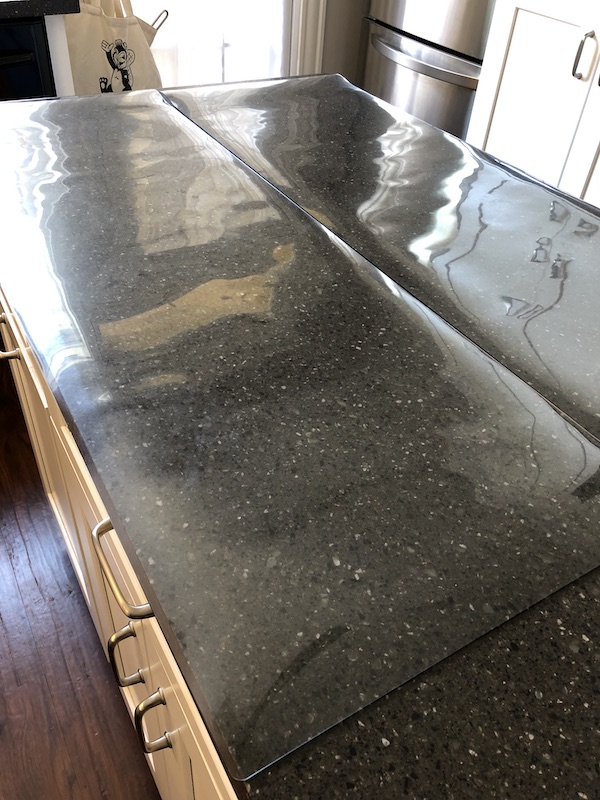
Then we just placed each on the shelf. It couldn’t have been easier. I’ve never liked shelf liners because of the hassle of measuring and cutting and so forth. (And, in my case, the risk of error in cutting.) But these custom-made liners were a breeze! Here’s a photo of the shelf liner placed on one shelf in the cabinet without anything on it:
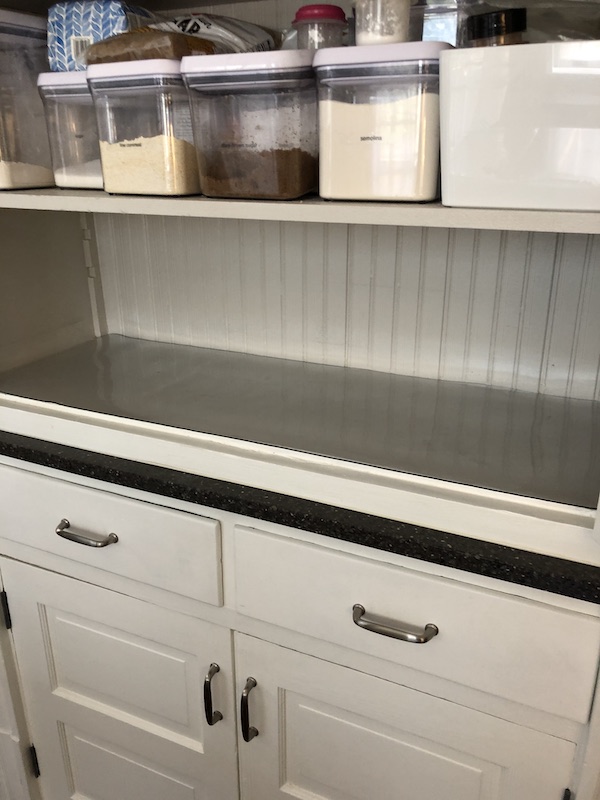
I really like the way they look nice. They remind me a smooth, glass surface. And they don’t grip our stuff. (Hooray!) The lined shelves are so much better than the bare painted surface we had before. Here’s a couple of the shelves with the liner and the stuff placed back on top:
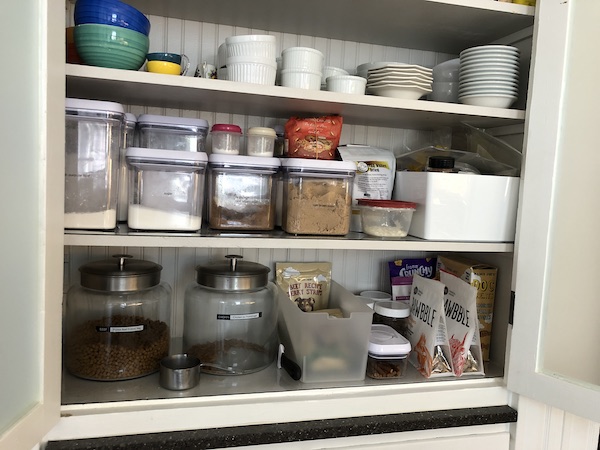
I’ll absolutely be telling my clients about them. They do require some planning, of course. And they come with a price tag. But for those clients who have the budget and like to use shelf liners, I’ll absolutely recommend them!
Obscure words for messes
I’m a word person. I made my living as a freelance pet writer for ten years before starting Peace of Mind Organizing in 2005. I love writing, which is how I manage to blog at least once a week on two different blogs. And I especially love writing about organizing and clutter. So how is it that I never heard of these words?
My friend and podcast co-host, Shannon Wilkinson, introduced me to two synonyms for “mess,” when she posted one of her cartoons on Facebook. My reaction was “how have I never heard of these words?” So she sent along a link to this blog post from the inimitable Merriam-Webster.com.
Here’s her cartoon:
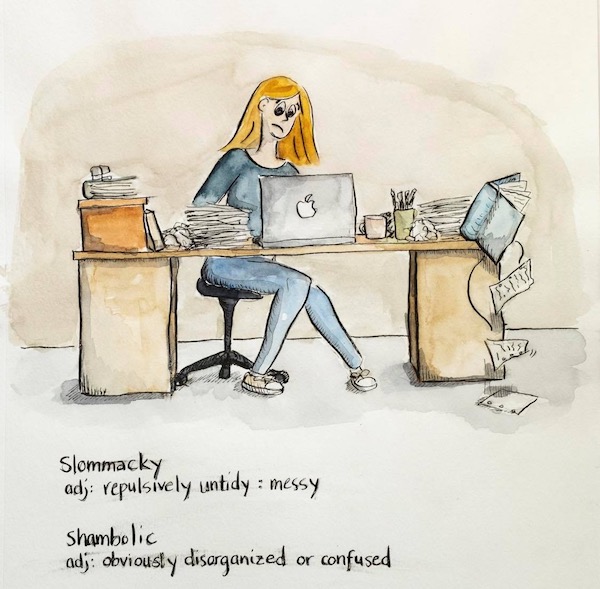
Have you ever heard of these words?
- Strubbly
- Gaumy
- Streel
- Slommacky
- Hurrah’s nest
- Shambolic
They all have subtly different meanings. I think my favorite (or perhaps the one I can relate most to) is Shambolic, which, as Shannon’s cartoon points out, means “obviously disorganized or confused.”
I encourage you to read the Merriam-Webster blog post, 6 obscure words for messes to learn more about these excellent words, including their origins.
Follow Shannon on Instagram if you’d like to see more of her cartoons!
Worth repeating: Five questions to ask yourself before getting rid of paper
Paper is one of the toughest things for people to make decisions about. I wrote this post eight years ago to help you figure out whether you need to keep a piece of paper. These five questions are still valid today.
Sometimes when I work with clients, I realize that they’ve hung onto a lot of paper out of fear. They’re afraid that they’ll toss or shred a piece of paper and find out later that they need it.
When you’re afraid to let go of paper, before long you get overrun. Then you add a feeling of overwhelm to the fear and it becomes really hard to go through the paper.
So to make things a little easier (and perhaps take away some of the fear), here are the five questions I suggest you ask yourself when you’re trying to make a decision about whether or not to keep a particular piece of paper (particularly paper related to finances):
- Can I get this information online?
- Can I replace this paper if necessary?
- Have I kept this type of information in the past and, if so, did I reference it?
- Can I scan this document and keep it electronically?
- What’s the worse that can happen if I get rid of this?
The fact of the matter is that very few papers are irreplaceable. So fear of getting rid of them is pretty unwarranted. You can always ask your tax advisor or your financial planner for advice. But hanging onto unneeded paper can weigh you down.
Why not take a few minutes now to go through your file cabinet and get rid of some outdated paper? (Don’t forget to shred anything with identifying information like social security numbers or account numbers.)
Photo by Steve Johnson on Unsplash
Countdown to the Hamilton movie

I’ve made no secret of the fact that I adore the Broadway show Hamilton (and its non-Broadway incarnations). I’ve seen it four times (three times in Chicago and once in St. Louis) and had a ticket for a May performance in St. Louis that was canceled. I was also planning to see it on our anniversary trip to New York in April. That trip, too, was canceled, thanks to the pandemic.
So you can imagine my glee when I learned that the Hamilton movie —a filmed version of the Broadway production with the original cast, shot two weeks before the original cast stopped performing—is being released for streaming on Disney+ on July 3, rather than in October 2021 in movie theaters as originally planned.
I’m already thinking about what I want to do to prepare in order to enhance my viewing pleasure. And I’m clearing my calendar for the day on July 3 with the intention of watching it many times.
Here’s my plan, in case you’re also a fan and might find it helpful:
- I’m going to re-listen to The Hamilcast podcast episodes featuring The Cabinet (i.e. the creative geniuses behind the production, Lin-Manuel Miranda, who wrote the book, music and lyrics and stars in the original cast as Alexander Hamilton; director Thomas Kail, who also directed the movie; orchestrator Alex Lacamoire and choreographer Andy Blankenbuehler). That’s been made easy with a special page linking to those episodes. I’d better get busy because there are 13 episodes in this collection.
- I’m going to re-read Hamilton: The Revolution the book about creating the show and bringing it to Broadway.
- I’ll listen to the soundtrack many times between now and July 3 (but I’d do that anyway), as well as the Hamilton Mixtape.
- I’m going to scour YouTube looking for interviews and performances I might have missed (or re-watching favorites). I just noticed this interview on CBS that had escaped my notice. And to whet my appetite, I’ll rewatch these two award-show performances: Alexander Hamilton on the Grammys and Yorktown on the Tonys, both in 2016 .
- If I have time, I might watch Fosse/Verdon on Hulu, the mini-series about Bob Fosse and Gwen Verdon. Tommy Kail directed five of the episodes and all four members of The Cabinet were involved. (I also love Cabaret and Chicago, so I’m sure to enjoy it.)
If you know of anything I should add to my list, please let me know in the comments. July 3 can’t come soon enough!
Nine things I love about Yoga with Adriene

Back in December 2018 after a visit from my niece, Miranda, who does a yoga workout on the Yoga with Adriene YouTube channel every morning, I decided to give yoga a try. I’d been toying with it for eons but had been paralyzed about how to get started. And I knew I really wanted at-home yoga.
I did daily yoga for three months before I broke the chain and my practice became more sporadic.
Then along came COVID-19. Since I’ve had fewer demands on my time, I have been able to incorporate yoga into my daily routine. I am so grateful for that. This morning, when I finished my practice, I jotted down some of the things I love about doing yoga, particularly doing it with Adriene. I thought I’d share them with you in hopes that I might inspire you to give it a go!
- I’m getting stronger and more flexible. I’m 57 years old. I am absolutely thrilled to be getting stronger and more flexible, not the other way around.
- It’s good for my body and my mind. Stilling my mind, breathing deeply and moving my body are absolutely what I need right now.
- It’s gentle. Adriene is such a kind and gentle communicator. Her workouts are full of love and body acceptance. She suggests modifications for every pose and normalizes the idea that you might be not able to do all the stretchy bendy things she can do.
- Adriene is funny. She’s a yoga goddess with a beautiful body but Adriene is self-deprecating and makes funny comments all the time. (Today she bowed her head, then commented, “I see toothpaste on my shirt. Class act.”)
- There are many options, but I don’t have to make a choice. I’m easily overwhelmed by options. Adriene offers 30-day yoga journeys every January where you just do the workout designated for that day. (You can start any time.) No choice necessary. She also offers a themed calendar every month, so you can do the workout for that day. (This month the theme is, appropriately enough, Courage.) So far, I’ve done three different 30-day journeys, two of them twice. I’ve done 2020’s Home twice, 2015’s 30 Days of Yoga twice and 2019’s Dedicate once. I love that I don’t necessarily have to choose which of her many videos to do!
- The workouts are varied but there’s continuity. Each workout has some sort of theme—it might be for a certain part of the body (today I did neck and shoulder relief) or it might be to create a certain feeling, like “Soften”. After doing it this long, the yoga poses are familiar but there endless ways to put them together and each workout feels fresh to me.
- It’s free! Adriene does have a paid community, but all the workouts on her YouTube channel are free. And they’re not interrupted by ads.
- I get to do yoga in my pajamas. I know if would be very hard for me to leave the house to do yoga. Now, I just have to take a few steps from my office to my guest room to do yoga in the morning. And most mornings I do it in my pajamas. Talk about letting it be easy!
- Benji. Adriene’s Australian Cattle Dog, Benji, is present in almost all the videos. He’s calm and zen and adorable. Usually he’s extremely well behaved but occasionally he does something funny (like the time he sat on Adriene’s head when she was in child’s pose.) Adriene always acknowledges him and treats him with love.
The bottom line is that I’m really glad Adriene Mishler is part of my life. I wish I knew her in real life but I will settle for welcoming her into my home via my computer every morning. I truly feel love for her. Thanks to her, I’m healthier, stronger, and calmer. I wish that for you, too!
Staples blog post on creating work routines
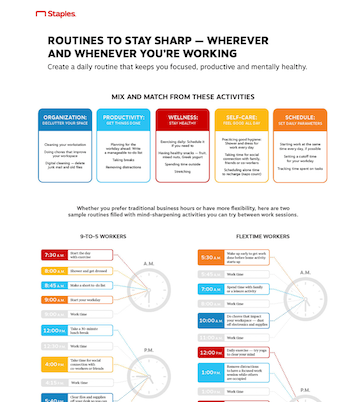
I’m so happy to have been interviewed for an article (along with Lisa Zaslow of Gotham Organizers) on the Staples Worklife blog about creating work-from-home routines. It’s called, Routines to Stay Sharp—Wherever and Whenever You’re Working. The interview took place at the beginning of the pandemic (which feels like a year ago).
The bulk of the post is a downloadable infographic with mix-and-match options to create a routine that work for you, whether you’re a nine-to-five worker or a flextime worker. If you’re struggling with maintaining some structure in your day while working from home, you might find it helpful!
Search
Recent Posts
- Worth repeating: Figuring out what to watch on TV
- The power of incremental progress
- Podcast guest spot on the role of organization for folks with chronic illness
- No excuses series (part 3): "It was a present"
- No excuses series (part 2): "I paid a lot for that item"
- No excuses series (part 1): "But I might need it!"
- Retiring the New Organizer Guides
Tags
About Janine

Hello! I’m Janine Adams — a certified professional organizer based in St. Louis, and the creator of Peace of Mind Organizing®.
I love order, harmony + beauty, but I believe that the way that you feel about yourself and your home is what truly matters.
If you’re ready to declutter with a purpose and add more ease to your life, you’ve found the right blog — and you’ve found the right company.
read more »Links
- Are you interested in becoming a professional organizer?
- Organize Your Family History
- Getting to Good Enough podcast
- Ravelry
- Institute for Challenging Disorganization
- NAPO St. Louis
- Peace of Mind Spending
- National Association of Productivity and Organizing Professionals
- Shannon Wilkinson, life coach